
 FAQs
 Factory Tour



Fabricating complex glass shapes requires exceptional mechanical discipline. Whether you supply architectural panels, automotive windscreens, or bespoke furniture, irregular profiles quickly expose equipment flaws. Micro-cracks, edge flaking, and dimensional drift destroy your margins before the glass ever reaches the tempering furnace.
A high-precision glass shape edge grinding machine eliminates these bottlenecks. By automating complex contours, modern CNC platforms turn labor-intensive shaping into a repeatable, high-yield process. However, machine specifications vary significantly across manufacturers.
If you plan to upgrade your shop floor, this guide details the essential technical features your next CNC profiling station must deliver. Need immediate advice on machinery configurations? Contact BAINENG CNC today to discuss custom engineering for your production line.
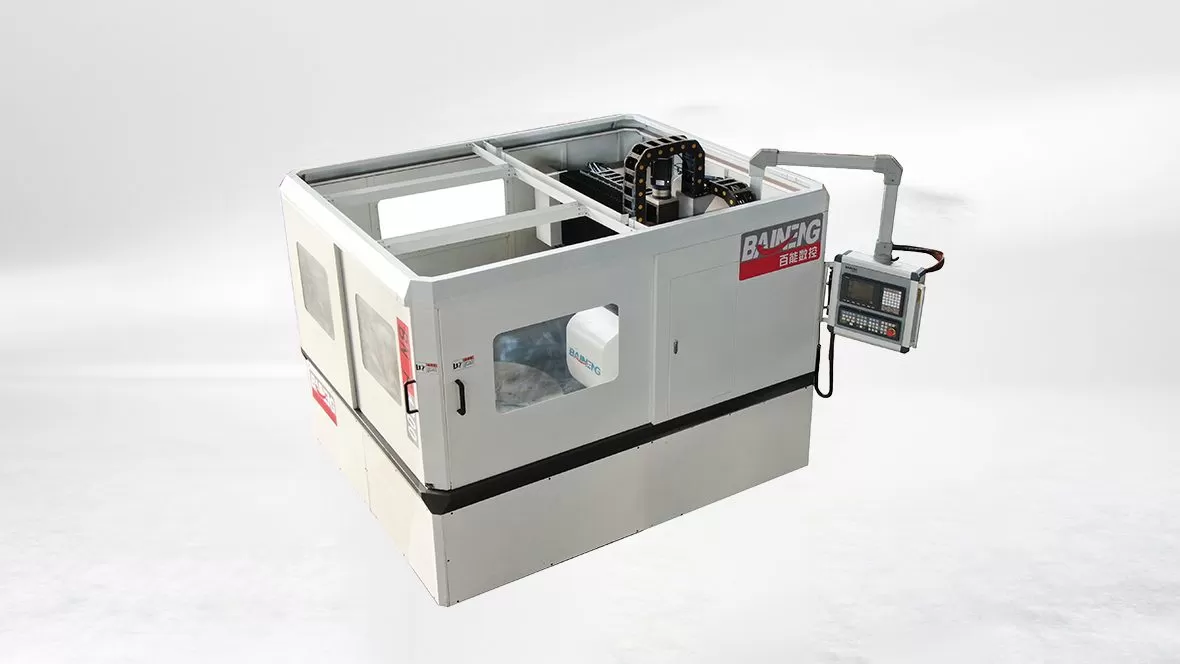
The Production Demands on Irregular Glass Processing
Straight-line edging is simple. Operators run sheets down linear tracks with fixed-angle spindles. In contrast, curvilinear profiling forces the tool head to adapt continuously along X, Y, and Z axes while maintaining steady peripheral pressure.
When you handle round, oval, wave, or multi-radius profiles, mechanical deflection becomes your primary enemy. According to industry guidelines from the National Glass Association (NGA), edge quality directly dictates the mechanical strength of annealed and tempered lites. Poor grinding introduces surface tensile defects that cause spontaneous breakage during heat treatment.
Investing in the correct high-precision glass processing equipment protects your business against costly sheet failures, long machine setups, and customer rejections.
1. Advanced CNC Multi-Axis Control System
At the center of every top-tier irregular glass edge grinding machine sits its motion controller. For standard geometric shapes, simple 3-axis interpolation might suffice. Yet modern architectural and interior designs demand multi-radius splines, stepped edges, and dynamic chamfers.
Look for machines featuring synchronized 3-axis to 5-axis CNC systems. True multi-axis interpolation ensures the grinding wheel remains perpendicular to the tangential vector of the curve at every millisecond of travel.
- Synchronous Axis Control: Prevents tool lag during sharp directional transitions, avoiding deep edge gouges.
- Constant Peripheral Speed: The CNC must automatically calculate and adjust wheel rotation as the diamond layer wears down, maintaining linear contact speed (m/s).
- Real-Time Trajectory Smoothing: Built-in jerk-limitation algorithms stop jerky movements that leave chatter marks on radius corners.
2. High-Rigidity Electro-Spindle with Dynamic Balancing
The spindle directly dictates your edge surface roughness (Ra value). If the spindle shaft displays even slight runout, your diamond wheels will bounce across the glass edge rather than shave it cleanly.
Prioritize direct-drive electro-spindles equipped with high-precision ceramic bearings. Spindle runout must stay within a strict tolerance of less than 0.003 mm (3 microns). High torque at both low and high RPM ranges allows the machine to handle deep arrissing as well as high-speed cerium oxide polishing without stalling.
High-end platforms, such as those engineered by BAINENG CNC, integrate dynamic wheel-balancing protocols. Balancing the wheel pack minimizes micro-vibrations, protecting the structural integrity of thin monolithic glass and heavy laminated sheets alike.
3. Automatic Tool Changer (ATC) System
Manual wheel adjustments kill workshop productivity. A manual changeover between coarse diamond profiling, fine grinding, and multi-stage polishing wastes up to 30 minutes per cycle.
An industrial-grade automatic glass profiling machine requires an onboard Automatic Tool Changer (ATC). Depending on your product mix, select a carousel or linear rack setup with 8 to 24 tool positions.
- Complete Edge Finishing in One Clamping: The machine transitions through segmented diamond, continuous diamond, resin-bond, and polishing wheels without operator intervention.
- Milling and Drilling Versatility: An integrated ATC allows the spindle to pick up core drills and finger bits, executing internal cutouts, hinge slots, and edge grinding sequentially.
- Automatic Tool Height Presetter: Laser or mechanical sensors measure tool length and diameter after each tool change, compensating automatically for wear.
4. Smart Vacuum Clamping and Zoned Suction Bed
Securing an irregular glass plate against lateral cutting forces without marring coated surfaces presents a mechanical hurdle. Mechanical clamps get in the path of the grinding spindle, making vacuum suction beds the industry benchmark.
High-precision machines utilize flexible suction pods combined with zoned vacuum tables. The vacuum system must pull sustained negative pressure (typically -0.08 to -0.09 MPa) to anchor heavy glass sheets against intense spindle side-load forces.
For operations processing Low-E glass, anti-reflective coatings, or mirrored stock, pay attention to the suction surface. The contact pods must use non-marking, vulcanized vulcanized synthetic rubbers. These hold the sheet securely while keeping sensitive metallic coatings clean from scratches and chemical transfer.
5. Closed-Loop Cooling and Filtration Infrastructure
Glass grinding generates micro-fine swarf and localized friction heat. If the contact zone lacks continuous coolant, thermal expansion creates micro-fractures along the edge, ruining the sheet during tempering. The ASTM International standards for glass edge finishing highlight uniform edge stress as a foundational metric for structural safety.
Your glass shape edge grinding machine must combine targeted internal and external spindle cooling nozzles:
- Internal Spindle Flushing: Coolant forced through the center of the tool shaft directly lubricates the cutting interface, flushing out glass slurry instantly.
- External Multi-Point Ring Manifolds: Surrounds the wheel to suppress glass dust and suppress frictional heat build-up.
- Integrated Slurry Filtration: Recirculating dirty water wears down coolant pumps and scratches glass surfaces. A reliable machine pairs with a centrifuge separator or multi-stage sedimentation tank to recycle clean, ambient-temperature water.
6. CAD/CAM Integration and Operator Interface
Machine hardware cannot deliver results without capable software. Skilled CNC programmers are rare and expensive. Your machine needs an interface that bridges the gap between mechanical power and straightforward day-to-day operation.
Opt for machines with industrial PC controllers running dedicated glass processing CAD/CAM packages. The software should process standard DXF and DWG files directly from your design office or auto-digitizing scanning tables.
Essential software features include:
- Automatic Toolpath Generation: The software calculates inner/outer offsets, tool entry/exit vectors, and speed ramps automatically based on glass thickness.
- Collision Avoidance Simulation: Visual 3D simulation reveals potential tool crashes with vacuum pods before the operator presses cycle start.
- Wheel Wear Compensation: As polishing wheels compress and
diamond profiles wear down, the software adjusts the axis offsets automatically
to maintain dimensional stability.
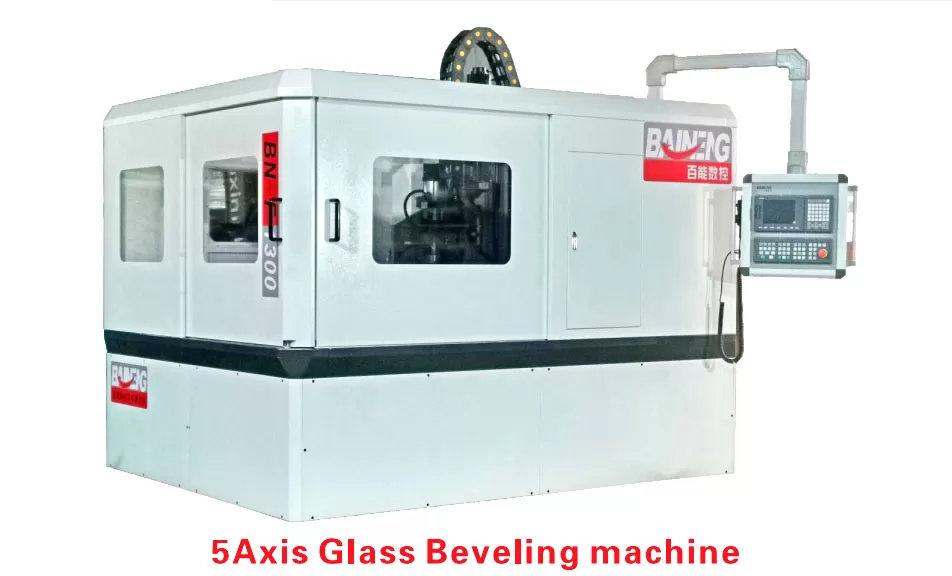
7. Heavy-Duty Stress-Relieved Machine Base
A fast CNC motion system produces aggressive directional changes. If the machine base lacks mass, dynamic inertia twists the chassis. This structural twisting introduces ripples and inconsistencies into the glass edge.
Evaluate the structural design of the machine bed. Industrial builders construct frames from thick-walled tubular steel or structural cast iron. Following welding, the entire chassis must undergo thermal stress annealing or vibration aging. This step removes residual material stresses, preventing bed warping across years of heavy production cycles.
Equally critical is a fully automatic centralized lubrication system. Linear guideways and high-pitch ball screws need metered doses of synthetic grease at scheduled running intervals. This keeps mechanical backlash to an absolute minimum and guards precision mechanisms against corrosive glass grinding water.
How High Precision Translates to ROI for Glass Processors
Investing in a high-end glass edge polishing machine requires deliberate capital planning. However, looking only at the initial purchase price ignores running operational costs. Superior engineering directly cuts recurring expenses across three operational areas:
1. Scrap Reduction
Low-tier shape edgers yield scrap rates of 5% to 8% due to corner chipping and edge variation. A rigid, precision-controlled platform reduces this scrap rate to under 1%. In facilities running expensive laminated, tinted, or oversized architectural panels, this reduction saves thousands of dollars in raw float materials monthly.
2. Labor Efficiency and Setup Time
Manual polishing of irregular contours consumes immense labor hours and relies on subjective operator skill. An automated CNC shape edging center enables a single operator to load one sheet, press start, and prepare the next program while the machine completes roughing, profiling, and polishing unattended.
3. Tooling Lifespan
Spindle chatter and uncontrolled axis movement destroy expensive diamond profiling wheels. By maintaining constant surface feet per minute (SFM) and zero spindle deflection, high-precision systems distribute wear evenly across the diamond matrix. Diamond tools last up to 35% longer, driving down your tooling cost per linear meter processed.
According to technical surveys published by Glass Magazine, automated machinery adoption remains the primary factor separating profitable fabrication operations from those struggling with narrow margins.
Frequently Asked Questions (FAQ)
Q1: What mechanical tolerance should I expect from a high-precision glass shape edge grinding machine?
A1: A properly calibrated, rigid CNC shape edger should maintain positional accuracy within ±0.05 mm and contour grinding tolerances between ±0.1 mm and ±0.2 mm across a standard 2500 mm x 1500 mm workspace, depending on the glass thickness and shape complexity.
Q2: Can a CNC glass shape edging machine process irregular Low-E coated glass without scratching the functional surface?
A2: Yes. High-precision machines use specialized vacuum pods that contact only uncoated support zones or feature synthetic vacuum surfaces formulated specifically for soft-coated glass. In addition, software paths can be defined to prevent coolant swarf from settling on delicate coatings during processing.
Q3: What is the main structural difference between a cantilever-style and a gantry-style shape grinding machine?
A3: Cantilever machines provide open access on three sides, simplifying the manual loading of small to mid-sized pieces. However, gantry-style machines support the moving bridge on both sides, providing superior structural rigidity and vibration dampening. This makes gantry designs better suited for heavy architectural lites and high-speed multi-axis profiling.
Q4: How does dynamic wheel compensation extend polishing wheel life?
A4: Polishing wheels wear down rapidly because of their elastic composition. An intelligent CNC platform tracks the electrical current of the spindle motor. As the wheel sheds material, the system automatically adjusts tool depth offsets to maintain exact surface pressure, ensuring a brilliant edge polish without crushing the tool.
Q5: Can an irregular glass edge grinding machine drill internal holes and shape sink cutouts?
A5: Yes. If the machine features a multi-position Automatic Tool Changer (ATC), a high-pressure core spindle, and compatible CAM software, it can switch seamlessly from external perimeter edging to internal milling, waterjet entry profiling, and drilling operations within the same clamping cycle.
Partner with BAINENG CNC for Precision Glass Processing
Selecting the best glass shape edge grinding machine comes down to balancing structural rigidity, motion software, and reliable local support. Cutting corners on spindle design or machine bed weight leads to persistent quality defects that disrupt your workflow down the line.
BAINENG CNC designs and builds industrial-grade CNC glass working centers, shape grinding systems, and vertical edging machinery for demanding processors worldwide. Our equipment integrates high-rigidity structural frameworks, world-class motion controls, and intelligent CAD/CAM software to solve tough fabrication challenges.
Whether you process curved furniture components, complex automotive glass, or modern architectural facades, our engineering team can configure an edging system targeted directly to your production volume. Contact the BAINENG CNC engineering sales team today to request machine specifications, calculate your potential ROI, or receive a formal price quotation.