
 FAQs
 Factory Tour



Glass fabricators face a harsh reality heading into 2026. Skilled CNC operators are harder to hire, energy tariffs remain volatile, and margins on basic flat glass continue to shrink. At the same time, commercial architects and interior designers demand complex cutouts, polished internal cutouts, and tight tolerances on heavy structural glass.
If your shop still relies on horizontal processing tables, you already know the bottlenecks. They devour hundreds of square meters of valuable floor space. They require multiple operators to flip heavy lites, and they risk scratching expensive soft-coat Low-E layers. Upgrading to an automated vertical glass working center is no longer just an equipment purchase; it is a structural defense for your operating margins.
Before you commit capital expenditures to upgrade your line, you must ensure your investment will not become obsolete within three years. Machinery manufacturers like BAINENG CNC have re-engineered vertical processing technology to answer modern shop-floor demands. Use this technical checklist to evaluate the seven non-negotiable features your next machine must include.
Planning an immediate line overhaul? Contact our engineering team today to request a machine layout audit and cycle time calculation tailored to your production schedule.
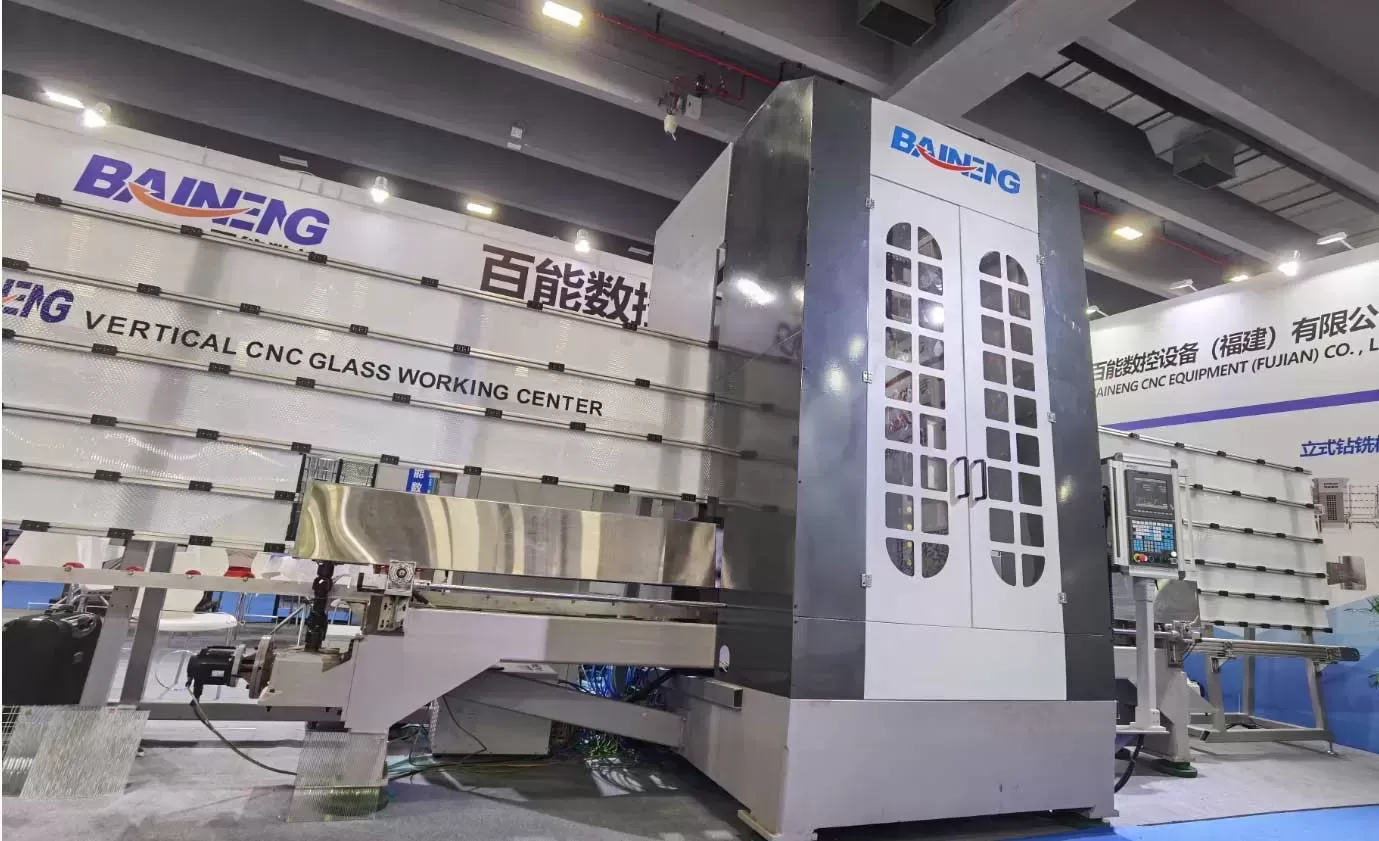
1. All-in-One Multi-Function Integration (Drilling, Milling, Edging, and Polishing)
The single greatest cause of broken glass in a processing plant is material handling. Every time an operator lifts a sheet off a cutting table, transfers it to a freestanding drill, moves it to a horizontal CNC, and rolls it over to an edging line, micro-fractures develop along the edge.
A high-performance vertical glass working center must complete all processing steps in a single clamping cycle:
- Core drilling from both sides simultaneously to eliminate exit breakout.
- Precision countersinking for architectural fittings.
- High-speed perimeter and internal cutout milling (hinges, handle notches, corner cutouts).
- Complete edge grinding and cerium oxide polishing.
By securing the lite once along an upright datum line, the machine eliminates cumulative positioning errors. The finished workpiece exits ready for the tempering furnace or laminating autoclave, slashing labor touchpoints by up to 70%.
2. Compact Footprint with Upright Ergonomics
Industrial real estate costs continue to soar. Horizontal CNC processing centers demand a massive footprint, not only for the machine bed itself but also for the mandatory loading and unloading clearance zones surrounding it.
A modern vertical CNC glass processing machine operates almost entirely on the Y-Z plane. By standing the glass at a 5-to-7-degree angle, you reclaim up to 60% of the floor space required by an equivalent horizontal table. This vertical orientation lets you position the machine directly against an exterior wall or tie it inline with an automated vertical washer.
Ergonomics matter just as much as floor space. Forcing operators to lean over horizontal tables to load 12mm or 19mm architectural lites causes fatigue and workplace injuries. Vertical staging allows operators—or overhead gantry suction lifters—to load massive panes with neutral spine posture, keeping cycle handoffs fast and safe.
3. Intelligent Dual Automatic Tool Changers (ATC) with Wear Compensation
Short production runs and custom architectural jobs define modern glass fabrication. If your operators spend twenty minutes swapping out diamond drill bits, milling fingers, and peripheral polishing wheels between batches, your overall equipment effectiveness (OEE) plummets.
Demand an onboard Automatic Tool Changer (ATC) system with at least 16 to 24 tool pockets. Top-tier machinery utilizes twin tool magazines—one mounted directly alongside the front machining spindle and one near the rear opposing drill head. This setup cuts tool exchange sequences to under ten seconds.
Furthermore, ensure the machine's control unit supports dynamic tool-wear compensation. Diamond tools wear down unevenly when chewing through thick soda-lime glass conforming to ASTM C1036 standard specifications. Laser tool presetting sensors must measure diameter reduction and wheel height automatically, updating tool offsets in real time to guarantee that edge profiles remain completely true across hundreds of cycles.
4. Scratch-Free Handling for Low-E and Coated Substrates
Architectural demand for double- and triple-silver Low-E glass continues to surge. However, these microscopic metallic coatings are notoriously delicate. Dragging a coated lite across dirty horizontal castor tables or static vacuum pods ruins expensive raw glass in a fraction of a second.
A future-ready vertical glass working center must prevent all mechanical contact with the functional face of the glass:
- Back-Cushion Air/Water Floatation: The support backplate should create a continuous fluid or air barrier, allowing the glass to glide effortlessly without dragging on hard backings.
- Automated Suction Pod Positioning: Dynamic vacuum clamps must automatically index their positions based on the DXF drawing, clamping only within non-cutout zones without rubbing against coated areas.
- Clean Contact Rollers: Polyurethane drive rollers should feature self-cleaning water scrapers to prevent abrasive cullet and glass sludge from embedding into roller surfaces.
Manufacturers like BAINENG CNC build their clamping systems around non-marking polymers specifically engineered to run soft-coated lites without requiring peeling or protective films.
5. Smart CAD/CAM Integration and Industry 4.0 Connectivity
Stand-alone machines that require manual G-code programming at the terminal have no place in a 2026 factory line. Your new vertical machining center must fit directly into a digitized, paperless production ecosystem.
Insist on an open CNC controller that accepts standard CAD drawing formats (.DXF, .DWG) straight from your office drafting team. The machine’s integrated CAM software should auto-detect hole patterns, select optimal drill bit pairings, assign milling lead-ins, and set tool speeds without operator intervention.
Look for barcode or 2D DataMatrix scanning capabilities. When an operator scans an incoming lite's label, the machine immediately calls up the parametric program from your MES or ERP server. The machine should output cycle time metrics, operational power usage, and maintenance warnings via modern protocols like OPC UA, compliant with ISO industrial automation guidelines.
6. High-Frequency Electro-Spindles with Synchronous Control
Glass is unforgiving. If your spindle exhibits radial runout or vibrates under feed load, glass edges will chip, internal cutouts will propagate micro-cracks, and diamond tools will shatter. High-speed precision hinges entirely on spindle engineering.
Demand dual opposing electro-spindles rated at minimum 9 kW to 12 kW with closed-loop liquid cooling. Ceramic bearings are essential to maintain rigidity at rotational speeds between 10,000 and 18,000 RPM. Synchronized dual-spindle drilling allows front and rear bits to engage the glass simultaneously. The front bit penetrates 70% of the thickness, and the rear bit finishes the hole from the reverse face, ensuring zero breakout around the hole edges.
The feed motion along precision ballscrews and linear guides must maintain positional repeatability within ±0.05 mm. You can review advanced motion control dynamics and machine tool kinematics through publications by the Society of Manufacturing Engineers (SME).
7. Closed-Loop Water Recycling and Sludge Separation
High-speed glass grinding generates abrasive silica fines that wreck mechanical seals and foul spindle coolant jackets. At the same time, regional water utility rates and strict discharge regulations make high-volume freshwater consumption cost-prohibitive.
Your vertical machine must feature an enclosed splash-containment cabin and a dedicated closed-loop water treatment system. High-pressure internal spindle flushing cools the tooling point, while external spray manifolds blast glass dust away from guide rails.
Ensure the coolant drainage integrates smoothly with a mechanical centrifugal separator or a chemical flocculant unit. Separating glass particulate before the water cycles back through the spindle prolongs tool life, protects internal components, and slashes water supply consumption by over 90%.
Vertical vs. Horizontal: The 2026 ROI Shift
Historically, horizontal processing centers dominated because they were mechanically easier to design. That dynamic has inverted. Below is an operational comparison for a plant processing 1,200 square meters of structural glass per shift:
- Footprint: A horizontal CNC setup requires roughly 120–150 m² including raw stock buffering. A vertical center requires roughly 40–55 m².
- Direct Labor: Horizontal tables need 2 to 3 operators for safe loading, maneuvering, and unloading. A vertical line requires only 1 operator (or 0 when integrated with automated shuttle carts).
- Changeover Delays: Repositioning horizontal vacuum pods for mixed-dimension batches takes 10 to 15 minutes. Vertical automated vacuum indexing takes under 30 seconds.
- Scrap & Breakage Rates: Traditional handling averages 2.5% to 4% breakage/scratch rates on complex workpieces. Vertical single-clamping systems keep scrap below 0.5%.
Factories that replace aged horizontal tables with modern machines engineered by BAINENG CNC typically achieve full capital payback within 12 to 18 months, driven by labor savings, scrap reduction, and reclaimed floor space.
The 2026 Buyer's Technical Checklist
Before issuing a formal Request for Quotation (RFQ) to any equipment vendor, ensure your team checks the following performance baselines:
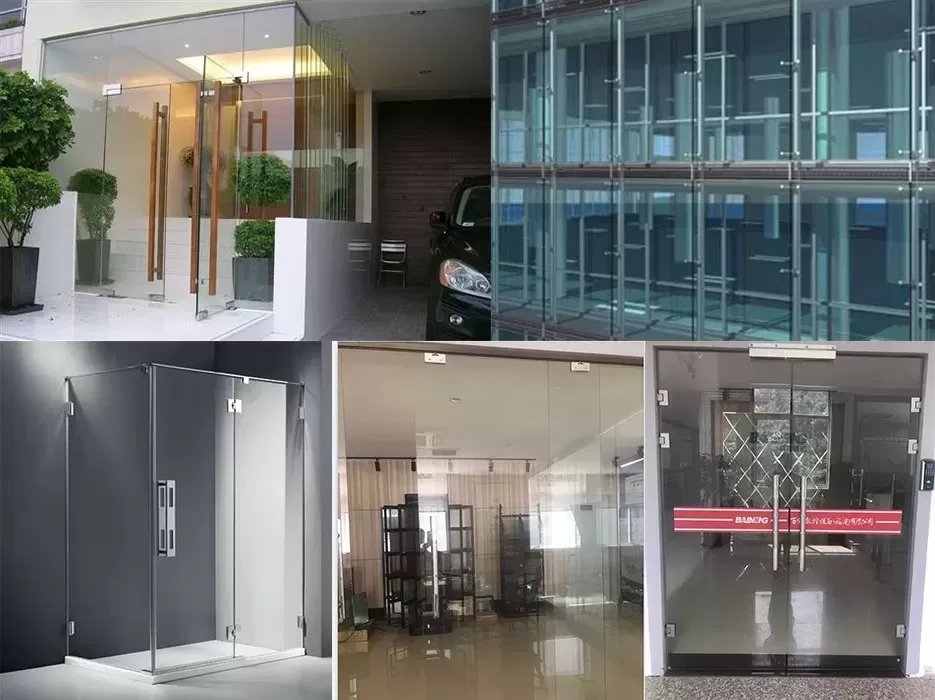
- Glass Size Envelope: Will the machine accommodate your architectural portfolio? Verify minimum sizes (e.g., 200 x 400 mm for shower doors) and maximum capacities (e.g., 3300 x 6000 mm for curtain walls).
- Thickness Range: Ensure the clamping system adjusts without mechanical recalibration across 3mm to 25mm monolithic panes and laminated packs.
- Remote Tele-Diagnostics: Does the CNC cabinet include an encrypted 4G/Ethernet industrial gateway for real-time remote factory service and software patches?
- Component Lineage: Verify that core electronic components (servo drives, PLC, contactors) come from Tier-1 suppliers like Siemens, Beckhoff, Schneider, or Yaskawa.
Frequently Asked Questions
Q1: Can a vertical glass working center process laminated and fire-rated glass?
A1: Yes. As long as the machine features dynamic water feed control and variable spindle speed adjustment, it can process multi-layer laminated glass and specialty fire-rated substrates. Opposing drilling eliminates inner inter-layer delamination during hole cutouts.
Q2: How does vertical processing prevent glass slippage during heavy edge milling?
A2: High-end vertical centers combine bottom-edge mechanical support rollers with high-vacuum independent suction plates. The vertical angle lets gravity seat the pane firmly against the transport reference line, while pneumatic vacuum chambers lock the pane against lateral milling forces.
Q3: How difficult is it to transition operators from horizontal tables to a vertical CNC platform?
A3: Modern vertical systems use intuitive graphical user interfaces (GUIs). Operators familiar with basic DXF workflows and Windows-based controls can typically operate the machine independently after 3 to 5 days of hands-on commissioning training.
Q4: How long do diamond tools last on a vertical machine compared to horizontal units?
A4: Tool life is generally 20% to 35% longer on vertical machines. Gravity pulls heavy glass fines and cullet straight down into the drainage channel instead of letting it pool on the glass surface where the diamond tooling repeatedly re-grinds it.
Q5: What are the primary daily maintenance tasks required on vertical processing machines?
A5: Daily maintenance is straightforward: wipe down the optical thickness sensors, empty the primary swarf trap, verify automatic central lubrication oil levels, and run an automated cleaning cycle on the toolholder cones.
Equip Your Factory for the Demands of 2026
Investing in processing machinery requires looking years down the road. Sticking to outdated horizontal tables ties your plant to high labor costs, elevated scrap rates, and wasted shop space. Upgrading to an intelligent vertical glass working center equips your company with the speed, precision, and digital connectivity required to win high-margin architectural contracts.
BAINENG CNC designs and builds precision-engineered vertical glass processing equipment engineered to run continuous shifts under demanding production environments. Do not let legacy equipment throttle your factory throughput.
Take action today: Contact the technical sales team at BAINENG CNC to schedule a private factory consultation, request comprehensive machine specifications, or receive a free production line simulation.