
 FAQs
 Factory Tour



Glass fabrication facilities face harsh operational realities in 2026. Factory floor rental rates continue to climb, skilled CNC operators remain difficult to recruit, and customer tolerances for architectural and shower glass are tighter than ever. Plant managers can no longer afford equipment that wastes square footage or creates bottlenecks during secondary processing.
For decades, the flatbed or horizontal CNC router was the standard workhorse for milling notches, cutouts, and drilling hinge holes. However, structural shifts in manufacturing economics have exposed the limits of this horizontal orientation. Today, leading fabricators turn to advanced vertical configurations to sustain profitability.
Choosing an industrial vertical glass drilling and milling machine engineered by innovators like BAINENG CNC allows processors to bypass the inherent bottlenecks of flat processing beds. If your plant is planning capital investments this year, examine how vertical architecture directly impacts your bottom line.
Planning to upgrade your factory floor? Contact BAINENG CNC technical team to receive a complimentary cycle time analysis and equipment footprint layout.
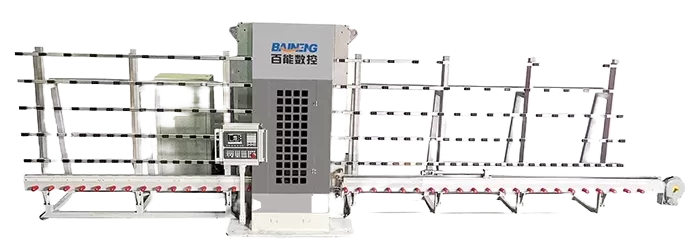
1. The Shift to Vertical: Factory Floor Real Estate in 2026
Commercial real estate costs for industrial manufacturing plants have hit historic highs. As a result, production managers must scrutinize the revenue generated per square meter of floor space. Horizontal CNC work centers demand massive footprints, not just for the machine frame itself, but for the perimeter access zones and suction-cup loading clearance required on all four sides.
A standard horizontal machine capable of processing architectural glass panels (e.g., 2500 mm x 1500 mm) routinely consumes between 45 and 65 square meters of active floor space. Add the mandatory loading tables and the swing clearance for jib cranes, and the footprint swells further.
In contrast, a high-performance vertical glass drilling and milling machine relies on a compact, upright backplane design. By positioning the glass panel at a steep 6-to-8-degree incline, the physical footprint shrinks by up to 60% compared to horizontal units. The processing line requires only a narrow entry and exit lane along the wall or production aisle.
- Reduced Aisles: Vertical feeding eliminates wide turning corridors previously needed for horizontal sheet transport.
- Straight-Line Flow: Glass moves through entry, work zone, and exit without leaving the linear plane.
- Multi-Machine Density: Fabricators can fit two vertical work centers into the space previously occupied by a single flatbed CNC.
2. Cycle Times and Opposed-Spindle Engineering
Cycle speed determines your delivery lead times and labor cost per panel. The classic horizontal CNC glass processing center operates with a single vertical spindle traveling overhead on an X-Y-Z gantry. Drilling a through-hole requires the tool to enter from one side, risking breakout (conchoidal fracture) on the bottom surface unless feed rates drop drastically near exit.
Modern vertical glass drilling and milling machines employ synchronized front and rear opposed spindles. The machine drills simultaneously from both sides of the glass sheet:
- The front spindle initiates the hole to half depth.
- The rear spindle advances to complete the core from the opposite face.
- The core ejects automatically into a collection chute without manual extraction.
This dual-spindle sequence cuts hole-drilling cycle times by more than 50% while preventing chipping. Standards such as ASTM C1048 govern mechanical strength and edge quality in heat-treated architectural glass; clean drilling directly reduces breakage rates inside the tempering furnace.
Milling operations on shower door hinges, radius corners, and internal cutouts also benefit from constant workpiece clamping. The glass remains held rigid by pneumatic rollers along the bottom and precision side clamps. The milling cutter moves across the vertical face with zero vibration, prolonging diamond tool life and eliminating chatter marks.
3. Elimination of Scratches and Cooling Slurry Management
Yield loss from surface abrasions represents one of the largest hidden operational expenses in flat glass production. On a horizontal CNC, broken glass chips (cullet) and abrasive grinding dust settle on top of the horizontal glass surface and within the vacuum suction pods.
As coolant flows during heavy milling, it creates a slurry pool on top of the panel. When workers drag panels off the bed, or when vacuum cups slide during repositioning, fine micro-scratches ruin expensive coated or Low-E glass. Fabricators must scrap the entire sheet or waste labor attempting to polish out defects.
A vertical glass drilling and milling machine harnesses natural gravity to solve this issue:
- Immediate Slurry Evacuation: Water spray and glass chips fall immediately downward into collection troughs below the work deck.
- Clean Glass Faces: The vertical sheet face sheds liquid instantly, leaving the upper and lower surfaces free from standing sediment.
- No Vacuum Drag: Instead of dozens of manual suction cups that require repositioning for every different CAD profile, vertical systems secure glass with mechanical, non-marking clamp bars that touch only non-critical edge bands.
By protecting delicate coatings according to architectural glass quality guidelines like ISO 12543, scrap rates drop from typical 3–5% levels on flat beds down to under 0.5% on vertical platforms.
4. Automation and Upstream/Downstream Connectivity
Standalone processing equipment creates workflow friction. Horizontal CNC machinery almost always acts as an island of automation. Glass arrives on an A-frame cart, workers lift it onto a tilting table, run the job, tilt it back up, and cart it to a standalone washer.
The contemporary automated glass drilling machine must communicate with upstream edging lines and downstream vertical washers. BAINENG CNC engineers vertical processing centers specifically to bridge this gap. Because the glass already travels on edge, the vertical glass drilling and milling machine connects directly via motorized roller conveyors to:
- Vertical straight-line edging and double-edging systems.
- Vertical CNC glass washing and drying stations.
- Automated robotic sorting racks and tempering furnace loading conveyors.
By removing two manual tilting stages, a factory removes the two most common points of glass handling breakage and operator back injury. The process shifts from batch handling to continuous single-piece workflow.
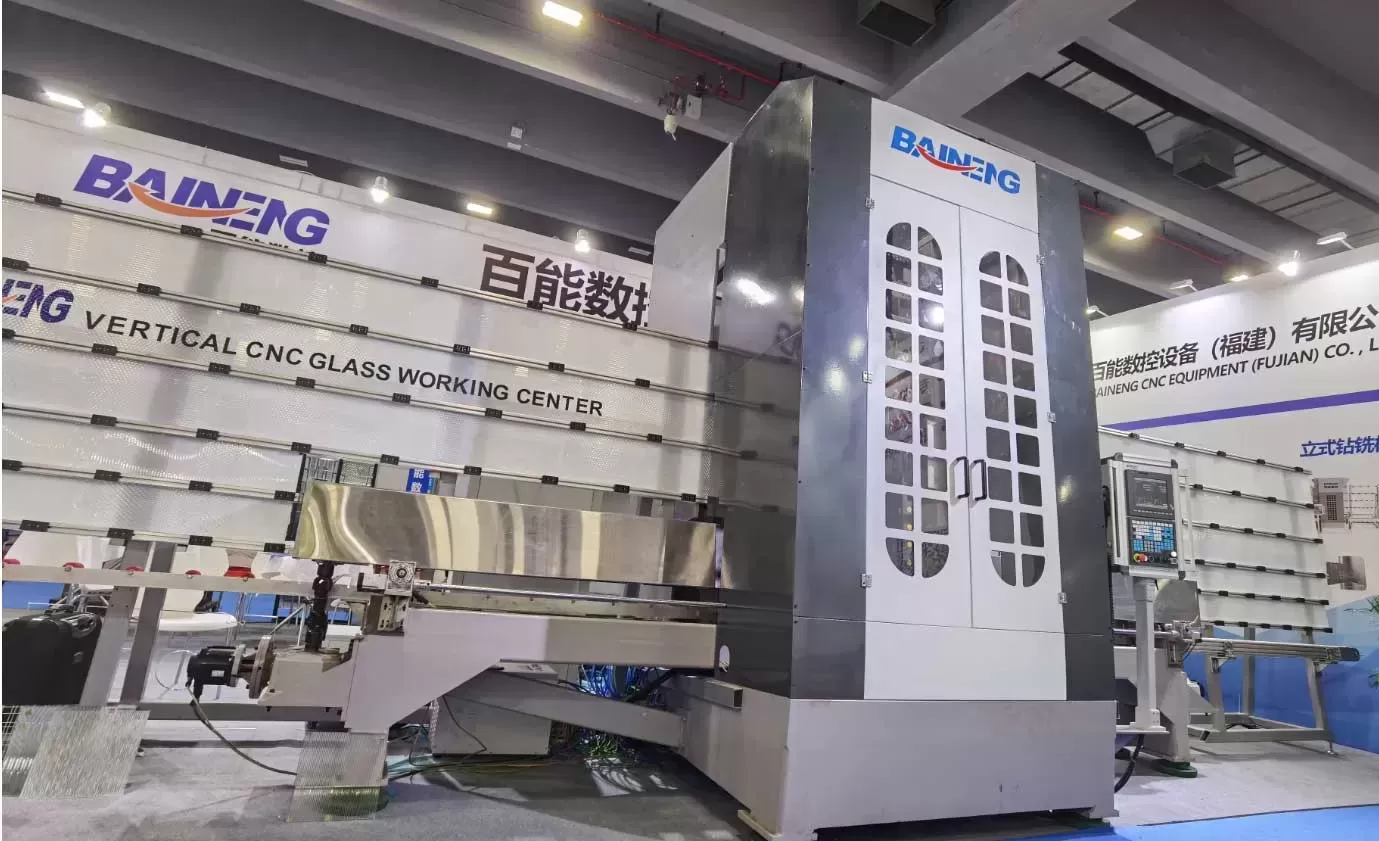
5. Horizontal vs. Vertical Glass CNC: Direct Comparison
To quantify the operational differences between these two machinery types, consider this performance baseline for standard 8 mm to 12 mm architectural tempered panels:
| Performance Metric | Horizontal CNC Router | Vertical Glass Drilling and Milling Machine |
|---|---|---|
| Floor Space Required | 50 – 70 m² (including loading perimeter) | 18 – 25 m² (linear wall-adjacent configuration) |
| Average Setup Time | 8 – 15 minutes (suction pod positioning) | Under 1 minute (barcode scan, automatic clamping) |
| Hole Drilling Method | Single spindle (entry chipping risk) | Twin opposed spindles (simultaneous, chip-free) |
| Water/Slurry Evacuation | Pools on glass face (causes scratches) | Gravity-assisted drainage into base flumes |
| Inline Automation | Requires robotic tilt loaders | Direct conveyor coupling to edgers & washers |
| Operator Requirements | 1–2 skilled operators per machine | 1 operator can oversee 2 connected lines |
6. Total Cost of Ownership (TCO) and ROI Analysis
Capital equipment should not be judged merely by the initial machine purchase price. Fabricators evaluating industrial glass fabrication machinery in 2026 evaluate Total Cost of Ownership over a 7-to-10-year asset lifecycle.
While an advanced vertical glass drilling and milling machine may carry a modest capital premium over an entry-level flatbed router, its operating expenditures (OpEx) are vastly lower:
- Labor Reductions: Automated tool changers (ATC) with high-capacity magazines, paired with barcode-driven software, reduce setup labor by up to 75%.
- Tooling Longevity: Constant water pressure directly into the tool bore, supported by vertical drainage, cools diamond pins and countersinks evenly. This balance extends diamond tooling life by 20–30%.
- Power Consumption: Vertical drive motors move smaller carriage masses along the Z and Y axes than massive horizontal gantry beams, lowering electrical draw per processed piece.
Most mid-to-large-scale processors achieve full return on investment (ROI) within 12 to 18 months based purely on scrap reduction and labor redeployment.
7. Buyer’s Checklist: What to Look for in 2026
When selecting a vertical glass drilling and milling machine, ensure the engineering specification satisfies strict production demands:
- Spindle Construction: Insist on dual water-cooled electro-spindles with ceramic bearings capable of reaching at least 12,000 to 18,000 RPM.
- Tool Magazine: Look for front and back automatic tool changers with a minimum of 8 to 16 positions each to run mixed batches without tooling swap downtime.
- Rigid Base Structure: Verify that the structural frame uses stress-relieved, heavy tubular steel or cast iron to suppress harmonic resonance during high-speed milling.
- Open CAM Compatibility: Ensure the operating system reads standard DXF files and interfaces with ERP software via standard protocols such as OPC UA or direct network share.
- Technical Support: Verify remote telemetry capability so machine builders like BAINENG CNC can diagnose sensors, drives, and software parameters remotely.
For more insights into modern CNC cutting and grinding dynamics, consult processing guidelines from industry bodies such as the National Glass Association (NGA).
Frequently Asked Questions
Q1: Can a vertical glass drilling and milling machine handle complex,
irregular shapes?
A1: Yes. Modern multi-axis vertical centers
process internal cutouts, hinge pockets, polished oval cutouts, and corner
radius cuts on both rectangular and shaped panels. Precision servo drives
smoothly interpolate across the X and Y axes simultaneously.
Q2: Is a vertical machine suitable for thin glass below 4
mm?
A2: Most vertical centers focus on 4 mm to 19 mm glass, which
covers standard shower doors, balustrades, and structural partitions. For
ultra-thin glass under 3 mm, specialized horizontal vacuum tables may still be
warranted to prevent flexure unless the vertical machine uses dynamic
multi-point back-pressure supports.
Q3: How difficult is it for an operator to transition from a
horizontal to a vertical machine?
A3: The transition is
straightforward. Because vertical machines rely heavily on touch screens,
automated edge-finding probes, and barcode scanners, operators no longer spend
time setting physical vacuum cups on a grid. Training typically takes less than
three business days.
Q4: How does the vertical orientation prevent glass slippage during
high-speed milling?
A4: Vertical machines utilize heavy-duty
pneumatic or hydraulic clamp assemblies fitted with high-friction, non-marking
polyurethane pads. These clamps automatically position themselves adjacent to
the milling path to provide rigid backing directly against cutting forces.
Q5: Can these machines perform polishing along the inside of
cutouts?
A5: Yes. By utilizing the automatic tool changer, the
machine performs milling with a rough diamond finger bit, followed by a
semi-finish diamond tool, and completes the internal cutout with an elastic
resin-bonded polishing wheel.
Take Your Production Floor to the Next Level
The manufacturing floor of 2026 rewards velocity, compact space utilization, and zero-defect output. Continuing to invest in bulky horizontal CNC tables ties up your capital, hogs valuable square footage, and exposes your products to unnecessary handling damage.
A precision-built vertical glass drilling and milling machine engineered by BAINENG CNC delivers the processing speed, scratch-free handling, and inline connectivity your plant needs to outpace competitors. Build a faster, leaner glass fabrication line today.
Ready to modernize your glass processing
capability?
Submit an inquiry to the BAINENG CNC engineering team
today. We will analyze your typical panel sizes and hole patterns to provide a
customized machine configuration, layout drawing, and ROI timeline.