
 FAQs
 Factory Tour



Are you looking to scale up production and eliminate edge chipping on your architectural or decorative glass lines? Choosing industrial equipment requires a balance between technical specifications, budget constraints, and real-world throughput.
If you need immediate technical specifications, machine comparisons, or an accurate price estimate for your facility, contact the engineering team at BAINENG CNC today for a custom consultation.
Demand for high-end decorative glass is rising across interior and exterior architecture. From frameless shower enclosures to mirrored feature walls, clients demand deeper grooves, crisp intersections, and flawless finishes.
However, buying the wrong machine causes bottlenecks. Underpowered spindles lead to micro-fractures, slow cycle times eat into margins, and flimsy beds cause vibrations that ruin precision cuts.
This guide breaks down the technical parameters, structural designs, and financial considerations you must evaluate before purchasing a glass V groove machine for your plant.
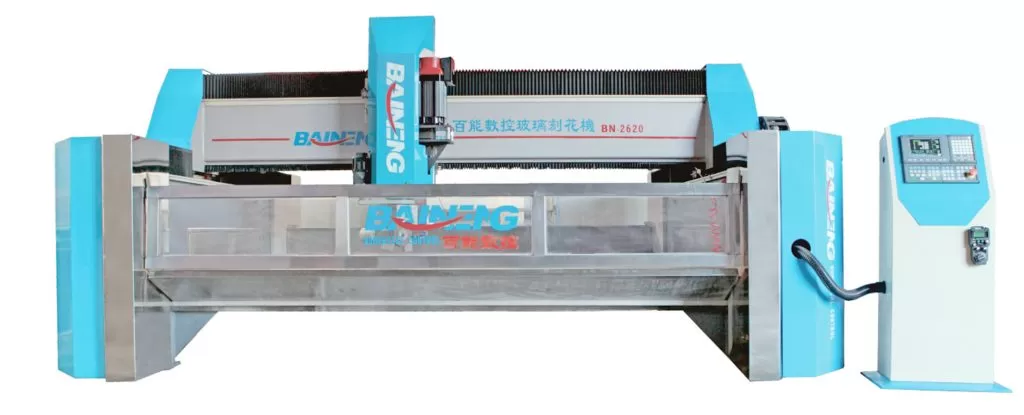
What is a Glass V Groove Machine and How Does It Work?
A glass V groove machine is a specialized processing center designed to cut precise V-shaped, U-shaped, or flat-bottom channels into flat glass. The process combines rough diamond cutting, fine shaping, and integrated polishing into automated cycles.
Unlike standard abrasive sandblasting or basic manual routers, an industrial CNC unit executes complex vector designs directly from CAD/CAM software. Diamond wheels remove glass stock under heavy coolant flow to prevent thermal stress, followed immediately by resin or cerium oxide polishing wheels.
Typical applications in modern fabrication plants include:
- Residential and commercial shower doors with geometric patterns.
- High-end furniture components, vanity tops, and glass tabletops.
- Decorative sliding doors, partitions, and office dividers.
- Silvered mirror borders, beveled art pieces, and architectural panels meeting ASTM International safety standards.
- Curtain wall decorative accents and retail storefront display glazing.
5 Critical Factors to Consider When Buying a Glass V Groove Machine
Not all grooving centers perform equally under high-volume production shifts. Focus on these five critical engineering areas during your evaluation process.
1. Automation Level and Control System (CNC vs. Semi-Automatic)
Entry-level workshops often consider semi-automatic linear grooving machines due to lower initial costs. However, these units fail to deliver when handling custom patterns, radii, or irregular lines.
A true multi-axis CNC glass V grooving machine runs on an industrial PC controller. It allows operators to import standard DXF files and generate G-code within minutes. This capability reduces machine setup errors and prevents expensive glass scrap.
Look for systems that feature an automatic tool changer (ATC). An ATC allows the spindle to switch between coarse diamond carving wheels, medium smoothing wheels, and final polishing stones without manual operator intervention. This setup slashes cycle times on complex decorative patterns by up to 45% compared to manual-tool systems.
2. Processing Precision and Spindle Quality
The core of every grooving center is its spindle assembly. A weak spindle vibrates at high RPMs, creating chatter marks and micro-chipping along the groove edge that will fail quality inspections.
- Spindle Power and Speed: Look for a constant-torque electric spindle rated between 5.5 kW and 9.0 kW, capable of reaching 6,000 to 12,000 RPM.
- Drive Mechanics: High-precision helical rack-and-pinion or zero-backlash ball screws driven by premium Japanese or European servo motors ensure smooth linear movement.
- Positioning Repeatability: Your target machine should guarantee a positioning accuracy within ±0.05 mm to maintain crisp line intersections without overrun marks.
At BAINENG CNC, our engineering teams optimize spindle rigidity and dynamic balance to ensure diamond tooling tracks smoothly, even at high feed rates on 19mm architectural glass.
3. Processing Bed Size and Workshop Logistics
Size your machine bed to handle your plant's largest projected panels while staying mindful of total floor space. Oversized beds waste shop space, but undersized beds turn away profitable contracts.
Common standard dimensions range from 1500 x 2500 mm (suited for shower glass and residential mirrors) to 2500 x 4000 mm (engineered for jumbo facade panels and oversized sliding systems). Factor in loading access: does the machine bed allow integration with overhead crane lifters, scissor loaders, or external roller tables?
Review industry trends published by the National Glass Association (NGA) regarding the rising demand for oversized interior architectural panels before committing to a final bed size.
4. Machine Bed Rigidity and Corrosion Control
A glass V groove machine generates significant dynamic forces during fast directional changes. A light, bolted sheet-metal frame will deform over time, permanently skewing operational accuracy.
Choose an industrial bed constructed from thick, normalized steel plate or stress-relieved casting. Heat treatment before machining eliminates internal stresses, keeping the bed flat over years of heavy use.
Glass grinding also produces an aggressive, abrasive slurry. Ensure the machine features:
- Total stainless steel or anti-corrosion composite cladding inside the processing zone.
- Enclosed linear guide rails and drive racks protected by pressurized bellows.
- A multi-stage water filtration and recirculation system to clear glass sludge before it ruins water pumps and seals.
5. Tooling Versatility and Groove Geometry
Customer demands change rapidly. One month you may produce wide V-grooves for interior doors; the next month brings orders for U-grooves, light fluting, or flat-profile steps.
Ensure the machine software and tool holders accept a broad array of tooling geometries:
- V-groove wheels from 60 degrees to 150 degrees.
- U-groove wheels with radii ranging from 3 mm to 20 mm.
- Polishing wheels designed for clear, satin, or brilliant optical finishes.
Total Cost of Ownership (TCO) and ROI for Glass Plants
Never base an equipment purchase solely on the initial invoice. Cheap machines often hide high operational costs behind slow feeds, high scrap rates, expensive electrical demands, and scarce replacement parts.
Use this basic formula to project your monthly Return on Investment (ROI):
Net Monthly Gain = (Additional Sq. Meters Processed × Profit Margin per Meter) - (Monthly Machine Amortization + Maintenance + Labor)
A high-speed glass V groove machine increases plant output in three distinct areas:
- Reduced Rework: Clean cutting edges prevent breakage during the downstream tempering furnace cycle. Reports tracked by Glass Magazine confirm that micro-fractures in decorative channels cause up to 60% of furnace explosions.
- Labor Consolidation: One automated CNC station with an automatic tool changer replaces up to three manual edging and engraving benches.
- Higher Revenue: Polished V-grooves carry premium retail
margins compared to plain cut-and-edged glass.
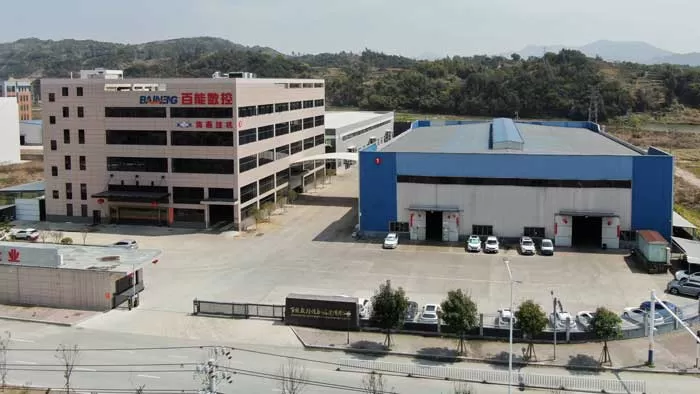
Vetting the Machine Manufacturer
When you invest in heavy glass machinery, you form a long-term operational relationship with the manufacturer. Thoroughly audit their industrial capabilities before issuing a deposit.
Check the origin of all primary components. Reliable builders openly document their component supply chain, including Schneider electrics, Rexroth or Hiwin rails, and AirTAC pneumatics. Proprietary or unbranded components lead to extended downtime when parts fail.
Ask clear questions regarding commissioning and after-sales support:
- Does the supplier provide on-site technical deployment and operator training?
- Can the engineering team connect to the machine via remote industrial VPN for fast software troubleshooting?
- What is the standard warranty on spindles, servo motors, and structural castings?
- Can the manufacturer share real video walk-throughs of their factory floor and reference client installations?
Frequently Asked Questions
Q1: What is the maximum glass thickness a glass V groove machine can process?
A1: Most industrial grooving centers handle glass thicknesses between 4 mm and 25 mm. The software allows operators to set groove depths safely, typically capping the depth at one-third to one-half of the total glass thickness to preserve structural integrity during tempering.
Q2: Can I groove glass after it has been tempered?
A2: No. Tempering introduces high surface compression and internal tensile stress. Any attempt to cut, groove, or drill glass after tempering will instantly shatter the sheet. You must complete all grooving, washing, and edge-finishing operations prior to heat treatment.
Q3: How often do diamond grooving wheels require dressing or replacement?
A3: Tool life depends on spindle speed, feed rates, coolant flow, and glass hardness. In typical daily production, a high-quality metal-bond diamond wheel runs for several hundred linear meters before requiring redressing with an abrasive stone, and thousands of meters before replacement.
Q4: How does the CNC machine hold the glass panel down during aggressive milling?
A4: Machines use high-capacity dry or liquid-ring vacuum pumps linked to a matrix table or movable vacuum suction pods. These pods firmly grip the glass plate from below, preventing movement under lateral cutting pressure without scratching the bottom surface or coated mirrors.
Q5: Can standard operators run the CNC grooving center, or do I need a programmer?
A5: Modern machines do not require dedicated programmers on the shop floor. The built-in software automatically converts standard DXF, DWG, and CAD files into operational paths. Operators only need basic computer literacy to select tool libraries, place panels against positioning stops, and press start.
Conclusion and Action Plan
Selecting the right glass V groove machine requires auditing your plant's current bottlenecks, panel sizes, and future market growth. Avoid underpowered, light-duty frames that compromise cut accuracy. Focus on strong spindle mechanics, automated tool changers, durable bed castings, and transparent service support.
BAINENG CNC builds heavy-duty CNC glass machining centers, vertical groovers, and custom fabrication equipment for high-throughput factories worldwide. Let our engineering team analyze your production goals and recommend the exact machine setup your plant requires.
Ready to modernize your glass workshop? Contact our technical sales team right now to request a tailored machine configuration, processing cycle calculations, and a direct factory quotation.