
 FAQs
FAQs Factory Tour



In the architectural, signage, and high-end furniture manufacturing sectors, the demand for intricate, defect-free transparent materials is accelerating. Processing these materials—whether traditional mineral silica glass or synthetic polymers like PMMA (commonly referred to as "acrylic glass")—presents significant engineering challenges. Achieving a flawless, optical-grade acrylic glass engraving or processing a deeply routed edge profile requires heavy-duty machinery capable of extreme vibration dampening and precise toolpath execution. For industrial fabrication facilities, deploying the correct CNC architecture, from multi-axis spindles to advanced vertical working centers, dictates overall throughput, edge quality, and operational profitability.
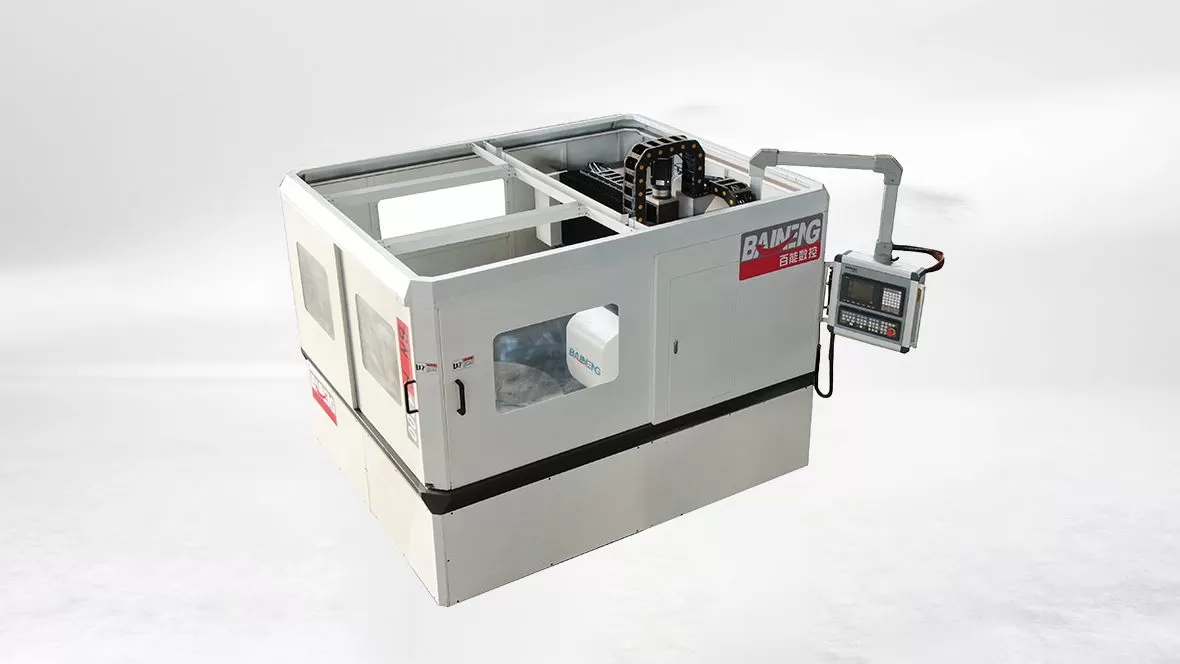
Material Dynamics: Machining PMMA versus Silica Glass
Before selecting capital equipment, production managers must understand the distinct thermomechanical properties of the substrates being processed. The machinery must be versatile enough to handle both the thermal sensitivity of plastics and the extreme brittleness of mineral glass.
Acrylic glass (PMMA) is a thermoplastic. During the milling or routing process, the primary enemy is friction-induced heat. If a CNC spindle rotates too fast while moving too slowly across the material (a low chip load), the acrylic chips melt instantly. This molten plastic re-welds itself to the cutting channel and adheres to the flutes of the cutting tool, destroying the workpiece and snapping the bit. Successful acrylic glass engraving requires machinery capable of maintaining high-torque at lower RPMs, coupled with rapid feed rates to evacuate chips before they reach their melting point.
Conversely, traditional silica glass requires an entirely different mechanical approach. Glass does not melt under a router bit; it fractures. Machining architectural glass requires diamond-impregnated tooling operating under a continuous, high-volume flood of liquid coolant. The machinery must possess massive structural rigidity—typically a heavy cast-iron base or thick welded steel gantry—to eliminate micro-vibrations. Even the slightest chatter during a beveling or grooving operation will cause microscopic edge chipping, ruining a highly expensive pane of architectural glass.
Evaluating Advanced CNC Glass Processing Architecture
To scale production beyond simple 2D cutting, modern fabrication floors integrate specialized CNC platforms designed specifically for the unique demands of heavy, transparent substrates.
The CNC Glass Working Center
The traditional flatbed CNC glass working center serves as the backbone for custom fabrication. These robust horizontal machines utilize heavy-duty vacuum suction cups to elevate and secure the glass pane above the machine bed. This elevation allows the spindle to access the outer edges of the material for complex edge profiling, polishing, and internal cutout operations (such as sink holes or hinge notches). A critical component of a high-end working center is the Automatic Tool Changer (ATC). The machine must seamlessly swap between roughing wheels, resin polishing wheels, and fine engraving bits in seconds, enabling continuous, unattended operation across complex architectural jobs.
The 5-Axis Glass Beveling Machine
For applications demanding intricate 3D geometry, such as decorative mirrors, luxury furniture components, and custom awards, a 3-axis machine is insufficient. A 5-Axis Glass Beveling Machine introduces rotational and tilting capabilities to the spindle head. This complex kinematics allows the diamond tool to approach the glass at virtually any angle. The 5-axis interpolation is essential for creating variable-angle bevels, deep V-groove acrylic glass engraving, and complex edge chamfering on curved or irregularly shaped panes, eliminating the need for manual edge finishing.
Vertical Glass Working Centers and Drilling Modules
Processing massive panes of architectural or shower-door glass on a horizontal flatbed requires an enormous factory footprint and introduces significant material handling risks. Vertical Glass Working Centers solve this spatial dilemma. By holding the glass pane at a slight vertical incline, these machines reduce the required floor space by up to 70%. Loading a two-ton sheet of glass vertically via overhead cranes is exponentially safer for operators. When integrated with specialized Glass Vertical Drilling and Milling Machines, these lines can execute high-speed, dual-sided drilling. The opposed drilling heads meet in the center of the glass pane, preventing the breakout (chipping) that commonly occurs when a single drill bit exits the backside of brittle materials.
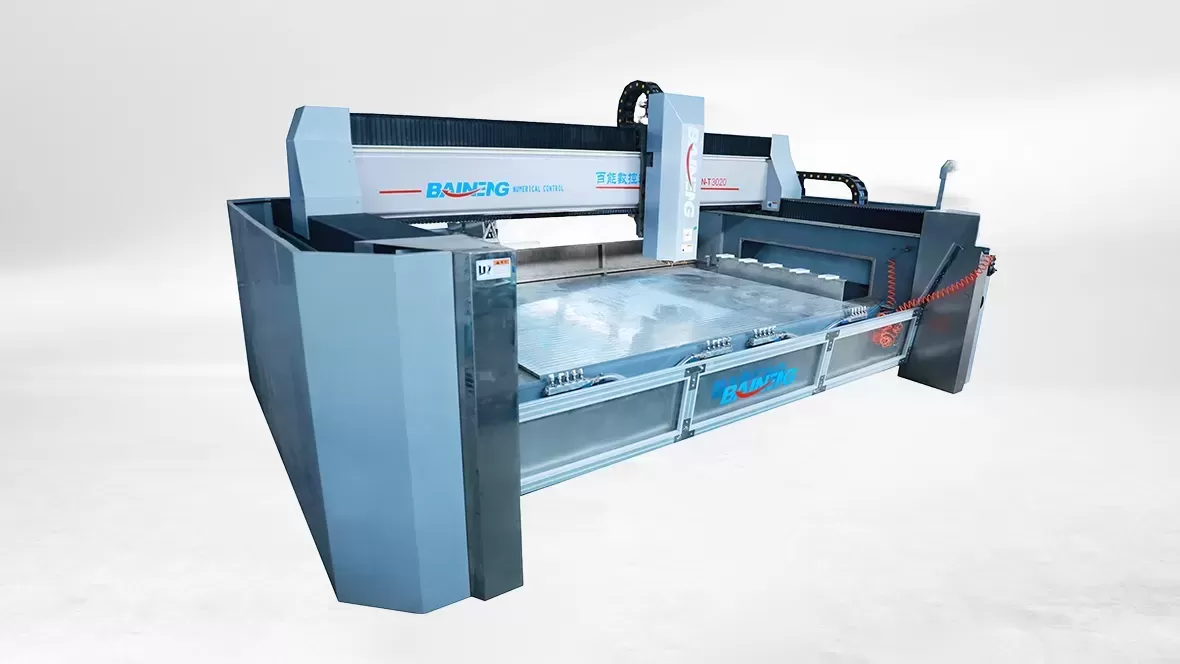
Integrating Glass Laser Technology for Surface Etching
While CNC machinery dominates heavy material removal, edge profiling, and deep structural engraving, laser technology occupies a crucial role in high-speed, high-resolution surface etching.
A specialized Glass Laser Machine operates by utilizing a focused CO2 or UV laser beam to rapidly superheat microscopic points on the material's surface. On acrylic, the laser vaporizes the top layer, creating a beautiful, frosted white contrast that is highly desirable for illuminated LED signage and corporate awards. When processing traditional mineral glass, the laser beam causes controlled microscopic thermal fracturing (micro-spalling). This technique produces a highly detailed, permanent frosted mark without placing any mechanical pressure on the glass pane, making it ideal for etching complex logos, QR codes, or serial numbers onto fragile, thin glass components where physical CNC pressure might cause shattering.
Automation and Smart Fabrication Floors
Investing in heavy machinery is only the first step; maximizing Return on Investment (ROI) requires integrating software that minimizes human setup time. Modern CNC and laser equipment utilize advanced CAD/CAM (Computer-Aided Design and Manufacturing) interfaces.
These software suites allow engineers to import DXF files directly from architectural clients. The software automatically calculates the optimal toolpaths, assigns the correct RPM and feed rates for the specific material thickness, and schedules the automatic tool changes. High-end machines feature automated tool measurement sensors. As abrasive diamond tools wear down during glass grinding, the machine's laser sensor detects the microscopic loss in tool diameter and automatically adjusts the CNC coordinates in real-time. This automated wear compensation ensures that the first pane of glass and the thousandth pane of glass exit the machine with perfectly identical edge profiles.
Frequently Asked Questions
Q1: Why does acrylic glass sometimes turn white and cloudy during CNC
engraving?
A1: Cloudy or melted edges occur due to
excessive friction heat. This usually happens if the spindle RPM is set too high
relative to the feed rate, or if an incorrect multi-flute router bit is used.
Utilizing a single-flute "O-flute" solid carbide bit with proper chip load
calculations ensures a clean, clear cut.
Q2: What is the advantage of a vertical glass working center over a
horizontal one?
A2: A vertical configuration
significantly reduces the required floor space in the factory. More importantly,
it allows operators to load massive, heavy panes of architectural glass safely
using overhead hoists, minimizing the risk of breakage and operator injury
during material handling.
Q3: Can a CNC working center perform both rough grinding and optical
polishing?
A3: Yes. A high-end CNC glass working
center is equipped with a high-capacity Automatic Tool Changer (ATC). The
machine runs a programmed sequence, starting with coarse diamond wheels for
material removal, followed by progressively finer resin or cerium oxide
polishing wheels to achieve a flawless, optical-grade edge finish without human
intervention.
Q4: How does a glass laser machine prevent the glass from cracking
during engraving?
A4: Glass laser engraving relies
on creating microscopic, controlled surface fractures rather than deep
structural cuts. The software precisely controls the laser's pulse frequency and
power output. Additionally, operators often use wet paper masking or specialized
air-assist nozzles to rapidly cool the surface and prevent thermal stress
propagation.
Q5: Why is 5-axis machining necessary for glass
beveling?
A5: Standard 3-axis machines are limited
to vertical tool movements. A 5-axis machine can tilt and rotate the spindle
head, allowing the polishing tool to maintain continuous, perfect tangential
contact with the glass edge, even on complex curves or variable-angle bevels,
ensuring uniform polishing quality across intricate geometries.
Upgrade Your Fabrication Line with BAINENG CNC
Scaling a glass and acrylic fabrication facility requires capital equipment engineered for unyielding rigidity, precise automation, and minimal downtime. As an industry leader in heavy-duty machinery, BAINENG CNC develops comprehensive manufacturing solutions tailored for the architectural and decorative glass sectors. Whether you need to streamline high-volume edge polishing with our Vertical Glass Working Centers, execute complex 3D acrylic glass engraving on our 5-Axis Glass Beveling Machines, or integrate rapid surface etching with our advanced Glass Laser Machines, our engineering portfolio is designed to maximize your production throughput. Contact the technical sales team at BAINENG CNC today to discuss your facility's specific machining requirements, request detailed equipment specifications, or arrange for a custom sample processing demonstration.