
 FAQs
FAQs Factory Tour



Precision defines value in modern industrial glass fabrication. Whether you produce architectural panels, home appliances, automotive glass, or bespoke decorative installations, your edge quality and cut depth dictate your scrap rates and profitability.
Fabricators often face a critical machinery investment decision: should you deploy a CNC glass engraving machine or adopt industrial laser engraving systems? Both promise micro-level accuracy, but they achieve their results through fundamentally opposing mechanics.
Choosing the wrong technology leads to micro-fractures, inconsistent line depths, and costly post-processing. At BAINENG CNC, we engineer high-precision machinery designed to solve these exact production bottlenecks. If your factory struggles with edge chipping or shallow profile limits, send an inquiry to our engineering team for a free technical consultation and tooling assessment.
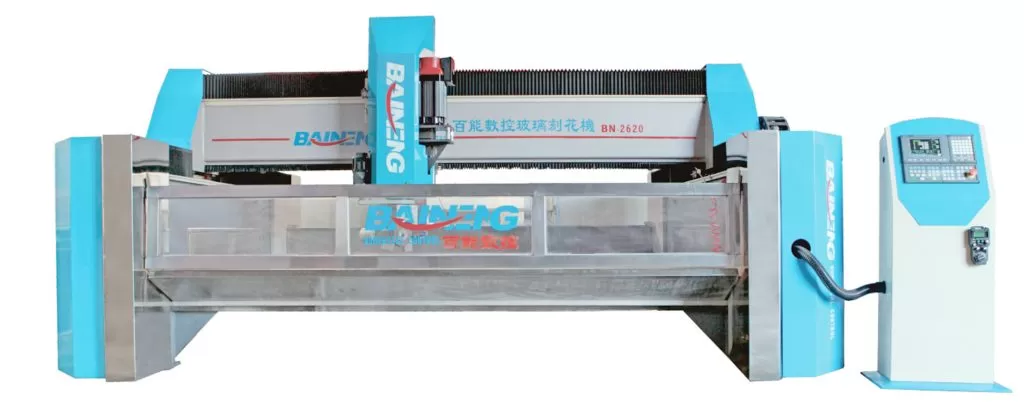
Defining "Precision" in Glass Engraving: It’s Not Just About DPI
In digital printing and laser marking, salespeople frequently define precision strictly by DPI (dots per inch) or spot size. In heavy industrial glass processing, this definition falls short.
True glass processing precision requires three critical metrics:
- Z-Axis Depth Control: The ability to carve at uniform, predictable depths across large sheets without drifting.
- Edge Geometry: Producing smooth, chip-free sidewalls that maintain structural integrity and resist breakage under thermal stress.
- Absence of Thermal Shock: Preserving the chemical stability of the glass matrix adjacent to the cut line.
While an optical laser offers high theoretical two-dimensional resolution, it introduces localized thermal energy. In contrast, mechanical cutting using a dedicated CNC glass engraving machine applies direct physical torque coupled with continuous coolant flow. The difference between mechanical micro-chipping and thermal micro-cracking determines the final structural precision of your part.
How a CNC Glass Engraving Machine Achieves Mechanical Precision
A heavy-duty CNC glass engraving machine utilizes a high-speed, rigid electric spindle driving sintered diamond tools. The machine physically removes material via grinding rather than thermal ablation.
Diamond tool glass carving relies on three core mechanical pillars:
- High Spindle Rigidity and Runout Control: Industrial spindles with dynamic runout below 0.003 mm ensure diamond tools contact the brittle substrate without vibration-induced chatter. This mechanical stability allows precise V-grooves, U-grooves, and wide bevels.
- Constant Closed-Loop Flood Cooling: High-pressure internal and external water channels direct coolant straight to the diamond interface. This rapidly carries away glass slurry and keeps the working zone at ambient room temperature, eliminating thermal expansion.
- Accurate Z-Axis Control: Heavy cast-iron machine beds absorb vibrations, allowing ball-screw driven Z-axes to maintain depth consistency within ±0.01 mm, even across large 3-meter glass sheets.
This physical cut produces polished, structurally sound grooves that can undergo tempering without cracking. It delivers authentic 3D reliefs that refract light clearly across architectural panels.
How Laser Glass Engraving Works: Optical Accuracy vs. Thermal Stress
Laser glass processing generally relies on CO2 or UV (ultraviolet) laser sources. Rather than mechanical tooling, the system fires focused beams of concentrated light energy at the substrate surface.
CO2 lasers (typically operating at 10.6 μm) rely on localized thermal micro-fracturing. The glass absorbs the beam energy, heats up instantly, and tiny surface particles fracture off due to rapid expansion. UV lasers (“cold lasers” at 355 nm) operate through photochemical ablation, breaking molecular bonds with a much smaller heat-affected zone (HAZ).
Laser systems offer noticeable optical advantages:
- Sub-Millimeter Beam Spot: A laser can focus down to 20 to 50 microns, enabling tiny 2D details, small serial numbers, and complex vector graphics.
- Zero Tool Wear: Because no physical bit touches the surface, there are no mechanical lateral forces, clamping requirements, or spindle deflection issues.
However, thermal mechanics limit industrial utility. Heating glass causes micro-fissures around the cut border. For deep grooves, lasers require multiple overlapping passes, which leaves rough, uneven floors, irregular sidewalls, and weakened glass structural integrity.
Head-to-Head Comparison: Precision Breakdown
To understand which system fits your factory floor, examine how their core mechanical parameters compare in daily production environments.
| Feature / Parameter | CNC Glass Engraving Machine | Industrial Laser Engraving System |
|---|---|---|
| Primary Mechanism | Diamond tool grinding with liquid coolant | Thermal fracturing (CO2) or photochemical ablation (UV) |
| Z-Axis Depth Capability | 0.1 mm up to 15 mm+ in a single controlled profile | Shallow surface marking (typically 0.02 mm to 0.5 mm) |
| Depth Uniformity | Exceptional (±0.01 mm via mechanical positioning) | Poor on deep passes (inconsistent energy absorption) |
| Edge Quality & Micro-Cracks | Smooth, polished, zero micro-cracks under coolant | Micro-chipping and thermal fissures present (CO2) |
| 2D Micro-Graphic Detail | Limited by minimum tool tip radius (around 0.5 mm) | Extreme precision (down to 0.05 mm spot lines) |
| Tempering Compatibility | Safe for post-temper processing (clean edge profiles) | High scrap rates during tempering if deep-engraved |
| Processing Versatility | Carving, edge polishing, drilling, milling, and beveling | Surface marking, etching, vector line drawing only |
1. Depth Consistency & 3D Relief
When an architect specifies a 3 mm deep V-groove across a shower door or decorative partition, depth consistency must remain absolute. A CNC glass engraving machine wins this category without contest. The rigid Z-axis holds its physical depth regardless of glass color, chemical composition, or light reflectivity.
Laser beams struggle with deep ablation. As the laser passes over the glass repeatedly to dig deeper, the varying surface topography disperses the focal point. This creates scalloped, uneven troughs and unpredictable depth variances.
2. Edge Quality & Micro-Cracking
Precision relates directly to edge cleanliness. Because glass is brittle, mechanical micro-chipping or thermal micro-fracturing can ruin structural integrity. Under high magnification, CO2 laser cuts reveal millions of microscopic fissures caused by thermal expansion.
A high-performance system like those manufactured by BAINENG CNC uses diamond wheels continuously flushed with high-pressure coolant. The water prevents localized heat accumulation, while balanced abrasive grits grind the edge down smoothly. The resulting profile is smooth and stable enough to proceed directly to the tempering furnace without spontaneous breakage.
3. Fine Detail & Vector Graphics
For fine photographic reproduction, micro-lettering, or barcode tracking on thin substrates, laser technology holds the advantage. A UV laser writes lines thinner than a human hair without exerting lateral cutting pressure on fragile pieces.
A mechanical CNC cannot carve details smaller than the radius of its smallest diamond bit. While specialized 0.2 mm engraving burrs exist, they require slower feed rates and careful handling. For surface-level serial numbers or intricate flat raster art, laser marking remains the faster, sharper option.
4. Material Adaptability
Industrial glass production involves varied materials: laminated structural glass, low-iron sheets, tinted architectural stock, mirrors, and thick monolithic panels. A CNC glass engraving machine processes all these substrates reliably. Because the physical diamond tool removes glass mechanically, changes in glass coating, tint, or light transmission do not disrupt the process.
Lasers interact inconsistently with different tints and reflective coatings. Low-iron glass absorbs light differently than green float glass, requiring continuous parameter adjustments. Furthermore, running a laser over laminated glass can scorch or blister the internal PVB or EVA interlayer.
Beyond Precision: Factors Influencing Your Equipment Choice
Precision does not exist in an operational vacuum. Plant managers must balance line accuracy with operational expenses, production uptime, and floor flexibility.
Consider these plant-floor variables:
- Cycle Time vs. Depth: Lasers execute shallow surface frosting faster than CNC machines. However, the moment your design calls for carved lines deeper than 0.5 mm, laser cycle times balloon exponentially as multiple passes are required. A CNC machine removes deep glass volumes rapidly in single or dual passes.
- Tooling and Consumable Costs: Laser operators avoid continuous diamond wheel purchases, but replacement RF laser tubes, optics, and mirrors carry high periodic capital costs. CNC diamond tooling requires regular redressing and replacement, though individual wheel costs remain predictable and low.
- Process Multi-Tasking: A laser marks and etches. A
multi-axis industrial CNC glass engraving machine handles engraving, edge
grinding, corner polishing, hinge-pocket milling, and hole drilling within a
single sheet setup. Consolidating these operations on one bed reduces handling
damage and floor space requirements.
.webp?t=1792049870875 "CNC GLASS ENGRAVING MACHINE")
Which Should You Choose? Industrial Applications
Your finished product catalogue dictates your machine procurement strategy.
Deploy a CNC Glass Engraving Machine if your facility processes:
- Architectural glass, partition walls, and deep V-grooved visual art panels.
- Frameless bathroom mirrors, shower screens, and beveled furniture tops.
- Appliance glass (cooktops, oven doors, refrigerator shelving) requiring polished boundary steps.
- Heavy structural glass panels that require tempering and zero thermal edge-fatigue.
Deploy an Industrial Laser System if your facility processes:
- Traceability markings, datamatrix codes, and micro-scale logos.
- Hollow glassware, stemware, tumblers, and bottles using a rotary axis.
- Ultra-thin electronic display glass that cannot tolerate clamping force or mechanical tool loads.
- Shallow decorative surface frosted patterns where structural depth is unnecessary.
Frequently Asked Questions (FAQ)
Q1: Can a CNC glass engraving machine produce polished grooves, or
will cuts look frosted?
A1: A CNC system can produce both frosted
and clear, polished finishes. The finish depends entirely on the diamond grit
and tooling sequences you run. Facilities typically run roughing passes with
coarse metal-bond diamond wheels, followed by fine resin-bond diamond wheels or
cerium-oxide impregnated polishing wheels to achieve an optical finish directly
on the machine bed.
Q2: Does laser glass engraving cause panels to crack during the
tempering process?
A2: Yes, it frequently can if the laser engraving
penetrates deeply. Standard CO2 lasers create micro-cracks through intense
thermal shock. When the glass enters the tempering furnace and encounters
extreme heat followed by rapid quenching, these micro-cracks act as stress
concentration points, often causing catastrophic panel explosions inside the
furnace.
Q3: What maintenance routines are critical for maintaining precision
on a CNC glass engraving machine?
A3: Daily maintenance focuses on
three areas: diamond wheel dressing to maintain tool profile geometry, cleaning
spindle coolant filtration screens to prevent glass slurry from scratching
bearings, and inspecting automatic lubrication lines on linear guide rails and
ball screws to prevent mechanical backlash.
Q4: Can CNC machines engrave laminated glass without damaging the
inner layer?
A4: Yes. Because the Z-axis depth of a CNC glass
engraving machine is mechanically constrained and water-cooled, you can carve
precise grooves into the top glass ply without transferring heat or vibration to
the PVB/EVA interlayer. Lasers often overheat and discolor the interlayer
beneath.
Q5: How does coolant quality affect precision on a glass CNC
machine?
A5: Coolant quality is essential. Recirculating glass swarf
or particulate-heavy slurry dulls diamond tools prematurely, increases friction,
and causes micro-chipping along the cut edge. Installing a dedicated centrifuge,
sedimentation tank, or paper-band filtration system keeps water pure, protects
machine components, and ensures razor-sharp engraving lines.
Conclusion & The Future of Glass Engraving
When evaluating precision between laser systems and a modern CNC glass engraving machine, consider the dimension of precision you require. If your business depends on two-dimensional micro-marking, logos, and shallow frosted surface effects, an industrial laser system is an effective tool.
However, if your production demands true mechanical precision, deep 3D structural reliefs, polished V-grooving, and clean edges that pass architectural tempering tests, the CNC glass engraving machine remains the industry benchmark. Mechanical rigidity, automated diamond tool tracking, and flood cooling combine to eliminate thermal failure points completely.
BAINENG CNC builds rigid, multi-axis industrial glass centers engineered to run around the clock with micron-level repeatability. Our team can help you select the ideal spindle configuration, tooling path, and automation setup to lower your production costs per square meter.
Do you need to improve your edge yield and eliminate engraving defects? Contact the BAINENG CNC engineering team today to review your drawings, schedule a machining sample demonstration, or receive a fast, detailed quotation for your production line.