
 FAQs
FAQs Factory Tour



Flat and curved glass fabrication demands extreme rigidity, micro-inch accuracy, and robust mechanical engineering. As architectural, automotive, and interior design sectors impose tighter tolerances on dimensional profiles and edge finishes, glass processors must move away from manual and semi-automated cutting stations toward closed-loop automated machining centers. Searching for a suitable glass cnc machine for sale requires looking past basic marketing sheets to evaluate dynamic mass, spindle drive design, interpolation kinematics, and lifecycle maintenance engineering.
Modern architectural installations routinely specify oversized monolithic or laminated panes requiring precision cutouts for patch fittings, countersunk through-holes, complex perimeter arrising, and polished edge contours. Executing these profiles without chipping or micro-fissures requires a machinery architecture capable of dampening high-frequency harmonics while delivering stable torque across varying feed rates. Procurement teams must scrutinize the core physical attributes and software integration that dictate long-term machine performance.
.webp?t=1788764558831 "glass cnc machine for sale")
Chassis Geometries and Mechanical Vibration Damping
Glass is an inherently brittle, non-yielding substrate with an ultimate tensile strength that drops precipitously whenever surface micro-cracks form during abrasive operations. Machine bed construction serves as the foundation for vibration absorption. Welded tubular steel frames that have not undergone thermal stress relief will inevitably experience dimensional drift over multi-shift operational cycles, causing axis misalignment.
High-grade platforms, such as those engineered by BAINENG CNC, use finite element analysis (FEA) optimized base castings or heavy-gauge, stress-relieved steel tubular structures filled with mineral composite materials. This structural mass counteracts dynamic forces generated by rapid axis acceleration and deceleration. When reviewing any glass cnc machine for sale, structural weight serves as an initial indicator of build quality: heavier, strategically braced frames resist resonance caused by diamond grinding wheels spinning up to 12,000 RPM while applying lateral pressure on 19mm laminated lites.
Linear motion components must match this base stability. High-precision recirculating ball linear guideways mounted onto precision-milled reference surfaces maintain low friction coefficients under heavy continuous loads. Dual-drive gantry designs, utilizing synchronized high-torque brushless AC servomotors coupled to ground ball screws or helical rack-and-pinion systems, eliminate racking errors across wide crossbeams. Absolute optical encoders mounted directly to the machine axes provide direct positional feedback, eliminating the mechanical backlash inherent to rotary motor encoders.
Electrospindle Architecture and Tooling Mechanics
The electrospindle is the functional core of any vertical or horizontal machining center. Processing soda-lime, borosilicate, or quartz glass involves abrasive grinding via metal-bonded and resin-bonded diamond tools rather than shear cutting. Consequently, spindle requirements differ radically from metal or woodworking centers.
Spindle Torque Curves and Bearing Configurations
Continuous torque delivery at moderate RPM ranges (between 2,500 and 6,000 RPM) is mandatory for core drilling and heavy edge stock removal with coarse-grit diamond profile wheels. Conversely, fine polishing with cerium oxide-impregnated wheels demands spindle stability at higher operational velocities. Quadruple angular contact ceramic hybrid bearing sets installed in back-to-back configurations withstand both heavy axial thrust loads during vertical drilling cycles and intense radial side-loads during perimeter shaping.
Internal Coolant Delivery and Debris Evacuation
Spindle design must integrate high-pressure internal coolant delivery routed directly through the rotor shaft. Grinding glass generates abrasive sub-micron swarf that quickly glazes diamond matrices if not flushed away continuously. Pressurized coolant (8 to 15 bar) entering the center of core drills and peripheral profile wheels cools the glass-tool interface, washes particulate out of the processing zone, and extends tool longevity. Tool-holder tapers—predominantly ISO 40, BT 40, or HSK-63—require pneumatic positive-pressure sealing to prevent water and abrasive glass slurry from contaminating the internal spindle motor windings and drawbar assemblies.
Kinematics, Axes Interpolation, and CAD/CAM Workflows
Workpiece processing typically requires simultaneous three-axis interpolation for 2D shaped panels, with advanced facilities requiring 4-axis or 5-axis capabilities to produce beveled architectural facets, non-standard mitered edges, and complex water-jet entry cleanups. Evaluating a glass cnc machine for sale requires assessing how the computerized numerical control system handles corner decelerations and surface path optimization without burning or chipping the glass edge.
Look-ahead algorithms within the CNC trajectory planner calculate acceleration and deceleration profiles hundreds of blocks in advance. When the machine approaches a sharp radius or corner cutout, the axis drive must reduce feed rate smoothly while maintaining optimal wheel peripheral speed. If the feed slows down without a balanced reduction in tool pressure, localized thermal friction will micro-fracture the edge, which can lead to spontaneous panel breakage during downstream thermal tempering cycles.
Parametric Macro Libraries: Built-in subroutines for standard door cutouts, hinge notches, circular holes, and socket cutouts allow machine operators to bypass manual drafting, adjusting coordinates directly through the industrial HMI.
Vacuum Clamping Automation: Multi-zone vacuum tables utilizing mechanical positioning stops and dynamically routed vacuum pods secure diverse sheet sizes without requiring manual clamping setups that impede peripheral wheel clearance.
Automatic Tool Wear Compensation: Diamond profile wheels lose outer diameter and change profile shape over linear meters ground. Laser or mechanical tool pre-setters measure tool geometry after set operational hours and automatically update the tool offset table within the CNC executive software.
Glass Positioning and Environmental Enclosures
Machining wet glass demands deliberate machine layout to balance operator safety, maintenance access, and moisture containment. A horizontal glass cnc machine for sale allows ergonomic loading of heavy architectural lites via overhead crane vacuum lifters, but requires expansive floor space and an extensive catch-basin drainage system to direct water back to centralized filtration units.
Closed-loop, continuous-loop synthetic coolant management systems separate abrasive glass glass-powder sediment via hydrocyclone units or chemical flocculant tanks. Allowing dirty, glass-laden water to recirculate through high-pressure pump seals causes premature erosion of tool holders, hoses, and spindle bearings. Stainless steel splash guards, internal LED illumination, and pressurized way-cover bellows shield critical drive components from the corrosive combination of water and glass fines.
BAINENG CNC incorporates purpose-built containment and ergonomic multi-zone bed layouts to maximize productive machine hours. Fast-acting vacuum systems with secondary safety sensors ensure vacuum levels remain above operational thresholds during processing. If an unexpected pressure loss occurs within the vacuum supply, axes execute an emergency controlled stop sequence, preserving the workpiece and preventing tooling collision.
Industrial Applications and Manufacturing Versatility
The deployment of high-specification machining centers spans across varied industrial sectors, each imposing unique performance expectations on machine kinematics and dynamic stability.
Architectural and Structural Processing
Architectural glass manufacturing focuses heavily on laminated balustrades, commercial curtain wall panels, structural fins, and frameless shower enclosures. Processing thick glass laminates (e.g., 10+10mm or 12+12mm with structural interlayers) requires significant vertical spindle rigidity. In these operations, a glass cnc machine for sale must perform rough grinding, finishing, and arrising in continuous cycles without overheating the polymer interlayers.
Appliance and Automotive Precision
Refrigerator shelving, oven door viewing panels, display case fascias, and automotive sidelites demand rapid cycle times, high edge polish brilliance, and precise cutout placement. Automotive specifications often dictate zero edge flaw tolerances to ensure safety glass properties are preserved after chemical or thermal tempering. Here, multi-tool magazine configurations and rapid tool-change cycles (under 10 seconds chip-to-chip) lower cycle times across large production runs.
Commercial Display and Furniture Applications
Modern interior glass products feature complex edge profiles, including waterfall edges, triple-beveled borders, and smooth interior sink cutouts. These shapes require high-resolution interpolation along the X, Y, and C axes. The C-axis controls the tangential orientation of the aggregate head relative to the perimeter path, ensuring consistent wheel contact angles even across erratic geometric arcs.
Procurement Metrics: Beyond Initial Capital Expenditure
Evaluating machinery proposals requires tracking the total cost of ownership across the operational lifespan rather than focusing solely on acquisition pricing. Downstream expenses are largely determined by electrical efficiency, compressed air demand, scheduled maintenance cycles, and spare component availability.
Procuring a platform backed by engineering support ensures that critical spares—such as electrospindle assemblies, linear guide blocks, and rotary drive couplings—are accessible on short notice. Machinery built on modular, non-proprietary control platforms (such as systems running standardized industrial fieldbus protocols like EtherCAT) simplifies ongoing electronics maintenance compared to platforms locked into closed proprietary protocols.
A reliable glass cnc machine for sale should feature central automatic lubrication systems that deliver metered doses of synthetic grease to linear rail trucks and ball screw nuts at defined distance intervals. Manual lubrication schedules in wet machining environments often fail due to human error, resulting in dried grease, water ingress, and catastrophic scoring on precision ground ways.
Frequently Asked Questions
What is the difference between a vertical and horizontal glass CNC machining center?
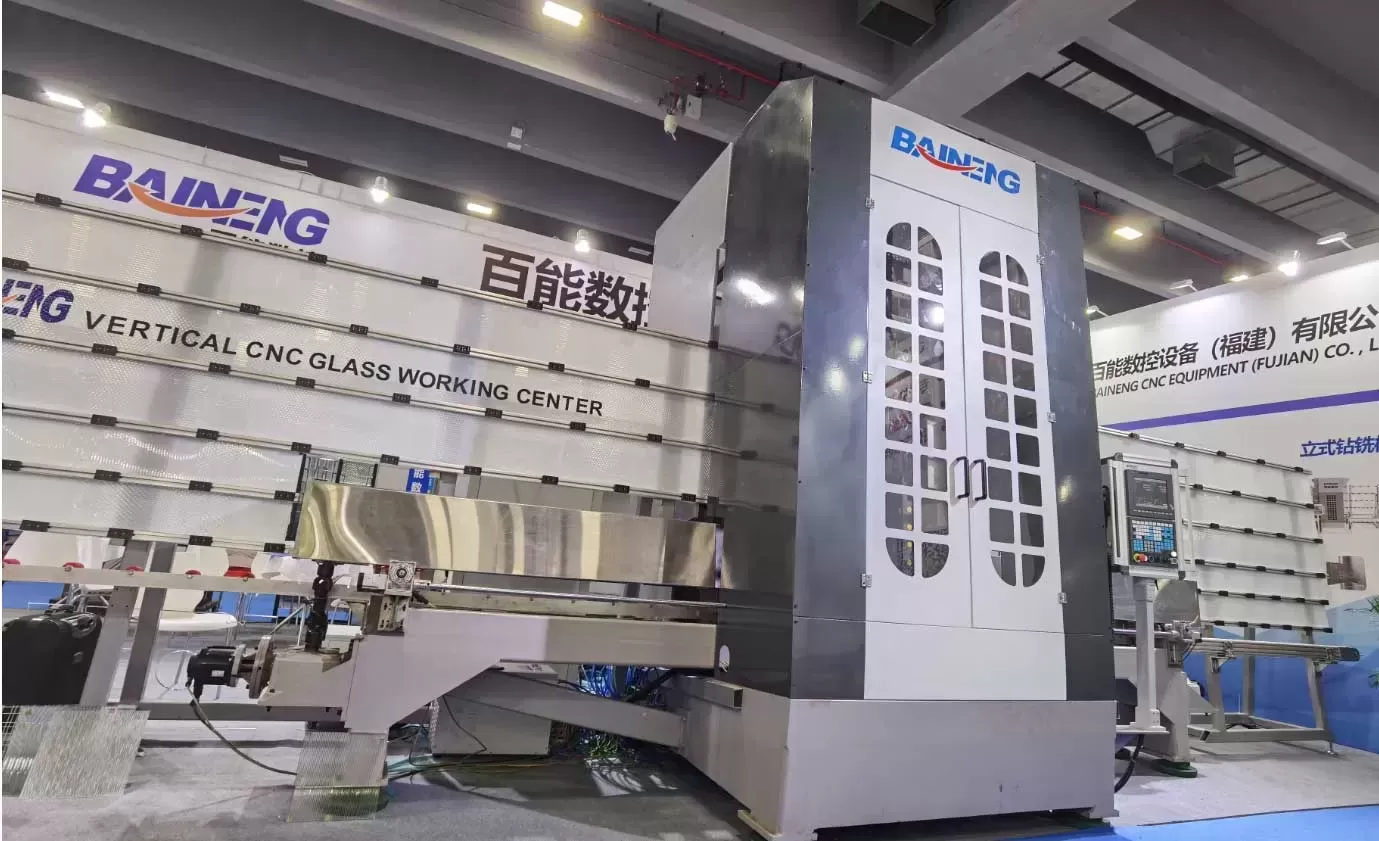
Horizontal machines support the glass sheet flat on a table using vacuum cups. They excel at processing complex internal cutouts, heavy beveling, and irregular geometric shapes, providing flexible tooling access across the surface. Vertical machines hold the glass slightly tilted on motorized rollers. Vertical machines occupy a substantially smaller physical footprint, streamline automated conveyor-line loading, and simplify the handling of standard rectangular building panels, though they may offer less adaptability for deep internal milling operations.
How does internal spindle cooling protect diamond tooling?
Internal spindle cooling routes water directly through the tool shaft into the diamond matrix face. This steady fluid stream prevents localized thermal build-up at the cutting surface, flushes away abrasive glass fines before they can embed into the bond, prevents tool glazing, and reduces the likelihood of edge burning or stress micro-fractures in the glass.
Can a glass CNC machine process laminated security glass?
Yes. Machining laminated glass requires specialized programming parameters, dynamic spindle speed adjustments, and specific tool geometries. The cutting passes must remove both the brittle glass layers and the flexible polymer interlayers (such as PVB or SentryGlas) cleanly without tearing the core material or causing edge delamination due to excess heat.
What routine maintenance keeps glass CNC centers operational?
Critical maintenance schedules focus on water filtration efficiency, spindle drawbar force verification, tool holder taper cleaning, and linear motion lubrication. Water filtration tanks must be cleared of glass sludge daily to protect pumps. Automatic lubrication reservoirs require regular top-offs of approved lubricants, and pneumatic water traps must be drained daily to keep dry air entering the spindle seals.
How does automated tool dressing work inside the machine?
Automated tool dressing relies on a dedicated station equipped with aluminum oxide dressing sticks permanently or temporarily mounted to the table. After a programmed number of linear meters processed, the CNC system calls a dressing sub-routine. The machine runs the diamond wheel across the dressing stone at a controlled depth and feed rate, stripping back dull bond layers and exposing fresh, sharp diamond particles to maintain grinding efficiency.
Initiating a Technical Procurement Inquiry
Selecting the correct mechanical specification requires an evaluation of your plant's typical glass thicknesses, maximum sheet dimensions, edge finish specifications, and production volumes. BAINENG CNC provides engineered solutions balanced for production throughput and operational reliability. Submit your production drawings, glass specifications, and factory floor layouts to our engineering team to receive a detailed machine configuration proposal and formal quotation tailored to your operational requirements.