
 FAQs
FAQs Factory Tour



Industrial glass fabrication is reaching an inflection point. Tightening global chemical regulations and rising scrap costs are forcing plant directors to phase out hydrofluoric acid etching and mechanical sandblasting. These legacy methods introduce micro-cracks, generate toxic slurry, and lack the repeatability required for modern downstream processes.
At the same time, the transition to lights-out production demands machinery that operates inside automated cells rather than isolated manual workstations. Modern glass laser etching equipment solves these challenges by combining non-contact photonic ablation with precision multi-axis CNC motion. Manufacturers like BAINENG CNC engineer these systems specifically to bridge heavy-duty mechanical rigidity with smart factory connectivity.
Choosing the right production-grade machinery in 2026 requires an understanding of laser physics, motion control architecture, and Industrial Internet of Things (IIoT) frameworks. This guide outlines the technical criteria required to procure the right system for high-yield, round-the-clock manufacturing.
The Shift to Dry Photonic Processing
Traditional glass etching relies on wet chemical baths or abrasive grit. Chemical processing creates hazardous waste, requires complex wastewater treatment plants, and yields inconsistent etching depths across large surface areas. Sandblasting produces heavy airborne particulates, causes mask degradation, and leaves subsurface fractures that reduce the structural integrity of the glass.
Laser etching removes material through controlled photonic interaction. Because glass exhibits high optical transparency and low thermal conductivity, incorrect energy delivery results in runaway thermal stress. This stress causes edge chipping, micro-cracks, and sudden shattering during tempering or lamination.
Next-generation equipment eliminates these failure points by deploying cold laser ablation or precisely tuned wavelengths. Energy deposits faster than heat can diffuse into the surrounding material matrix. The result is a sharp, clean mark with virtually zero heat-affected zone (HAZ), preserving the mechanical load capacity of the glass sheet.
Core Laser Technologies: Choosing the Right Engine
The laser source dictates what materials you can process, your cycle times, and your final edge quality. Three primary laser classifications dominate industrial applications in 2026.
1. Ultrafast Picosecond and Femtosecond Lasers
Ultrafast lasers represent the gold standard for high-value components, including ultra-thin glass (UTG), display panels, and semiconductor substrates. These systems emit pulses measured in picoseconds or femtoseconds, triggering multi-photon absorption.
Ablation Mechanism: Direct molecular ionization (cold ablation) bypassing thermal melting.
Heat-Affected Zone (HAZ): Less than 2 microns, preventing micro-crack propagation.
Best Use: Microfluidic chips, smartphone cover glass, high-density 2D Data Matrix codes, and anti-counterfeiting micro-features.
2. Industrial UV Lasers (355 nm)
Solid-state ultraviolet lasers provide a balanced compromise between system cost and processing precision. The short 355 nm wavelength features a high single-photon absorption rate in silicate glasses compared to infrared light.
Ablation Mechanism: Photochemical bond breaking coupled with minimal localized thermal input.
Processing Quality: Smooth edges with micro-crack zones consistently held below 10 microns.
Best Use: Automotive HUD windshields, medical diagnostic slides, architectural touch panels, and appliance control surfaces.
3. High-Power Pulsed CO2 Lasers (9.3 to 10.6 µm)
While unsuited for sub-micron detailing, high-efficiency CO2 lasers remain dominant for rapid, large-scale surface texturing. Silicate glass absorbs 9.3 µm wavelengths more efficiently than standard 10.6 µm beams, reducing thermal shock.
Ablation Mechanism: Rapid localized thermal vaporization and controlled micro-fracturing.
Throughput: High volumetric removal rates capable of covering square meters in minutes.
Best Use: Architectural privacy panels, anti-slip flooring glass, and large-format structural elements.
CNC Kinematics and Dynamic Autofocus Systems
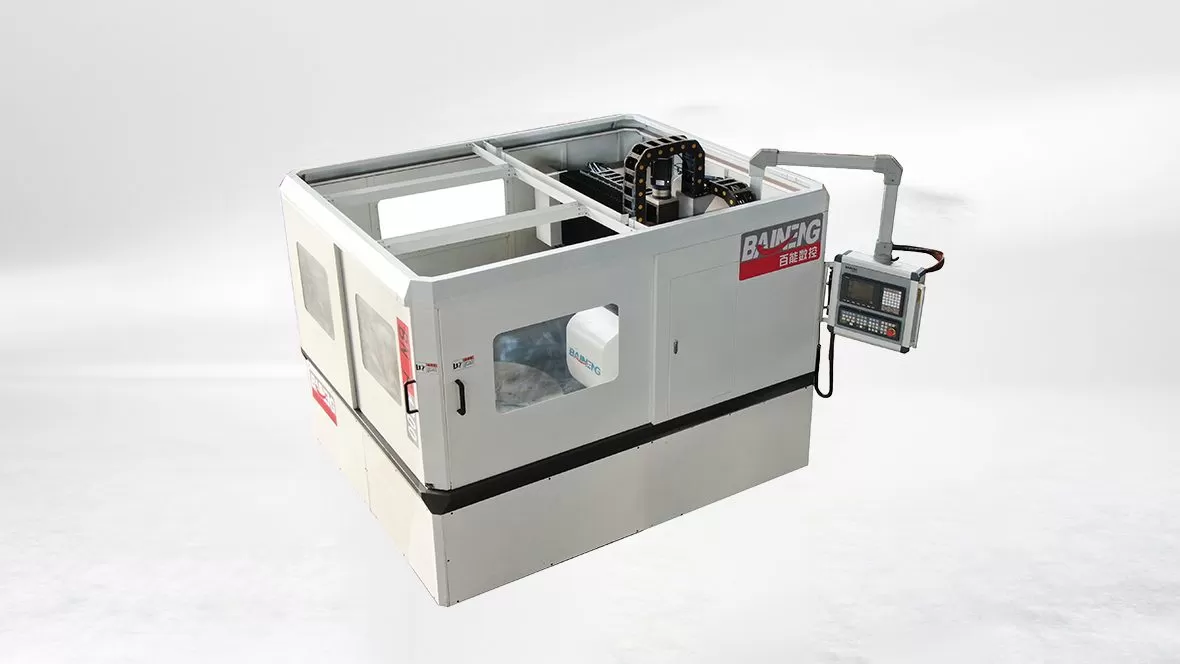
High-end glass laser etching equipment combines optical scan heads with precision machine tool kinematics. Flat glass sheets frequently display subtle thickness variations, while automotive and aerospace parts incorporate complex compound curves. Fixed-focus optical heads cannot maintain spot consistency across these geometries.
Advanced CNC machines mitigate this by deploying 3D dynamic focusing galvanometers synchronized with five-axis mechanical stages. A fast-moving voice coil motor adjusts the focal lens position along the optical Z-axis in real time. This optical tracking works alongside high-speed laser displacement sensors that map the glass topography milliseconds before the beam fires.
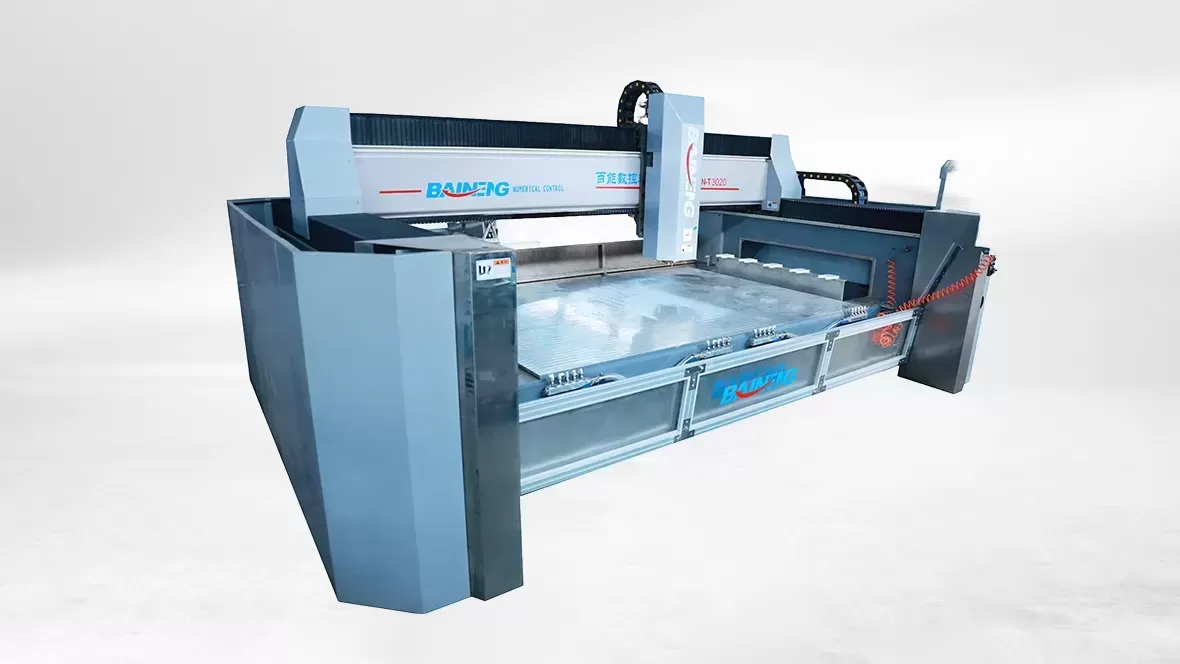
Rigid machine architecture remains non-negotiable. Machines built by BAINENG CNC utilize synthetic granite or stress-relieved welded steel beds driven by linear motors. This mechanical damping prevents external factory vibrations from transferring to the focal spot, holding optical positioning tolerances within plus-or-minus 5 microns across multi-meter travel envelopes.
Smart Factory Integration: Moving Beyond Standalone Units
In a smart manufacturing facility, a laser machine cannot operate as an isolated island. It must communicate bi-directionally with line-level control systems, transport robots, and plant management software.
Industrial IoT and Telemetry
Modern equipment runs native fieldbus architectures supporting OPC UA and MQTT communication protocols. The CNC unit streams operational variables directly to the factory Manufacturing Execution System (MES):
Real-time laser power degradation and pulse stability telemetry.
Chiller water temperature and flow rate metrics.
Dynamic cycle-time tracking and consumable performance.
Predictive maintenance alerts based on axis servo vibration signatures.
Machine Vision and Closed-Loop Alignment
Thermal expansion and mechanical loading errors cause incoming glass sheets to shift by fractions of a millimeter. Modern laser equipment utilizes high-resolution, coaxial vision systems paired with edge-detection software. The vision engine identifies fiducial marks or mechanical corners, recalculates the coordinate matrix, and dynamically offsets the laser path. This closed-loop routine prevents off-center etching and eliminates human setup errors.
Robotic Loading and Material Flow
To support lights-out production, high-volume machines incorporate standardized interfaces for robotic loading arms and Automated Guided Vehicles (AGVs). Automated roller tables with non-marking, vulcanized polyurethane rollers feed sheets into the cutting and etching zone. Pneumatic sheet centering and vacuum hold-down tables secure the glass without scratching anti-reflective or low-emissivity coatings.
Selection Matrix: Matching Equipment to Industrial Sector
Different production sectors face distinct tolerances, takt times, and durability requirements. Use this matrix to guide your hardware configuration.
| Application Sector | Primary Substrate | Recommended Laser Source | Required Motion Platform | Critical Machine Feature |
|---|---|---|---|---|
| 3C Consumer Electronics | Aluminosilicate, UTG, Gorilla Glass | Picosecond UV (355 nm) or Green (532 nm) | Linear motor stages, granite base | Vision-guided sub-micron fiducial registration |
| Automotive Glazing | Laminated float, tempered 3D glass | Nanosecond UV or Picosecond IR | 5-axis dynamic scan head with gantry | 3D surface mapping with autofocus tracking |
| Architectural & Energy | Float glass, coated low-E, solar glass | Pulsed 9.3 µm CO2 or UV | Large-format rack-and-pinion or dual-drive servo | Continuous conveyorized throughput system |
| Biomedical & Microfluidics | Fused silica, borosilicate | Femtosecond NIR/Green | High-precision aerostatic bearing stages | Zero-HAZ smooth-wall channel etching |
Total Cost of Ownership (TCO) and ROI Evaluation
High-end laser systems demand significant initial capital expenditures (CAPEX). However, a procurement analysis focused solely on the purchase price ignores the massive operational savings (OPEX) achieved on the factory floor.
Replacing acid etching with a dry laser process eliminates recurring chemical sourcing costs, neutralization chemicals, hazardous material disposal fees, and continuous protective equipment outlays. Unlike sandblasting, laser etching requires no abrasive media, nozzle replacements, or single-use masking films.
Calculating Scrap Reduction Savings
The primary driver of fast ROI in glass processing is yield optimization. In an automotive HUD production run processing 600,000 lites annually, micro-cracks from mechanical processing can cause an attrition rate of 4% to 7% during furnace tempering. Switching to cold-ablation laser processing routinely drives that scrap rate below 0.5%.
Consider this baseline calculation for yield recovery:
Annual production volume: 500,000 units
Value per unit before tempering: $45.00
Baseline scrap rate (mechanical/acid): 5% (25,000 lost units = $1,125,000)
Optimized scrap rate (laser cell): 0.8% (4,000 lost units = $180,000)
Annual Direct Scrap Savings: $945,000
Factoring in reduced labor costs from automated robotic handling, facilities typically achieve complete equipment amortization within 11 to 16 months of commissioning.
Vendor Evaluation Checklist
Before issuing a purchase order for high-volume glass laser etching equipment, perform a thorough audit of the machinery supplier:
Laser Source Provenance: Does the vendor use field-proven optical engines (e.g., Coherent, IPG, Trumpf) with readily available regional spares?
Motion Control Independence: Is the CNC running on open industrial platforms (such as Beckhoff, Siemens, or custom industrial controllers) that allow internal engineering modifications?
Frame Dynamics: Did the manufacturer stress-relieve the machine bed? Request FEA (Finite Element Analysis) vibration simulation reports.
Optical Path Protection: Is the beam delivery system pressurized with clean, dry air to prevent atmospheric particulate buildup on mirrors and lenses?
Service Level Agreements (SLA): Does the supplier provide 24/7 remote diagnostics, rapid on-site support, and guaranteed spare parts availability?
Frequently Asked Questions
Q1: Why choose a UV or picosecond laser instead of a CO2 laser for
technical glass?
A1: CO2 lasers rely primarily on thermal energy to
vaporize and micro-fracture glass, leaving rough surface edges and microscopic
fissures. UV and picosecond sources operate via photochemical cold ablation.
They sever molecular bonds directly, leaving smooth surfaces with minimal
micro-cracking, which preserves the structural temper and tensile strength of
the substrate.
Q2: Can standard CNC glass laser etching equipment integrate with our
existing factory MES?
A2: Yes, provided the system uses
non-proprietary industrial communication protocols. Look for machinery
supporting OPC UA, MQTT, or Modbus TCP. These open interfaces allow the laser
controller to transmit piece counts, error diagnostics, optical health
parameters, and batch recipe confirmations straight to your operational
software.
Q3: What maintenance routines are required for industrial laser
etching units?
A3: Industrial solid-state and ultrafast laser
sources run sealed optical paths that require minimal day-to-day servicing.
Primary maintenance routines include inspecting and cleaning external
beam-delivery optics, changing chiller water filters every three to six months,
checking mechanical lubrication pumps, and monitoring exhaust filtration
units.
Q4: How does dynamic autofocus track curved automotive glass
surfaces?
A4: The machine integrates high-speed laser triangulation
or confocal displacement sensors directly into the optical head. As the CNC
stages move across the part, the sensor measures surface variations in fractions
of a millisecond. A voice coil motor or high-response Z-axis dynamic lens shifts
instantly to keep the focal spot locked on the glass plane.
Q5: What are the main operating cost differences between laser
etching and chemical etching?
A5: Laser etching involves virtually
zero consumables aside from standard electrical power and occasional filter
replacements. In contrast, chemical etching requires ongoing purchases of
hazardous acids, protective safety gear, neutralization chemicals, single-use
application masks, and expensive hazardous waste removal services.
Modernize Your Glass Processing Facility
Meeting modern production quotas requires eliminating mechanical tool wear, chemical handling liabilities, and unpredictable yield rates. BAINENG CNC develops structural, high-yield CNC glass laser etching equipment engineered to withstand multi-shift industrial demands. Connect with our applications engineering team today to review your production prints, schedule material processing trials, or request a complete technical quotation for your plant.