
 FAQs
FAQs Factory Tour



The industrial adoption of laser technology for glass decoration, marking, and functional texturing has grown substantially, driven by demand for high-precision, non-contact processes. Unlike organic materials, glass presents unique challenges: high hardness, brittleness, and optical transparency that varies with wavelength. Achieving consistent, crack-free etching requires deep understanding of laser-matter interaction, beam delivery systems, and process optimization. This guide draws on field-proven methodologies for B2B manufacturers, job shops, and in-house production lines.
Physics of Glass Interaction with Laser Beams: Wavelength Matters
Glass is not a uniform absorber across the electromagnetic spectrum. Standard soda-lime or borosilicate glass transmits over 90% of visible and near-infrared light but absorbs strongly in the far-infrared (above 5 µm) and deep ultraviolet (below 300 nm). This selective absorption defines which laser types are viable for etching.
CO₂ lasers (10.6 µm) – Energy is absorbed within the first 10-20 µm of the glass surface, causing rapid heating and thermal expansion. Controlled thermal shock produces micro-fractures that scatter light, creating a frosted, etched appearance. This is the most common method for decorative engraving and serial numbering.
DPSS UV lasers (355 nm) – High photon energy enables direct material ablation via bond breaking (cold ablation). Minimal heat affected zone (HAZ) makes UV lasers ideal for fine markings, QR codes on medical glass, or thin glass scribing, though equipment cost is higher.
Fiber lasers (1064 nm) – Standard 1 µm wavelength passes through most glasses without significant absorption. However, pulsed fiber lasers with high peak power can induce nonlinear absorption (multiphoton ionization) at focal points, allowing subsurface engraving — a specialized technique for 3D internal marking.
For routine B2B glass etching — logos, scales, barcodes, or decorative panels — CO₂ lasers remain the workhorse due to their efficiency and accessible power levels. BAINENG CNC integrates air-cooled and sealed CO₂ laser sources (30W–150W) with customized beam expanders to optimize spot size and depth uniformity on flat or cylindrical glass items.
Machine Configuration and Parameter Optimization for Industrial Glass Etching
Consistent results depend on fine-tuning five core groups of parameters. Small deviations in focal position, scan strategy, or pulse timing directly translate into micro-cracking or poor visibility. Below are the essential adjustments for quality etching.
Laser Source Selection & Power Density Management
Power setting: 25% – 60% of rated power (e.g., 40W on a 100W CO₂ laser). Excessive power causes thermal shock cracking; too low power yields faint markings requiring multiple passes.
Pulse frequency: 20 kHz – 50 kHz. Lower frequencies produce more distinct dots and deeper fractures, suitable for barcode etching; higher frequencies (80-100 kHz) generate smoother frosted surfaces.
Scan speed: 400 mm/s – 1200 mm/s. Faster speeds reduce heat accumulation, preventing shattering. However, extremely fast speeds (above 1500 mm/s) on coated glass may skip surface absorption layers.
Optical Configuration and Focal Positioning
Lens focal length: 2.0" or 4.0" (50.8 mm or 101.6 mm). Shorter lenses produce smaller spot sizes (80–120 µm) for fine details, while longer lenses provide greater depth of field for uneven glass surfaces.
Precise focal offset: Place the focal plane slightly below (0.2–0.5 mm) the glass surface. This reduces peak power density at the immediate top layer, minimizing catastrophic spallation.
Beam delivery with air assist: Use coaxial compressed air at 0.2–0.4 MPa to eject debris and cool the engraved line, preventing secondary absorption of molten ejecta.
Masking and Surface Preparation Techniques
Direct etching on bare clear glass often produces uneven results because reflectivity causes spot-to-spot variation. Professional B2B operations apply a thin sacrificial coating — commonly a mixture of dish soap and water, white tempera paint, or commercial laser masking spray. The coating absorbs stray radiation and converts it to localized heat, enhancing contrast and reducing chipping. After etching, the residue is removed with water or isopropyl alcohol, leaving a consistent matte finish.
Step-by-Step Process for Laser Etching Glass (Industrial Workflow)
Following a structured procedure minimizes rejects and maximizes throughput. The sequence below is used in high-mix, low-volume production environments and can be adapted to fully automated lines.
Glass cleaning and inspection: Remove any oil, dust, or coatings using a non-abrasive cleaner. Inspect for pre-existing edge chips or internal stresses.
Apply masking layer: Spray or brush a thin, uniform coat of laser-sensitive medium. Allow to dry completely (3–5 minutes forced air drying).
Set up workpiece fixturing: Use rubber grippers or vacuum tables to avoid point-contact pressure. For curved objects (bottles, beakers), a rotary axis (indexing chuck) is mandatory.
Parameter test on scrap glass: Run a matrix of power/speed/frequency combinations on identical material. Evaluate for edge sharpness, micro-crack density, and surface roughness using a 10× loupe.
Execute laser etching: Use unidirectional or bidirectional scan patterns. Avoid overlapping start/stop points; instead, extend the pattern 1-2 mm beyond the design boundaries to hide turning marks.
Post-etch cleaning: Rinse with warm water and mild detergent to remove masking residue. For deeper marks, use a soft brush under running water.
Quality assurance: Measure etch depth (if required) with a profilometer. Check for radial cracks using polarized light inspection. A pass/fail threshold for edge chipping should be established (typically <0.1 mm extension).
For large-scale production, BAINENG CNC offers automated systems with inline parameter adjustment based on glass thickness feedback, reducing setup time by 40–60% compared to manual recalibration.
Addressing Industrial Pain Points and Defects
Even with optimized parameters, glass etching can suffer from recurring defects. Understanding root causes leads to effective countermeasures.
Issue 1: Uncontrolled Micro-Cracking and Edge Spallation
Symptoms: Cracks radiating from etched characters, or flaking around sharp corners. Root cause: Thermal gradient too steep; heat accumulation exceeds glass tensile strength. Solution: Reduce pulse energy (lower power + increase frequency), enable “warm-up passes” at 50% speed to preheat the area gradually. Alternatively, switch to shorter pulse width (<80 ns) if using a pulsed fiber or CO₂ with fast rise-time control. Also, adding a chamfer to the design (0.2 mm radius) disperses stress.
Issue 2: Low Contrast or Invisible Etching on Clear Glass
Symptoms: Mark is barely visible unless viewed at an oblique angle. Root cause: Insufficient surface fracture density or smooth ablation without light scattering. Solution: Apply a thin wet masking layer of dish soap (diluted 1:5) and let it dry into a film. This increases initial absorption threefold. Also, use hatching with 0.05–0.08 mm line spacing combined with cross-hatching (0°/90°) to create isotropic frosted texture.
Issue 3: Non-Uniform Etch Across Large Glass Panels
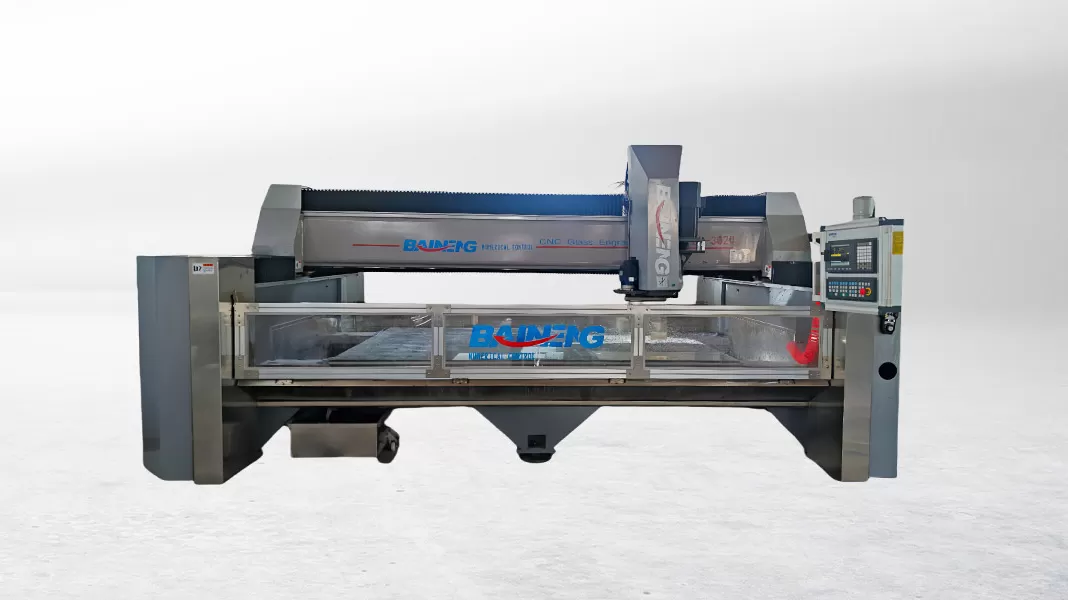
Symptoms: Deeper etching on the left side than right. Root cause: Beam power drop due to beam clipping or lens decentering; also, glass flatness variation >0.3 mm. Solution: Verify beam alignment with a thermal sensor card. For large-format etching (e.g., 1.2 m × 2 m glass), use a flying-optics system with dynamic autofocus. BAINENG CNC’s large-bed gantry systems include an integrated distance sensor that adjusts the Z-axis in real time, keeping the spot size consistent across the entire table.
Issue 4: Post-Etching Fragility and Glass Strength Loss
Symptoms: Finished parts break unexpectedly during handling or thermal cycling. Root cause: Micro-cracks act as stress risers, reducing flexural strength by 30-50%. Solution: Perform a chemical edge treatment (diluted hydrofluoric acid dip for 30 seconds) to etch away crack tips, followed by thorough neutralization. For non-critical applications, a simple flame-polishing pass (low-power CO₂ raster) seals the surface layer. Note: Flame polishing modifies dimensions slightly; test beforehand.
Common Industrial Applications of Laser-Etched Glass
Laser etching adds value across multiple B2B sectors by providing permanent, chemically resistant, and tamper-evident marks.
Automotive glazing: Etching VIN codes, heating grid alignment marks, and defroster patterns on rear windows. The process is integrated into assembly lines with cycle times under 12 seconds per panel.
Electronics and appliances: Marking logos, warning symbols, and serial numbers on glass control panels, oven doors, and refrigerator shelves. UV laser etching is preferred for thin tempered glass.
Pharmaceutical packaging: High-contrast 2D Data Matrix codes on borosilicate vials and ampoules for track-and-trace compliance. Lasers achieve cell-level readability even after sterilization.
Architectural and decorative glass: Custom patterns, gradients, and backlit signage. CO₂ laser engraving produces a smooth satin finish that does not trap dirt like sandblasting.
Scientific instruments: Graduation marks, logos, and optical alignment features on beakers, cuvettes, and flow cells. Laser etching offers sub-millimeter precision without weakening the glass structure.
Each application demands specific parameter libraries. Industrial users often maintain separate profiles for thickness variations, annealing states, and glass types (float, borosilicate, quartz).
Equipment Reliability: Why Industrial-Grade Laser Systems Outperform Desktop Units
While low-cost diode or small CO₂ lasers may etch glass sporadically, B2B operations require repeatability across thousands of parts per shift. Industrial systems differ in four critical aspects: beam quality (M² < 1.2), environmental sealing against glass dust, active cooling (water or chiller), and backlash-free motion stages. The integration of these features prevents drift in marking position and depth over extended runs.
BAINENG CNC designs its glass etching workstations with Class 1 enclosures, high-precision linear guides, and proprietary parameter libraries for more than 40 glass grades. The control software includes automated power calibration routines that compensate for tube aging, maintaining ±2% etch depth consistency over 8,000 operating hours. For users scaling from prototyping to volume production, this reliability translates to lower scrap rates and predictable maintenance intervals.
Frequently Asked Questions (FAQ)
Q1: Can any CO₂ laser cutter etch glass, or does it require special modifications?
A1: Basic CO₂ laser systems can etch glass, but results vary widely. For consistent, industrial-grade etching, you need three features: adjustable pulse frequency (to control thermal shock), a stable focal lens with air assist, and the ability to apply a temporary absorption coating. Without these, you risk surface spallation or faint marks. High-end systems from BAINENG CNC include pre-programmed glass etching cycles that automatically set frequency and power ramping.
Q2: What is the best laser wavelength for etching clear glass without a mask?
A2: Unmasked direct etching on clear glass is most effective with a CO₂ laser (10.6 µm) because the glass naturally absorbs this wavelength. However, for high precision without a mask, a 9.3 µm CO₂ laser offers even higher absorption in soda-lime glass, reducing the required power by ~30% and minimizing micro-cracks. UV lasers (355 nm) also work without a mask but are slower and costlier per watt.
Q3: How can I avoid glass cracking during etching, especially on thin sheets (1-2 mm thick)?
A3: For thin glass, employ three strategies: 1) Use a lower power setting (15-25% of rated power) and increase passes (2-4 passes). 2) Set a scan speed above 800 mm/s to prevent heat accumulation. 3) Apply a heat sink — place the glass on a silicone mat or aluminum block with thermal paste to draw away residual heat. Additionally, preheating the glass to 80-100°C reduces thermal shock sensitivity.
Q4: Does laser etching weaken the structural integrity of glass?
A4: Yes, any surface removal or thermal fracturing introduces stress concentrators. The degree of weakening depends on etch depth and crack density. Shallow etching (<50 µm depth) with a CO₂ laser reduces flexural strength by 15-25%. Deep engraving (>200 µm) may reduce it by up to 45%. Mitigation methods include flame polishing the etched area or applying a compressive ion-exchange coating after etching. For load-bearing glass components, we recommend testing samples per ASTM C158.
Q5: Can I etch curved glass surfaces like bottles or beakers with a standard flatbed laser?
A5: Flatbed lasers cannot maintain focus on curved surfaces unless a rotary attachment (4th axis) is fitted. The rotary chuck rotates the glass synchronously with the laser scan, keeping the focal distance constant. For irregular shapes (conical flasks), a 3D dynamic focusing system is required. BAINENG CNC offers plug-and-play rotary modules with diameter compensation software, allowing seamless etching on cylinders from 10 mm to 200 mm diameter.
Q6: What mask materials provide the highest contrast and edge sharpness for glass etching?
A6: For high-contrast black marks (not possible on clear glass, but for frosted contrast), a mixture of 70% water, 20% isopropyl alcohol, and 10% dish soap yields consistent results. For ultra-fine features (<0.2 mm line width), specialized laser marking sprays (e.g., CerMark or Enduramark) produce a durable white or dark mark after etching. However, these require a curing step and are more expensive than DIY masks. Always test adhesion on the specific glass type.
Q7: What is the typical etch depth range achievable with industrial CO₂ laser etching?
A7: With a 100W CO₂ laser and multiple passes, typical etch depths range from 20 µm (light frosting) to 400 µm (deep engraving for tactile feel). Beyond 400 µm, the risk of chipping grows exponentially. For deep lettering (e.g., braille signs), we recommend using a 150W CO₂ source with 3-4 passes and intermediate cleaning. Exact depth depends on glass composition — lead glass etches deeper at the same parameters than borosilicate.
Optimize Your Glass Etching Production Line Today
Integrating laser etching into your manufacturing workflow requires more than a machine — it demands process know-how, application testing, and ongoing support. Whether you are engraving thousands of glass panels per day or developing a new decorative product line, the correct parameter strategy and hardware reliability directly impact your yield and unit cost. BAINENG CNC provides turnkey solutions including machine installation, operator training, and custom parameter libraries for your specific glass types.
Our engineering team offers free sample processing: send your glass substrate and design files, and we will return etched samples with full process documentation. To discuss production volumes, automation options, or request a live online demonstration, please submit an inquiry through our official B2B portal. Provide your material specifications (glass type, thickness, desired throughput) and a technical consultant will respond within 24 business hours with a tailored solution proposal.
Contact our industrial sales team for a no-obligation consultation and process audit → Send Inquiry Now