
 FAQs
FAQs Factory Tour



For B2B glass fabricators, achieving a consistent, scratch-free surface finish on cut edges or broad sheets has traditionally required skilled manual labor. Manual polishing is not only slow but introduces variable quality—edge chips, uneven gloss, and microscopic surface fractures. Automatic glass polishing machines have transformed this operation by integrating programmable motion control, controlled abrasive application, and real-time feedback. This guide provides a technical evaluation of automatic glass polishing equipment, covering machine architectures, abrasive selection, common defect remediation, and selection parameters for flat glass, automotive glazing, and specialty thin glass applications.
Understanding the Mechanics of Automated Glass Polishing
Unlike grinding that removes bulk material, polishing aims to reduce surface roughness (Ra) to below 0.02 μm while generating a transparent, defect-free finish. Automatic glass polishing machines achieve this through a combination of rotating wheels or belts, precisely metered polishing compound (typically cerium oxide or diamond paste), and controlled normal force. The process involves three distinct phases: initial smoothing (removal of grinding scratches from previous sizing operations), final glossing (producing optical clarity), and edge arris finishing (rounding sharp corners to prevent chipping).
Rotary spindle polishers: Multiple independently driven heads (2 to 12 spindles) arranged on a linear or rotary indexing table. Each spindle holds a felt or polyurethane pad. These systems excel at polishing small to medium glass parts, such as smartphone covers, watch crystals, or decorative pieces.
Belt-type continuous polishers: Wide abrasive belts (100–1000 mm width) running over contact rollers. Glass sheets move through the machine on conveyor rollers or vacuum tables. Belt polishers are common for flat architectural glass up to 3 meters in width, processing both sides simultaneously in double-belt configurations.
CNC-controlled edge polisher: Designed specifically for glass edges. A typical unit includes a shaping wheel (rough grinding), a fine grinding wheel, and one or two polishing wheels using felt pads with cerium oxide slurry. The glass is held by clamps or suction cups while the polishing head follows the perimeter based on a CAD profile.
Most industrial automatic polishing lines now incorporate touchscreen HMI (human-machine interface) with recipe storage. Operators can recall parameters for different glass types—soda-lime, borosilicate, aluminosilicate—each requiring different polishing pressure, spindle speed, and abrasive flow rate. For example, aluminosilicate glass used in display covers demands a lower polishing pressure (0.15–0.25 MPa) to avoid surface pitting, whereas soda-lime architectural glass accepts up to 0.45 MPa.
Critical Performance Parameters for Automatic Glass Polishers
Selecting the best automatic glass polishing machine for a given production environment requires evaluating six engineering parameters. Below is a detailed breakdown.
2.1 Abrasive Delivery Method: Slurry vs. Fixed Abrasive
Cerium oxide slurry remains the standard for final gloss polishing due to its chemical-mechanical action on silica. Automatic systems integrate a recirculating slurry tank, pump, and distribution nozzles directly over each polishing pad. Key design features include a magnetic separator to remove glass debris (which would otherwise scratch the workpiece) and a viscosity controller that maintains consistent particle concentration. For high-speed edge polishing, fixed abrasive wheels (resin-bonded diamond or sintered felt impregnated with cerium) reduce consumable changeover time and eliminate slurry management. However, fixed abrasives produce a slightly lower gloss (75–85 GU) versus slurry (90–95 GU) on premium architectural glass.
2.2 Pressure and Speed Control Profiles
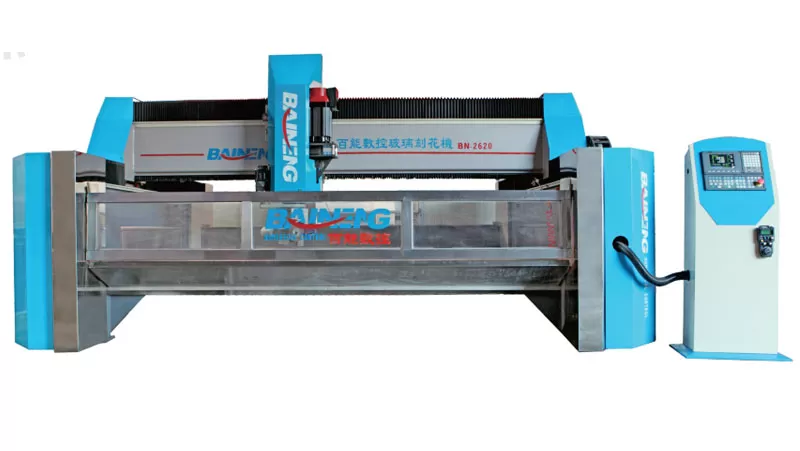
Automated polishing machines must regulate normal force and tangential speed to avoid thermal cracking or over-polishing. Advanced systems employ closed-loop force control with piezoelectric sensors beneath each polishing head. For instance, when polishing a 4 mm thick glass sheet, the pressure starts at 0.35 MPa during the smoothing phase, then reduces to 0.20 MPa for the glossing phase. Spindle speeds typically range between 800 and 2500 RPM; lower speeds with higher dwell time produce a smoother surface on soft glass types. Feed rate (for conveyor or gantry systems) is often set between 1.5 and 4 m/min. Machines such as those from BAINENG CNC integrate these parameters into a digital recipe system, allowing operators to switch between double-sided polishing of thin glass (<1 mm) and heavy-edge finishing of 12 mm thick balustrade glass without manual recalibration.
2.3 Cooling and Glass Debris Evacuation
Friction from polishing raises glass surface temperature, potentially causing thermal shock or micro-cracks. A closed-loop water cooling system directed at the polishing interface maintains temperatures below 40°C. The same water flow carries away glass particulates and spent cerium oxide. Industrial automatic polishers include a multi-stage filtration tank (sedimentation, cartridge filtration down to 5 μm, and optional diatomaceous earth filter) to recycle water. Without proper debris evacuation, particles trapped between the pad and glass create random deep scratches—a typical failure in low-cost machines. Look for machines with separate cooling nozzles positioned ahead of the polishing pad and a vacuum extraction slot immediately after the contact zone.
Industry-Specific Applications of Automatic Glass Polishing Machines
Different glass product categories impose distinct polishing requirements. Below are three major B2B sectors and their technical specifications.
Architectural and interior glass: Polished edges for shower doors, partitions, glass railings, and shelving. Requirement: edge gloss uniformity >85 units on a 60° glossmeter, with arris radius of 0.5–1.5 mm. Automatic double-edge polishers (vertical orientation) process sheets from 300×300 mm up to 2500×3600 mm. Some configurations add a beveling wheel for decorative beveled edges.
Automotive glazing: Side windows, rear screens, and laminated windshields. Automotive standards (ECE R43, ANSI Z26.1) mandate that edge chips larger than 2 mm are prohibited. Automatic polishing lines for automotive glass often combine rough grinding wheels (diamond, 180–240 grit) followed by two polishing steps with felt wheels. The entire cycle per piece is under 90 seconds for a typical side window. Edge strength after polishing must meet ≥70 MPa in four-point bending tests.
Electronics and thin glass: Cover glasses for tablets, instrumentation windows, and OLED substrates (thickness 0.3–1.1 mm). Polishing here requires warp control (<0.15 mm over 200 mm) and scratch-free surfaces under 20× magnification. Double-sided planetary polishing machines with upper and lower polishing plates rotating in opposite directions are standard. The polishing pressure is reduced to as low as 0.05 MPa, and the slurry particle size is tightly controlled to 1–2 μm.
For fabricators serving multiple sectors, flexible platforms such as those offered by BAINENG CNC allow swapping polishing heads (felt, polyurethane, or brush-type) and adjusting conveyor widths, reducing capital expenditure across product lines.
Troubleshooting Common Automatic Polishing Defects
Even with automated equipment, process deviations cause quality problems. The following table-style (in list format) provides technical root causes and solutions.
Problem: Random Deep Scratches After Polishing Stage
Root causes: Agglomerated cerium oxide particles, dried slurry chunks, or glass debris lodged in the felt pad. Resolution: Install a finer filtration system (10 μm absolute rating). Schedule automated pad cleaning cycles every 200 workpieces using a high-pressure water jet and vacuum suction. Replace pads when the surface hardness (Shore A) drops below 60 due to glaze build-up.
Problem: Edge Orange Peel or Frosted Appearance
Occurs most often on borosilicate glass (e.g., laboratory slide edges). Root cause: Insufficient polishing time or incorrect polishing compound—cerium oxide's chemical activity is lower on high-silica glasses. Resolution: Switch to a diamond-based polishing paste (1–3 μm particle size) applied to a short-nap felt wheel. Increase polishing pressure by 15% and reduce feed rate by 30%. For automation lines, add a second polishing station with softer pads and a silica-based colloidal suspension.
Problem: Non-Uniform Gloss Across the Glass Surface
Typical on wide flat glass polished by belt-type machines. Root cause: Uneven pressure distribution across the belt width due to worn contact rollers or misaligned platen. Resolution: Measure pressure profile using thin-film pressure mapping sensors every three months. Adjust pneumatic cylinders individually to achieve less than 5% variation across the belt. Replace the contact roller's rubber covering (80–85 Shore A durometer) every 2000 operating hours.
Many industrial systems from suppliers like BAINENG CNC include a built-in gloss measurement station that automatically rejects parts outside specification and logs the data for statistical process control (SPC). This closed-loop feedback allows the machine to adjust pressure or speed for the next workpiece.
.webp?t=1779268251270 "ScreenShot_2026-05-15_171524_850 (1)")
Selecting a Reliable Automatic Glass Polishing Machine: A B2B Checklist
Beyond comparing power ratings and work area dimensions, procurement decisions should include the following technical assessments:
Changeover time: How quickly can the machine switch between different glass thicknesses and edge profiles? Machines with quick-release polishing wheel hubs and recipe-driven servo adjustments for wheel height achieve changeovers under 10 minutes.
Consumable life monitoring: Does the system track cumulative polishing area and alert when felt pads or diamond wheels need replacement? Predictive maintenance reduces unplanned downtime.
Integration capability: Can the polisher be linked upstream to an automatic glass cutting/grinding line and downstream to a washing/drying station? Look for PLC communication via Profinet, EtherCAT, or Modbus TCP.
Safety and compliance: For wet polishing systems, check compliance with NFPA 79 (electrical safety in industrial machinery) and CE marking for the EU market. Enclosures must prevent slurry splash and contain rotating parts.
Request a process validation run using your glass samples before final purchase. Evaluate the edge quality under 30× magnification and measure gloss at five points per edge. An experienced supplier will provide a written parameter sheet and offer remote tuning support.
Operational Guidelines for Maximizing Throughput and Pad Life
Once the automatic polishing machine is installed, adhere to these operational practices:
Maintain slurry pH between 7.5 and 8.2. Acidic or alkaline slurry accelerates chemical wear on glass but can degrade polishing pad bonding.
Inspect water nozzles daily for clogging; a partially blocked nozzle leads to localized overheating and pad glazing.
Balance the polishing head spindle each time you replace a felt pad. Unbalanced spindles cause vibration marks (waviness) visible under glancing light.
Store spare felt pads in a humidity-controlled cabinet (40–50% RH). Dry felt becomes brittle and sheds fibers, contaminating the glass.
Frequently Asked Questions (FAQ)
Q1: What is the typical edge polishing speed for automatic glass polishers?
A1: For straight edge polishing on flat glass (e.g., 6 mm thickness), production speeds range from 2 to 8 meters per minute, depending on desired gloss level and the number of polishing heads. Single-head machines operate at 2–3 m/min; four-head sequential units reach 6–8 m/min. For small, complex shapes (curved edges), CNC-controlled polishers may run at 1 m/min to maintain accuracy.
Q2: Can an automatic glass polisher remove deep scratches (e.g., 100 μm depth)?
A2: Polishing alone cannot remove deep scratches because the material removal rate of polishing is extremely low (typically 1–2 μm per pass). Deep scratches must first be eliminated by a grinding stage (diamond abrasive, 400–800 grit). A full line usually includes grinding wheels, then finishing polishing wheels. Some advanced machines combine both stations in one frame. Without pre-grinding, polishing will only round the edges of the scratch, making it less visible but not eliminated.
Q3: What is the difference between wet and dry automatic glass polishing?
A3: Wet polishing uses water or water-based slurry as a coolant and debris carrier. It produces a superior finish (Ra <0.01 μm), extends pad life, and eliminates glass dust hazards. Dry polishing relies on extraction and bonded abrasives; it is faster but generates fine respirable silica dust (hazardous) and tends to leave micro scratches. For B2B high-volume production, wet polishing is nearly universal except for very small, portable units. Most automatic machines are wet-type with integrated water recycling.
Q4: How often should polishing pads be replaced on an automatic line?
A4: Felt pads impregnated with cerium oxide typically last for 1500 to 4000 linear meters of glass edge polishing, depending on glass thickness and pressure. For surface polishing (flat sheets), pad lifespan is measured in square meters (200–500 m²). Modern machines count both meters processed and pad rotation hours. Replace pads when the gloss value drops by 15% from baseline or when visible pad wear reduces effective contact area. Always replace in sets to maintain balanced pressure.
Q5: Is it possible to polish both edges of a glass sheet simultaneously?
A5: Yes, double-sided automatic polishers (also called twin-side or edge polishing lines) have two sets of spindles facing opposite edges. The glass sheet moves centrally between them, and both edges are processed in one pass. This design doubles throughput and guarantees symmetrical edge quality. However, for irregular shapes or very small parts (under 100 mm width), single-side sequential polishing may be more practical. Manufacturers such as BAINENG CNC offer both single-side and double-side configurations with automatic width adjustment.
Q6: Does automatic polishing affect the flatness of thin glass (under 0.5 mm)?
A6: Yes, excessive pressure can warp thin glass. Specialized double-sided planetary polishers apply extremely low pressure (0.02–0.08 MPa) and use porous polishing pads that float on a thin slurry film. These machines also incorporate non-contact thickness sensors that adjust platen spacing every few seconds. For sub-0.3 mm glass, some operations revert to chemical mechanical polishing (CMP) instead of traditional felt-based polishing, but CMP lines are significantly more expensive.
Selecting and operating automatic glass polishing machines requires careful matching of abrasive technology, pressure control, and workpiece handling to your specific glass types and production volumes. For fabricators seeking a partner with engineering support and application-specific customization, BAINENG CNC offers modular automatic polishing platforms—from compact edge polishers for job shops to complete double-sided lines for large-scale architectural glass production.
To receive a configuration recommendation and process test report based on your glass samples (size, thickness, edge profile, and required gloss value), send a technical inquiry to BAINENG CNC’s industrial glass division. Include your typical daily output and any existing upstream/downstream equipment specifications for integration advice.
Request a polishing parameter consultation → Contact BAINENG CNC (please attach glass type, dimensions, and edge finish targets).