
 FAQs
FAQs Factory Tour



The demand for high-precision decorative glass in interior design, architecture, and home appliances has led to a major transition in manufacturing methods. Manual cutting, etching, and grooving techniques are no longer sufficient to meet modern tolerance requirements and volume demands. Investing in a high-quality cnc glass v groove machine allows processors to meet these specifications by automating the engraving, grooving, and polishing processes on flat glass of varying thicknesses.
For glass fabrication facilities, selecting industrial-grade machinery is a decision that affects operational efficiency, product quality, and tooling costs over several years. Industrial platforms offered by manufacturers like BAINENG CNC are shifting the industry standard toward higher automation, improved rigidity, and reduced manual finishing requirements.
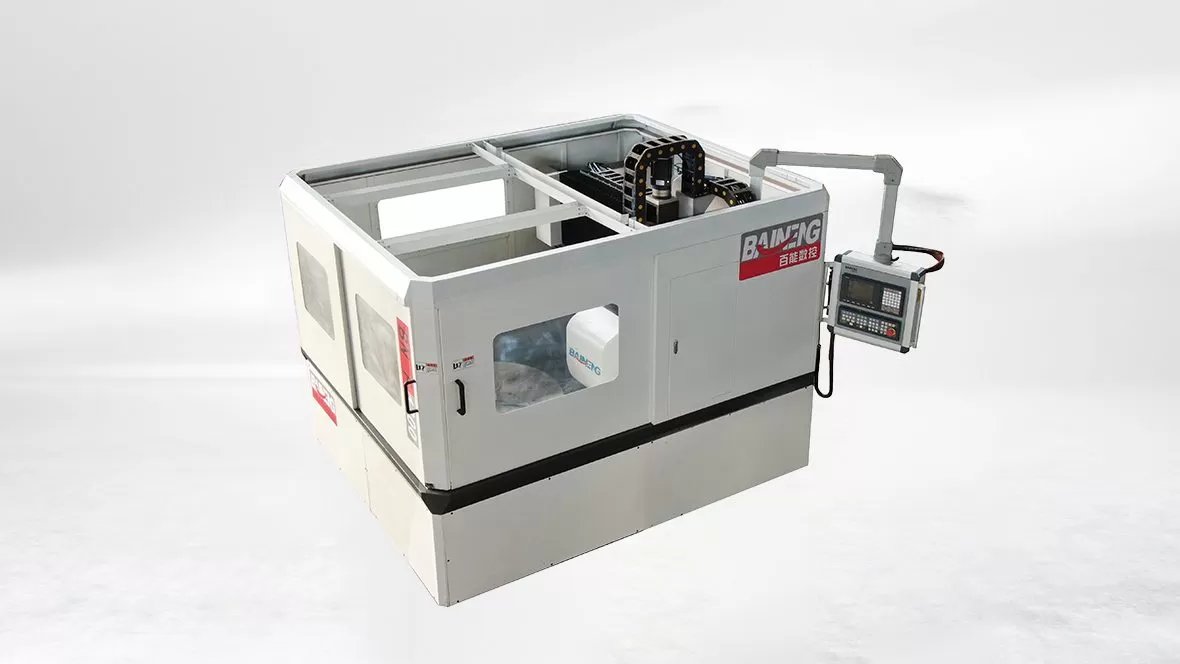
The Mechanics of Glass V-Grooving
To understand the value of automated grooving, it is necessary to examine the physical interaction between the tool and the glass substrate. Unlike metals or plastics, glass is a brittle material prone to micro-fractures, chipping, and thermal shock during machining. The process of V-grooving requires a balance of mechanical stability, precise spindle control, and managed coolant delivery.
Spindle Configurations and Power
The spindle is the core mechanical component of the machine. In glass processing, the spindle must maintain constant torque across different rotational speeds, typically ranging from 1,000 to 12,000 RPM. High-speed spindles allow for faster feed rates, but they also require robust bearings to prevent axial and radial runout. Any vibration in the spindle assembly directly translates to micro-cracks along the edge of the V-groove, which can lead to glass breakage during the subsequent tempering process.
Tooling and Diamond Wheels
The cutting tool typically consists of a diamond-impregnated wheel. These wheels come in various angles, such as 90 degrees, 135 degrees, or custom configurations, depending on the desired groove profile. As the wheel moves along the glass surface, the diamond grit grinds away the material. To maintain a clean finish, the machine must support both roughing wheels (for rapid material removal) and polishing wheels (to restore clarity to the grooved channel). Automatic tool changers (ATC) facilitate this transition without operator intervention, reducing cycle times.
Cooling Systems and Slurry Management
Glass grinding generates significant friction heat. Without adequate cooling, the localized thermal expansion will cause the glass to crack. Modern machines utilize internal and external cooling nozzles that direct a continuous stream of water or coolant directly to the contact point. Furthermore, the resulting glass slurry (a mixture of water and fine glass powder) is highly abrasive. Effective filtration systems are required to separate this slurry from the recycled water, protecting the linear guides, ball screws, and spindle seals from premature wear.
Addressing Common Industry Pain Points
Glass fabricators face several systematic challenges that affect their daily yields and operating margins. Identifying these issues helps in evaluating the capability of a cnc glass v groove machine to resolve them.
Chipping and Edge Micro-cracks
The most common defect in glass grooving is edge chipping. When the diamond wheel exits the glass edge or runs too deep, the mechanical stress exceeds the tensile strength of the glass. This issue can be mitigated through structural rigidity and advanced control software. The machine software must allow for variable feed rates, slowing down the tool at the entry and exit points of the cut to minimize mechanical shock. This is where the stability of a cnc glass v groove machine becomes apparent.
Machine Vibration and Geometric Accuracy
Over time, structural vibrations can cause the positioning accuracy of the X, Y, and Z axes to drift. A robust frame design is necessary to absorb these forces. Heavy cast-iron bases or tempered steel weldments provide the mass needed to damp vibrations. If a machine lacks this structural mass, the grooves will exhibit wavy patterns, inconsistent depths, and poor alignment, especially on large-format architectural glass sheets.
Software Compatibility and Setup Times
In a high-mix, low-volume production environment, setup times can limit overall throughput. Operators often waste hours converting customer CAD drawings into machine-readable code. Modern CNC control systems solve this by accepting direct DXF imports. The operator can assign specific tooling profiles, groove depths, and feed speeds directly from the control console, reducing the transition time between different batch designs.
High-Value Application Scenarios
The application of automated V-grooving spans several sectors, each with its own quality expectations and material constraints.
Architectural and Partition Glass: Large office partitions, sliding doors, and storefronts often feature geometric patterns grooved into the glass to create a decorative effect while maintaining structural integrity. Integrating a cnc glass v groove machine into an architectural glass fabrication line allows for consistent depth across spans exceeding three meters.
Frameless Mirrors and Furniture Glass: Decorative mirrors used in bathrooms, hotels, and wardrobes rely on polished V-grooves to catch and refract light. The grooved lines must be polished to a high sheen, which requires precise multi-pass programming using progressively finer polishing wheels.
Shower Enclosures: Tempered glass panels for shower cabins often feature subtle frosted or polished grooving. Because these panels undergo thermal tempering after processing, the grooves must be completely free of micro-cracks to prevent the panel from shattering in the tempering furnace.
Home Appliances and Electronics: Oven doors, refrigerator shelves, and control panels require precise, low-profile grooving for aesthetic framing and interface alignment. These components demand tight tolerances and clean edges.
Selecting and Maintaining a High-Performance Machine
Investing in capital equipment requires a thorough evaluation of the machine's technical specifications and the manufacturer's engineering standards.
Axes Configuration and Linear Motion
A standard configuration includes X, Y, and Z axes, but more complex designs may incorporate a rotating C-axis for curved and circular grooving. Linear motion should be guided by high-precision, pre-loaded linear guide rails and driven by AC servo motors coupled with ball screws. This setup ensures that the positioning accuracy remains within tolerances of ±0.05 mm over the entire worktable.
Worktable and Vacuum Clamping
The glass must be held completely flat and rigid during the grinding process. A vacuum table divided into multiple independent zones allows the machine to secure various sizes of glass panels without the need for complex mechanical clamps. The vacuum cups must be non-marking and adjustable to prevent scratching the bottom surface of the glass, particularly when processing low-E or coated glass varieties.
Structural Rigidity and Materials
Structural platforms designed by BAINENG CNC incorporate high-rigidity frames that undergo stress-relieving heat treatments during manufacturing. This process ensures that the frame does not warp or deform over years of continuous operation in wet, abrasive environments.
Routine maintenance is a key factor in extending the lifespan of the equipment. Daily procedures should include cleaning the linear guides, checking the lubrication reservoirs, and verifying the water filtration system's efficiency. Weekly inspections should focus on the spindle belt tension, the alignment of the vacuum cups, and the wear state of the diamond dressing blocks.
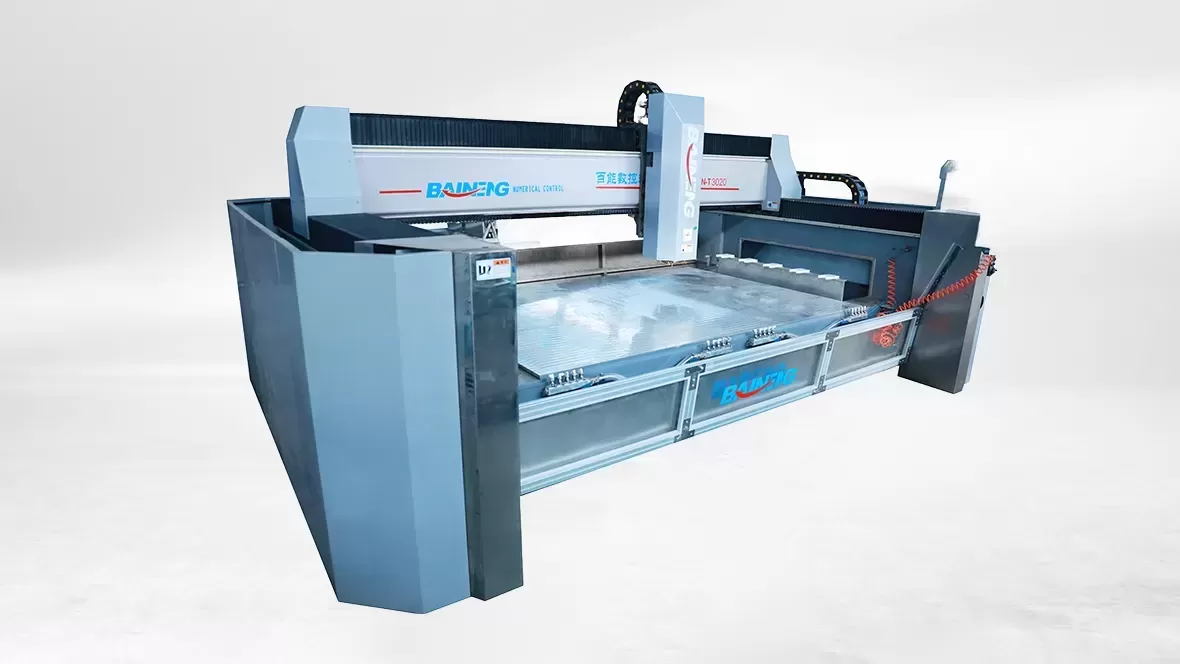
Detailed Specification Comparison
When comparing different models, production managers should look at the concrete parameters that define performance. The table below outlines typical specifications for standard, mid-range, and heavy-duty industrial grooving platforms.
| Parameter | Standard Duty | Industrial Grade | Heavy-Duty / High-Yield |
|---|---|---|---|
| Maximum Glass Size (mm) | 1300 x 2500 | 2500 x 3000 | 3000 x 5000 |
| Spindle Speed (RPM) | 0 - 8,000 | 0 - 10,000 | 0 - 12,000+ |
| Positioning Accuracy (mm) | ±0.10 | ±0.05 | ±0.03 |
| Tool Library Capacity | 4 - 8 Tools | 8 - 12 Tools | 12 - 24+ Tools |
| Total Power Consumption (kW) | 12 - 15 | 18 - 22 | 25 - 35 |
Frequently Asked Questions
Q1: What materials can be processed on a standard cnc glass v groove machine?
A1: These machines are primarily designed for flat glass sheets, including float glass, patterned glass, laminated glass, and low-E coated glass. They can also process silvered mirrors. However, the glass must be processed in its annealed state; tempered glass cannot be grooved or cut as it will shatter instantly due to internal stresses.
Q2: How does the machine handle different glass thicknesses?
A2: The vertical Z-axis is controlled by the CNC system, which reads the material thickness entered in the software program. High-precision sensors can also measure the actual thickness of the glass plate on the worktable, adjusting the tool height automatically to compensate for slight variations in the glass manufacturing tolerances.
Q3: What is the lifespan of the diamond wheels used in V-grooving?
A3: Tool life depends on several factors, including the glass thickness, feed rate, depth of the groove, and the quality of the cooling system. Generally, a high-quality diamond wheel can process between 1,500 to 3,000 linear meters of glass before requiring profiling or replacement. Regular dressing of the wheel helps maintain its shape and cutting efficiency.
Q4: Can this equipment create curved or custom-shaped V-grooves?
A4: Yes, provided the machine is equipped with an interpolating C-axis (spindle rotation) in addition to the standard X, Y, and Z axes. This allows the diamond wheel to rotate and remain tangential to the programmed path, enabling the fabrication of circles, ovals, S-curves, and custom artistic patterns.
Q5: What utility connections are required to install this machinery in a factory?
A5: A standard installation requires a stable three-phase electrical supply (typically 380V/50Hz or 460V/60Hz, depending on region), a consistent clean compressed air supply (minimum 6 bar) for pneumatic clamping and tool-change mechanisms, and a dedicated water recycling/filtration system to manage the cooling requirements and slurry collection.
Industrial Inquiries and Engineering Consultations
Selecting the appropriate machinery requires a detailed analysis of your production goals, material types, and floor space constraints. The engineering team at BAINENG CNC provides customized configurations, including customized table sizes, tool-changer capacities, and automation interfaces to fit your existing production lines.
For detailed technical specifications, quotation requests, or to schedule a processing demonstration with your specific glass samples, please submit a formal inquiry to our sales department. Our technical representatives will assist you in configuring a system that meets your operational requirements.