
 FAQs
FAQs Factory Tour



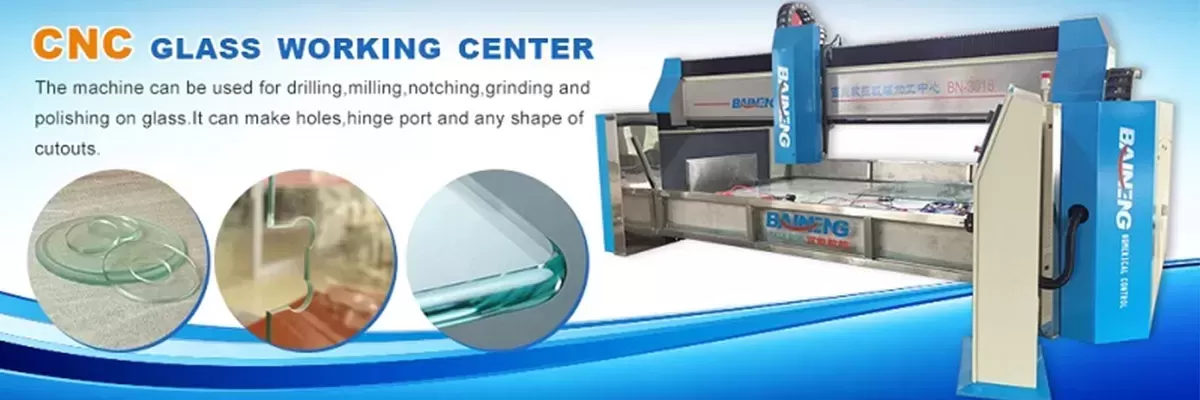
Industrial glass fabrication demands a high level of precision, repeatability, and structural integrity. From architectural facades and balustrades to home appliances and automotive glazing, the physical properties of glass present unique manufacturing challenges. Raw glass is brittle, highly sensitive to thermal shock, and prone to edge chipping during mechanical stress. To address these challenges, adopting a high-performance cnc glass processing center has become a standard approach for modern fabrication facilities looking to scale production while maintaining tight tolerances.
This article provides an in-depth analysis of the mechanical construction, operational parameters, software integration, and common processing difficulties associated with automated glass machinery. By understanding these functional elements, factory managers and purchasing directors can make informed decisions when upgrading their production lines.
Common Fabrication Bottlenecks in Industrial Glass Processing
Before examining automated machinery, it is necessary to identify the primary challenges faced during traditional or semi-automated glass processing. Glass cannot be machined in the same manner as metals or plastics. The abrasive nature of glass dust, combined with the material's structural fragility, introduces several operational problems:
Micro-Fracturing and Tempering Failures: Poorly drilled holes or rough edges contain microscopic cracks. When the glass enters the tempering furnace, these localized stress points expand rapidly under heat, leading to breakage inside the furnace. This results in material waste and downtime for furnace cleanup.
Rapid Tool Wear: Glass is highly abrasive. Without precise coolant delivery and correct feed rate adjustment, diamond milling bits and grinding wheels wear down prematurely, leading to dimensional drift and frequent tool replacements.
Inconsistent Edge Quality: Manual or semi-automated polishing processes rely heavily on operator skill. This leads to variations in the polish finish, particularly on thick glass panels or complex curved shapes.
Extended Setup Times: Transitioning between different glass thicknesses, shapes, and operations (such as moving from drilling to peripheral polishing) manually introduces significant downtime, reducing overall equipment effectiveness (OEE).
Structural and Engineering Principles of a CNC Glass Processing Center
A cnc glass processing center integrates multiple processing functions—such as cutting, milling, drilling, countersinking, and polishing—into a single machine footprint. To achieve high repeatability under continuous wet working conditions, the physical architecture of the machine must be engineered with specific design choices.
1. Machine Frame Rigidity and Vibration Dampening
The foundation of any high-precision glass machine is its bed. High spindle speeds combined with the resistance of grinding thick glass generate significant dynamic forces. Manufacturers like BAINENG CNC utilize heavy-duty cast steel frames that undergo stress-relieving heat treatments during manufacturing. A rigid frame minimizes structural deflection and dampens high-frequency vibrations, which is vital for preventing micro-cracks along the glass edge during grinding and polishing operations.
2. Guideway Protection and Sealing Systems
The water used for cooling glass machining operations contains fine, highly abrasive glass powder (silica slurry). If this slurry penetrates the linear motion components, it will rapidly destroy the linear guideways and ball screws. High-quality systems feature complete enclosure of the mechanical axes, utilizing stainless steel telescopic covers, bellows, and pressurized air seals. These seals prevent water ingress and maintain smooth, wear-free axis movement over long production lifespans.
3. High-Torque, Variable-Speed Spindles
The spindle is the core operational component of the machine. It must deliver consistent torque across a wide range of rotational speeds—typically from 0 to 12,000 RPM. Lower speeds are required for large-diameter drilling and heavy milling, while high speeds are necessary for high-gloss polishing with cerium-infused wheels. An integrated rotary joint inside the spindle allows high-pressure water to flow directly through the center of the tool, ensuring the cutting edge remains cool and lubricated during deep drilling and routing.
Functional Operations of Automated Glass Machining
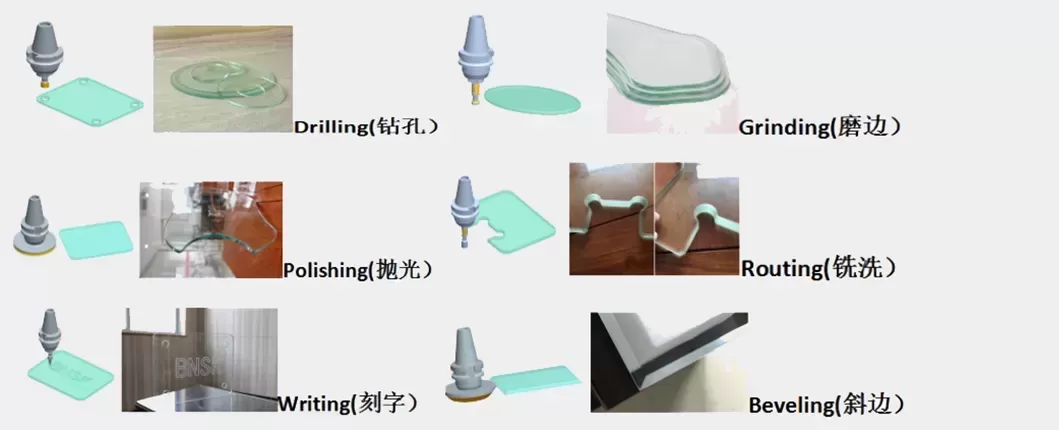
A multi-functional glass processing system handles several distinct operations sequentially without requiring the operator to reposition the glass sheet. This continuous workflow is governed by the CNC controller coordinating servo motors across the X, Y, and Z axes, and occasionally additional rotational axes (C and A axes) for complex beveling.
Edging and Arris Processing
Edging removes the sharp, raw edges of cut glass to make it safe for handling and to prepare it for tempering. The process typically involves three stages:
Coarse Grinding: Metal-bond diamond wheels remove bulk material and establish the basic profile (flat edge, pencil edge, or bevel).
Fine Grinding: Resin-bond wheels smooth out the rough grind, removing surface striations and preparation marks.
Polishing: Polyurethane or felt wheels, combined with polishing compounds or water, achieve a satin or high-gloss optically clear finish.
High-Precision Drilling and Countersinking
Drilling glass requires a dual-spindle configuration (opposing top and bottom spindles) to prevent breakout. The process is carefully sequenced: the bottom drill penetrates approximately halfway through the glass thickness, then retracts. The top drill then descends to complete the hole, meeting the initial cut in the middle. This method prevents the glass from fracturing on the exit side of the hole. Once the hole is drilled, countersinking tools can chamfer the edges to accommodate flush-mounted hardware.
Milling, Routing, and Internal Cutouts
For architectural glass used in frameless doors or shower enclosures, internal cutouts (hinge cutouts or "mouses") are frequently required. A segment tool or router bit cuts through the glass, interpolating along the programmed path. Because of the high lateral forces involved in routing, when configured within a multi-axis cnc glass processing center, these tools operate with advanced feed-rate interpolation software to slow down when negotiating tight corners, preventing localized stress buildup.
| Glass Thickness (mm) | Operation Type | Spindle Speed (RPM) | Feed Rate (m/min) | Coolant Pressure (Bar) |
|---|---|---|---|---|
| 4 - 6 | Flat Edging | 3,200 - 3,600 | 1.5 - 2.5 | 2.0 - 2.5 |
| 8 - 12 | Flat Edging | 2,800 - 3,200 | 1.0 - 1.8 | 2.5 - 3.0 |
| 15 - 19 | Flat Edging | 2,200 - 2,600 | 0.5 - 1.0 | 3.0 - 4.0 |
| 6 - 12 | Drilling (Ø 20mm) | 1,800 - 2,200 | 0.15 - 0.25 (axial feed) | 4.0 (Internal) |
Software Integration and CAD/CAM Compatibility
The mechanical capability of a machine is heavily dependent on the software that controls it. Modern glass fabrication plants rely on software that translates design drawings (commonly in DXF or DWG formats) into error-free G-code. The proprietary CAD/CAM software used by BAINENG CNC permits seamless importing of complex geometries, automatically identifying drilling coordinates, internal cutouts, and external perimeter paths.
Important software features to look for include:
Automatic Toolpath Generation: The software should automatically assign the correct sequence of tools—starting with drilling, then routing internal cutouts, and finishing with peripheral edging.
Tool Wear Compensation: As grinding wheels wear down, their diameter decreases. The control software must calculate this change and adjust the toolpath offset dynamically to ensure consistent glass dimensions over hundreds of cycles.
Collision Avoidance Simulation: Before initiating a cycle, the operator should be able to run a virtual simulation to verify that the spindle, suction cups, and mechanical holding clamps do not interfere with one another during rapid traverse moves.
Vacuum Cup Positioning Guides: The software calculates the ideal placement of the vacuum suction cups based on the glass geometry to provide maximum support while avoiding the toolpath of the spindle.
Selecting the Right CNC Glass Processing Center for Your Production Facility
Investing in a cnc glass processing center requires evaluating several operational variables to ensure the equipment matches your plant's specific throughput and product mix. Below are the key considerations for production managers:
1. Workpiece Dimensions and Machine Envelope
Determine the maximum and minimum glass sheet sizes your facility processes. Large architectural glass panels require a wide processing envelope with robust support systems. Conversely, processing small glass components for appliances requires precise positioning systems and specialized vacuum cup configurations to prevent thin glass from shifting under high grinding pressure.
2. Tool Storage Capacity and Automatic Changer (ATC) Speed
For high-mix, low-volume production, tool change times can bottleneck operations. A machine equipped with a fast automatic tool changer (ATC) containing 16 to 26 tool slots allows the machine to switch between drilling, grinding, and polishing tools without manual intervention. This minimizes idle time and keeps the spindle engaged in productive machining.
3. Water Filtration and Recirculation Requirements
A constant supply of clean water is crucial for high-quality polishing and extending tool life. If the recirculated water contains recycled glass particles, it will scratch the glass surfaces during polishing. Facilities must integrate a centralized water filtration system (centrifugal separators or flocculant dosing plants) to ensure the water supplied to the machine spindle is free of particulate matter.
Common Questions Regarding Automated Glass Processing
Q1: What is the primary difference between a 3-axis and a 4-axis glass processing center?
A1: A 3-axis machine moves along the linear X, Y, and Z axes, which is suitable for flat glass cutting, drilling, and standard edging. A 4-axis machine introduces a rotating C-axis, allowing the spindle to rotate continuous tools 360 degrees. This capability is required for complex shaped beveling, engraving, and polishing irregular contours where the tool angle must remain perpendicular to the glass edge.
Q2: What is the expected lifespan of tooling on a cnc glass processing center?
A2: Tool lifespan depends on factors such as feed rate, glass thickness, spindle speed, and coolant quality. Generally, metal-bond diamond grinding wheels can process several thousand linear meters before requiring redressing, while softer polishing wheels need more frequent dressing and replacement. Regular use of automatic tool dressing cycles integrated within the machine helps maintain consistent tool profiles and extends tool life.
Q3: How does the vacuum holding system secure varying shapes of glass?
A3: The work table of the machine features a grid system where operators place movable vacuum suction cups. These cups are positioned according to the glass geometry. A high-volume vacuum pump holds the glass firmly in place during machining. For small or narrow glass pieces where vacuum area is insufficient, mechanical pneumatic clamps are used in conjunction with the suction cups to prevent lateral movement.
Q4: Can a single machine process both laminated and monolithic tempered glass?
A4: Yes, but with distinct operating parameters. Monolithic annealed glass is easily machined, drilled, and ground prior to tempering. Laminated glass, which contains an inner plastic layer (such as PVB or SGP), requires adjusted feed rates and specialized routing parameters to prevent the polymer interlayer from melting or tearing during the cutting and milling process.
Q5: What daily maintenance is required to ensure machine accuracy?
A5: Daily maintenance includes clearing glass sludge from the work surface, checking water pressure and filtration levels, inspecting the central lubrication system for axis guides, and cleaning the spindle taper to prevent debris from causing tool runout. Weekly checks should include inspecting vacuum lines for leaks and testing axis calibration.
Technical Partnership and Inquiries
Integrating advanced automation into your glass fabrication line requires a clear understanding of your production volumes, material constraints, and floor space. Choosing an experienced machinery supplier ensures that your equipment is configured correctly for your exact product specifications.
To learn more about how a high-performance cnc glass processing center can improve your production yield and reduce manual processing steps, contact the engineering team at BAINENG CNC today. We can assist you with custom machine specifications, cycle time calculations for your specific glass parts, and layout planning for your production facility. Please submit your technical requirements and production targets to receive a detailed system proposal.