
 FAQs
FAQs Factory Tour



Industrial glass fabrication has shifted from mechanical hand-scribing and manual edge grinding to automated computer numerical control systems. Machining glass requires a thorough understanding of brittle material mechanics. Unlike ductile metals, which form continuous chips under shear stress, glass exhibits high hardness, low fracture toughness, and extreme susceptibility to crack propagation. Achieving micron-level precision requires rigorous control over tool geometry, mechanical vibration, coolant dynamics, and specialized feed-and-speed parameters.
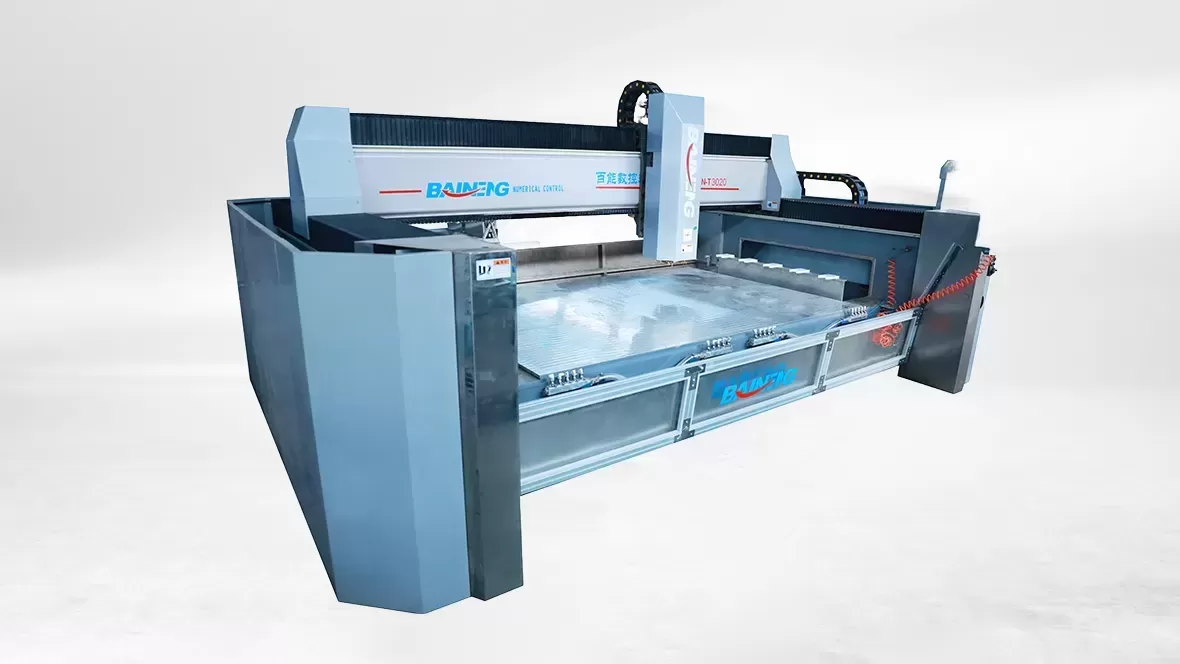
Modern glass cnc cutting centers integrate CAD/CAM software, multi-axis motion controls, and specialized diamond-abrasive tooling. These systems perform complex cutting, shaping, drilling, milling, and polishing operations on a single platform. This guide examines the structural physics, software parameters, material behaviors, and machine features required to optimize CNC glass processing for high-yield B2B manufacturing.
1. Structural Mechanics of Glass CNC Cutting
To machine brittle amorphous solids like soda-lime or aluminosilicate glass without catastrophic structural failure, processing parameters must operate within strict brittle-to-ductile transformation limits or utilize controlled abrasive micro-chipping.
Abrasive Material Removal vs. Direct Shearing: Cutting metals relies on single-point cutting tools shearing the material. Glass CNC cutting relies primarily on diamond-impregnated rotary tools. These tools remove material through high-frequency micro-fracturing and micro-grinding, preventing macro-cracks from propagating across the pane.
Stress Concentration and Micro-Fissures: Mechanical stress concentrated at the contact point between tool grit and glass can induce subsurface micro-cracks (Griffith flaws). Precise spindle RPMs combined with controlled feed rates limit lateral tensile stress, keeping micro-fissures within the localized grinding zone.
Coolant Hydraulics and Thermal Shock Mitigation: Glass has low thermal conductivity. Uneven localized heating during grinding creates thermal expansion gradients, leading to thermal shock and sudden fractures. High-pressure liquid coolant channels directly flush micro-debris (glass swarf) out of the cutting zone, cooling the contact region and preventing tool loading.
2. Process Architecture: From CAD Design to Multi-Axis Control
The transition from a two-dimensional engineering drawing to a fully machined, edge-polished glass component involves synchronized hardware and software execution.
Step 1: CAD/CAM Toolpath Generation
Engineers design components using CAD software, defining internal cutouts, radii, edge bevels, and countersunk holes. Specialized CAM post-processors convert these geometries into G-code toolpaths, specifying spindle speeds, linear feed rates, plunge vectors, and tool change sequences tailored to glass hardness and thickness.
Step 2: Workholding and Vacuum Fixturing
Securing brittle glass flat without inducing bending stress is critical. CNC glass working centers utilize high-flow vacuum suction cups mounted on precise aluminum or steel tables. Mechanical positioning pins automatically locate raw sheets, while zoned vacuum matrices clamp the substrate during heavy lateral tool engagement.
Step 3: Multi-Axis Motion Control
Modern CNC systems utilize multi-axis controllers—such as the high-speed Taiwan Syntec control system—to execute dynamic acceleration and deceleration algorithms across X, Y, Z, and C axes. Smooth vector interpolation prevents tool chatter at corners and curves, maintaining edge quality across complex profiles.
Step 4: Real-Time Automatic Tool Wear Compensation
Diamond abrasive wheels wear down continuously during long production cycles. Uncompensated wheel wear degrades dimensional tolerances and alters edge profiles. Industrial machines, such as the BAINENG CNC Glass Working Center, feature integrated automatic tool wear compensation. The controller dynamically measures tool radius decay and recalibrates axis offsets in real-time, maintaining strict dimensional tolerances without operator intervention.
3. Key Machining Operations in Glass Processing
A single CNC glass working center can perform multiple distinct operations through automatic tool changers (ATC) and versatile toolhead options:
Precision Profiling and Edging: Machining raw glass edges into functional shapes, such as flat edges with arris, pencil edges (C-shape), or decorative bevels. Edge profiling reduces peripheral stress concentrations, increasing the flexural strength of tempered glass.
Internal Milling and Cutouts: High-speed diamond routing bits plunge and interpolate to create interior cutouts for door hinges, outlet sockets, and architectural hardware fittings without cracking the surrounding pane.
Core Drilling and Countersinking: Opposed top-and-bottom drill spindles or specialized single-spindle helical diamond drills cut clean holes for fasteners, hinge pins, and waterjet access points, preventing breakout on the exit surface.
Grooving and Pocketing: Cutting defined channels and recessed areas into thick glass substrates to accommodate structural gaskets, seals, or embedded LED channels.
Edge Polishing: Utilizing sequential diamond grit steps followed by cerium oxide or resin-bonded polishing wheels to transform ground matte surfaces into optically clear edges.
4. Material Matrix: Machining Characteristics of Glass Types
Different glass compositions require adjustments to feed speeds, tool grit size, cooling strategy, and mechanical feed rates due to variations in hardness and thermal stability.
Soda-Lime Glass
The standard substrate for architectural windows, architectural facades, and furniture. Easy to machine, but prone to micro-chipping if feed rates are excessive. Requires consistent water cooling and balanced tool pressure.
Borosilicate Glass
Offers high thermal shock resistance and low thermal expansion coefficient. Widely used in optical components and lab equipment. Requires fine-grit diamond tools and precise spindle speeds to avoid surface fracturing during deep pocketing.
Aluminosilicate Glass
Exhibits high intrinsic mechanical yield strength, commonly used for high-strength displays and protective cover plates. Requires slow feed rates and precise spindle control to maintain structural integrity across thin profiles.
Fused Silica / Quartz Glass
Extremely hard with high purity, used in semiconductor wafer carriers, UV optics, and aerospace components. Demands specialized heavy-duty machine beds, high-torque spindles, and micro-grain diamond tooling to prevent rapid tool degradation.
5. Optimizing Tooling Parameters for Zero-Defect Production
Achieving defect-free glass cnc cutting requires balancing spindle torque, feed rate, diamond grain size, and mechanical dampening. The table below details recommended engineering baselines for processing standard architectural and technical glass:
Spindle Speed (RPM): Typically operates between 6,000 and 12,000 RPM for edge grinding, and up to 18,000+ RPM for small-diameter core drilling and internal routing. Higher RPMs reduce chip load per diamond grain, yielding smoother surface finishes.
Feed Rate (mm/min): Varies according to glass thickness. Thin glass (3mm–6mm) allows linear feed rates of 1,500 to 3,500 mm/min. Thick structural glass (12mm–19mm) requires slower feeds (500 to 1,200 mm/min) to prevent tool deflection.
Diamond Grit Size: Coarse grit (60–100 mesh) maximizes material removal during initial roughing; fine grit (200–400 mesh) removes subsurface fractures prior to polishing.
Coolant Pressure and Flow: Internal spindle coolant delivery at 3–6 bar directly flushes tool contact points, clearing slurry and preventing local overheating.
6. Industrial Applications for High-Precision Glass Machining
Standardized automated glass processing supports critical high-precision industries:
LED Mirrors and Sanitary Glass: Fast, repeatable edge beveling, drilling, and custom shaping for high-volume LED bathroom mirrors, vanity tops, and frameless shower enclosures.
Architectural Glazing & Balustrades: Heavy-duty cutouts and polished structural edges for tempered glass facades, curtain walls, stair balustrades, and retail storefronts.
Automotive Glazing: High-speed contouring and hole drilling for complex curved windshields, side windows, and side-view mirrors.
Electronics and Touch Displays: Micro-machining protective glass covers, medical equipment displays, and industrial control interfaces requiring strict positional tolerances.
Furniture and Interior Design: Complex custom profiles, frosted patterns, and polished edges for glass tabletop assemblies, shelving, and partitions.
7. Advanced Equipment Integration: The BAINENG CNC Solution
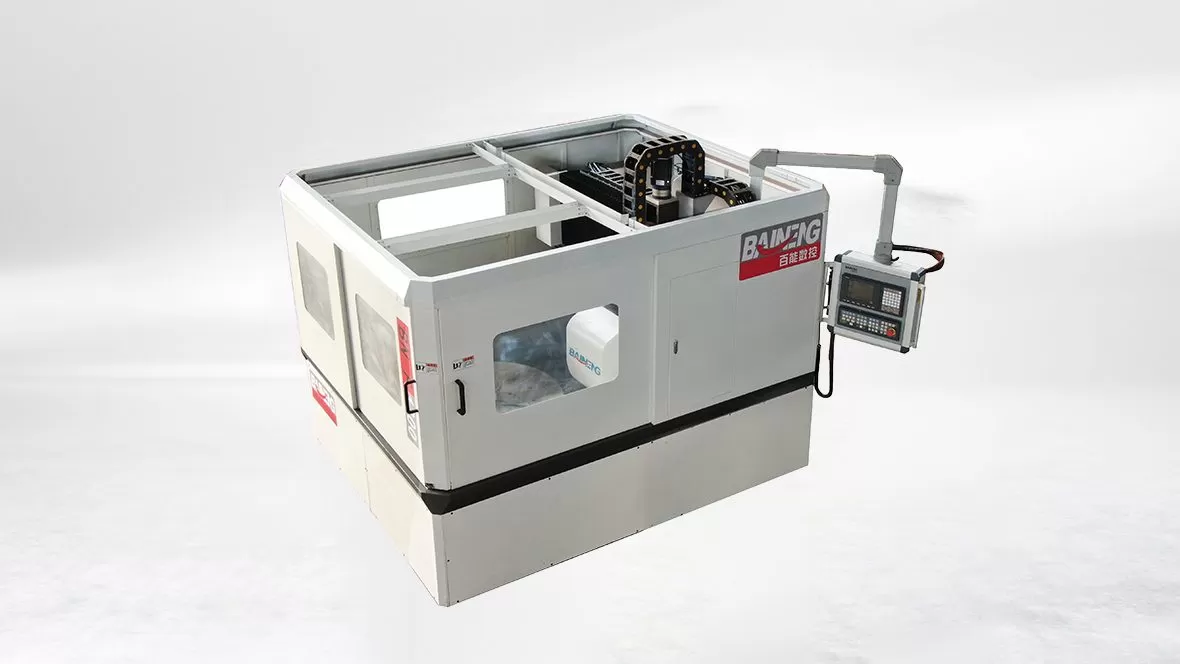
High-yield glass fabrication requires machines that combine structural rigidity, intelligent CNC control systems, and intuitive CAD/CAM integration. The BAINENG CNC Glass Working Center addresses core glass machining challenges through advanced engineering features:
Taiwan Syntec Control System: Provides dynamic multi-axis motion control, real-time speed adaptation, and high-speed processing capabilities.
Integrated BAINENG Software Suite: Native CAD support converts parametric drawings directly into optimized G-code toolpaths, automatically selecting the most efficient tool sequences and travel routes.
Automated Tool Compensation: Continuous dynamic measurement accounts for wheel wear during high-volume production, ensuring uniform edge profiles across batch runs.
Multi-Function Workstation Execution: Combines frosting, beveling, edging, milling, drilling, profiling, and polishing into a single production cycle, eliminating manual glass transfer between multiple single-purpose machines.
Frequently Asked Questions
What primary operational factors cause glass to chip during CNC milling?
Edge micro-chipping occurs when tool feed rates exceed material removal limits, spindle speeds are too low, or the tool experiences dynamic runout. Inadequate coolant flow can also build heat, leading to localized micro-fractures. Adjusting toolpaths, utilizing finer grit diamond tools, and increasing coolant pressure resolve these issues.
How does automatic wheel compensation improve dimensional accuracy in glass CNC cutting?
As diamond wheels grind glass, abrasive grit wears away, gradually reducing wheel radius. Without software adjustment, finished glass dimensions drift over time. Systems like the BAINENG CNC automatically adjust tool offset parameters based on calibrated wear curves, maintaining consistent dimensional control across large production runs.
Can tempered glass be machined using a CNC glass cutting system?
No. Tempered glass contains locked-in surface compressive stress and internal tensile stress equilibrium. Any surface mechanical processing, drilling, or milling breaches this stress layer, causing the pane to instantly shatter. All CNC cutting, milling, drilling, and edging operations must be completed on raw glass *prior* to thermal or chemical tempering.
What coolant type is recommended for industrial CNC glass working centers?
Water-soluble synthetic cooling lubricants mixed with water are standard. Water acts as a high-heat-capacity coolant, while synthetic rust inhibitors and flocculants protect machine ways, speed up swarf settling in coolant tanks, and improve edge surface smoothness.
How do diamond tool requirements differ between glass scribing and CNC abrasive milling?
Glass scribing utilizes a single-point diamond or carbide cutter wheel to score a shallow surface stress line, followed by mechanical breaking along the score. CNC abrasive milling uses high-speed rotary tools embedded with diamond grit to grind away material directly, enabling complex 2D/3D shapes, cutouts, holes, and polished edges that scribing cannot produce.
Upgrade Your Industrial Glass Processing Operations
Precision glass processing requires high machine stability, intelligent control systems, and optimized toolpath software. BAINENG CNC engineers complete CNC glass working centers designed for demanding industrial environments, supporting applications from architectural glass and LED mirrors to furniture and automotive components.
Contact the BAINENG CNC engineering team today to discuss your production metrics, request custom toolpath simulations, or receive a customized quote for your manufacturing facility.