
 FAQs
FAQs Factory Tour



The glass processing industry has experienced significant technological shifts, moving from manual, labor-intensive crafting methods to automated, high-precision computer numerical control (CNC) systems. For businesses, fabrication shops, and small enterprises entering this sector, identifying the appropriate entry-level glass etching machinery is a fundamental step. The selection process involves balancing technical capability, mechanical stability, and operational complexity to ensure a sustainable return on investment.
This analysis examines the primary glass etching technologies suitable for beginners, focusing on technical specifications, material interactions, operational challenges, and practical machinery configurations for modern industrial applications.
Understanding Glass Etching Technologies
Before selecting a machine, it is necessary to understand the distinct physical and chemical methods used to etch and engrave glass surfaces. Each technology offers specific advantages regarding surface finish, processing speed, and compatibility with different glass compositions, such as soda-lime, borosilicate, or tempered glass.
1. CO2 Laser Engraving and Etching
CO2 laser systems, operating at a typical wavelength of 10.6 micrometers, are widely utilized for surface marking and shallow etching on glass. The process relies on thermal interaction. When the laser beam strikes the glass surface, the localized rapid heating and subsequent cooling cause microscopic fractures (micro-cracking) in the material. This creates a frosted, matte appearance.
Wavelength: 10.6 µm is highly absorbed by silica-based glass.
Precision: High spatial resolution, capable of reproducing intricate vector graphics and high-density raster images.
Limitations: Depth of engraving is limited. Improper parameter calibration can lead to thermal stress, resulting in macro-fractures or surface flaking.
2. Mechanical CNC Engraving
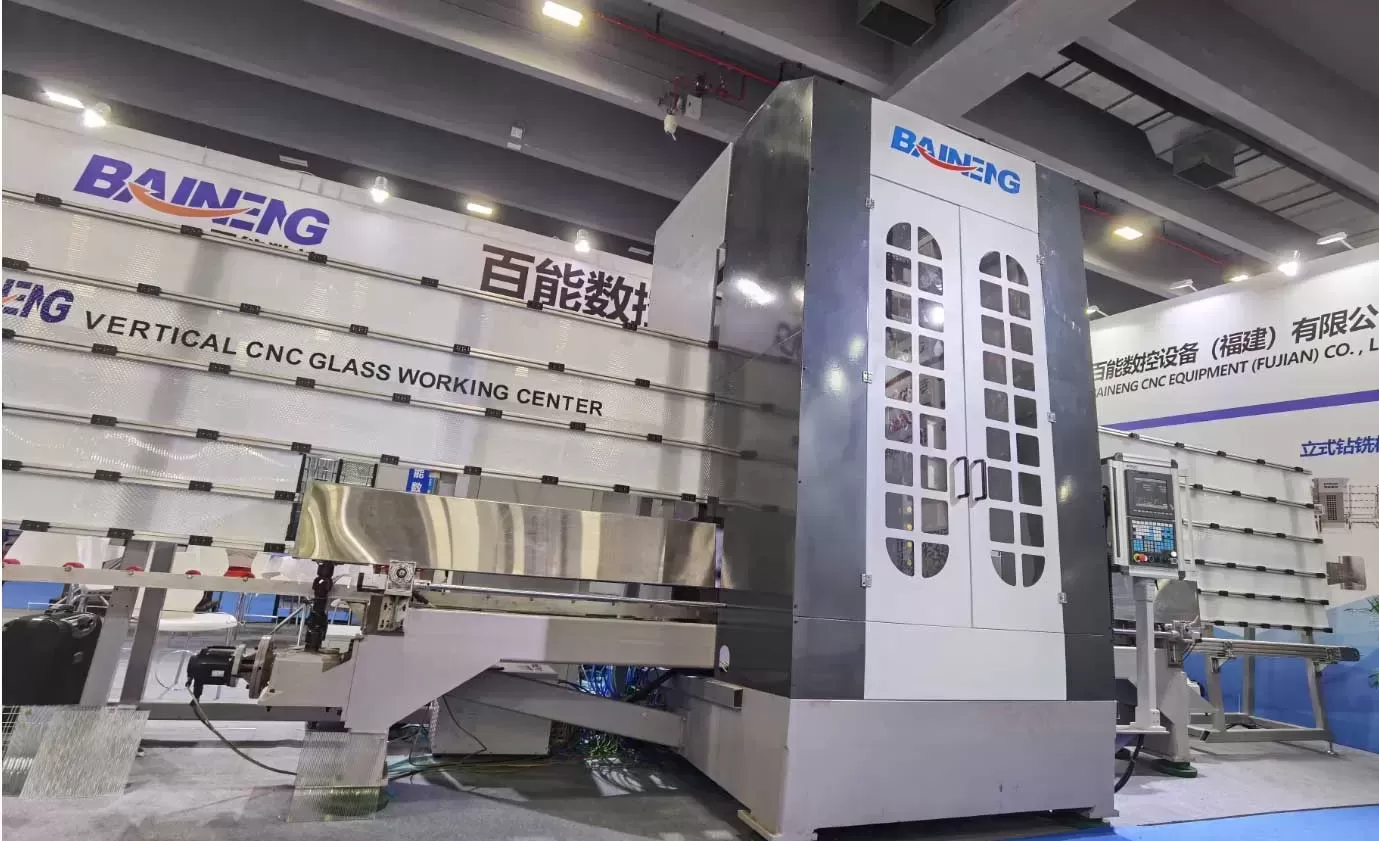
Mechanical CNC engraving utilizes physical cutting tools, such as diamond-tipped drag bits or rotating diamond abrasive burs, to physically remove material from the glass surface. This method is highly effective for deep grooves, V-grooves, and structural engraving. Modern mechanical systems, such as those engineered by BAINENG CNC, use high-speed spindles and precise multi-axis motion control to achieve clean, polished, or frosted cuts depending on the tool geometry and feed rate.
Material Removal: Mechanical shearing and abrasion under continuous liquid cooling.
Depth Control: High capability for deep, three-dimensional engraving and profiling.
Tooling: Requires diamond-impregnated or electroplated carbide tools designed specifically for hard, brittle materials.
3. Abrasive Sandblasting Systems
Sandblasting involves propelling abrasive media, such as silicon carbide or aluminum oxide, via compressed air through a nozzle onto a masked glass surface. While partially manual, automated sandblasting cabinets represent a viable entry-point for uniform frosted textures across large surface areas.
Surface Texture: Achieves a highly uniform, deeply frosted finish.
Depth: Variable, controlled by exposure duration and air pressure.
Operational Requirement: Demands robust masking procedures and extensive dust filtration systems.
Key Technical Parameters for Beginners to Evaluate
When selecting a glass etching machine, beginners must look past marketing terms and focus on verifiable mechanical and electrical specifications. These parameters directly influence processing quality, machine longevity, and overall operational efficiency.
Spindle Dynamics and Motor Configurations
For mechanical CNC etching machines, the spindle is the core component. High rotational stability is required to prevent tool chatter, which causes edge chipping on glass. Look for brushless AC spindles with variable speed controls. For glass processing, spindle speeds between 6,000 RPM and 24,000 RPM are standard. The drive system should ideally utilize high-precision stepper motors or, preferably for industrial applications, AC servo motors coupled with ball screws on all axes to ensure positioning accuracy within +/- 0.05 mm.
Laser Source Quality and Wattage
For laser-based etching, the power output of the CO2 laser tube must be carefully selected. For marking and etching, high wattage is not required; in fact, excessive power can cause thermal stress and crack the glass. A laser source with a power rating between 40W and 80W is optimal for glass engraving. Sealed glass CO2 tubes offer a cost-effective entry point, while RF (radio frequency) metal tubes provide a more stable beam profile and longer operational lifespans.
Cooling and Slurry Management Systems
Glass grinding and mechanical etching generate significant heat and highly abrasive glass dust (silica slurry). A mechanical glass etching machine must feature an integrated water-cooling delivery system that floods the cutting zone. This fluid lubricates the tool, cools the glass interface to prevent thermal fracture, and flushes away the abrasive slurry. Ensure the machine features a multi-stage settling tank or filtration system to protect pumps and prevent recirculating glass particles from damaging mechanical linear guides.
Control Interface and G-Code Compatibility
The control system represents the primary interaction point for the operator. Industrial controllers should support standard G-code generation from common CAD/CAM software platforms. Systems that accept standard DXF, DWG, and vector formats simplify the workflow. For beginners, intuitive user interfaces that allow for real-time feed rate and spindle speed overrides are highly beneficial during the initial testing and calibration phases.
Addressing Common Operational Challenges in Glass Etching
Engraving glass presents unique challenges compared to softer materials like wood, acrylic, or soft metals. Understanding these challenges helps in configuring the correct machinery setup from the start.
1. Micro-Chipping and Thermal Cracking
Glass is isotropic and brittle, meaning it lacks slip planes to accommodate
plastic deformation before fracture. Under mechanical stress or excessive laser
heat, the surface is prone to micro-chipping.
Solution: In
mechanical CNC processing, utilize continuous liquid coolant and choose tools
with appropriate diamond grit sizes. In laser processing, applying a thin, damp
paper mask or a light layer of liquid dish soap over the engraving area can help
dissipate heat evenly, minimizing thermal shock.
2. Rapid Tool Wear
The high hardness of silica glass causes rapid abrasive wear on mechanical
cutting tools. Dull tooling increases cutting forces, leading to poor finish
quality and higher rates of glass breakage.
Solution: Monitor tool
mileage and establish routine replacement schedules. Employing rigid machine
structures, such as those built by BAINENG CNC, minimizes vibration and spindle
runout, which extends the operational life of diamond-tipped tools.
3. Workpiece Hold-Down and Stability
Any movement of the glass pane during engraving will cause tool breakage or
inaccurate cuts. Due to the smooth surface of glass, standard mechanical clamps
must be configured with rubber or polymer pads to prevent point-loading stress
that could shatter the workpiece.
Solution: Vacuum table systems
equipped with rubber suction cups are the industrial standard for flat glass
engraving. They provide uniform downward pressure without inducing localized
stress zones.
Comparing Equipment Types for Startup Classifications
To assist businesses in determining the appropriate equipment class, the table below outlines the primary configurations suitable for entry-level and scaling operations.
| Machine Category | Primary Application | Pro | Con |
|---|---|---|---|
| Desktop CO2 Laser | Shallow surface etching, personalization, small-format signage | Non-contact process, low tooling costs, fast processing speeds | Limited depth, no 3D profiling capabilities, risk of micro-fracturing |
| Small-Format CNC Engraver | Deep V-grooving, structural etching, functional glass components | Precise depth control, clean mechanical edges, high structural rigidity | Requires constant liquid coolant, higher initial mechanical complexity |
| Automated Abrasive Cabinet | Large-area frosting, architectural panels, deep relief carving via stencils | Highly uniform surface finish, excellent depth variation via air pressure control | Requires external dust collection, manual stencil prep is time-consuming |
Why Machine Frame Rigidity Matters
For mechanical CNC etching, the frame construction of the machine is a major factor in determining finished part quality. Glass cannot absorb vibrations; instead, structural vibrations are transferred directly to the tool-material interface, resulting in micro-fractures along the engraved edge. High-quality machinery utilizes heavy cast-iron or thick-walled welded steel gantry frames that are stress-relieved through heat treatment. This ensures that the high-frequency vibrations generated by the high-speed spindle are dampened effectively, allowing for clean, polished engraving paths even at higher feed speeds.
Integrating Professional Software Workflows
A successful glass etching setup requires a reliable software chain. The workflow generally proceeds as follows:
Design Generation: Utilizing vector graphic software or CAD programs to generate high-precision lines and contours.
CAM Processing: Importing the vectors into CAM software to define toolpaths, select spindle speeds, feed rates, and entry/exit vectors. For glass, ramp-in strategies are preferred over direct plunge cuts to minimize initial impact stresses.
Machine Execution: Transferring the G-code to the CNC controller. Accurate simulation features within the controller software help beginners visualize the toolpath before executing the physical cut, preventing costly material wastage and tool collisions.
Concluding Considerations for Industrial Integration
Selecting the best glass etching machinery for beginners requires evaluating technical specifications against production goals. While lasers provide speed and fine detail for shallow surface work, mechanical CNC systems provide the depth, edge quality, and versatility required for architectural, industrial, and decorative glass manufacturing. Investing in a platform with robust structural dampening, efficient coolant management, and an accessible control system reduces the learning curve and ensures long-term process reliability.
For organizations looking to integrate professional-grade glass processing capabilities, BAINENG CNC develops high-performance mechanical glass engraving and working centers designed to meet the demands of both growing workshops and large-scale manufacturing facilities.
Industrial Inquiry and Technical Consultation
Are you looking to integrate professional glass etching, engraving, or processing systems into your production line? Contact our engineering team today to receive a detailed technical consultation. We can assist you in selecting the correct machinery configuration, optimizing tool selections, and tailoring processing parameters to match your specific application requirements.
Frequently Asked Questions
Q1: What is the primary difference between laser glass etching and mechanical CNC glass etching?
A1: Laser glass etching is a thermal, non-contact process that uses a CO2 laser beam to create micro-fractures on the surface, resulting in a frosted appearance with limited depth. Mechanical CNC glass etching is a contact process utilizing rotating diamond tools under liquid coolant to physically grind and remove glass material, enabling deep grooves, V-shapes, and highly polished structural engravings.
Q2: Can standard soda-lime glass and tempered glass both be etched mechanically?
A2: Standard annealed soda-lime glass can be etched both mechanically and thermally. However, tempered glass cannot be mechanically engraved or cut deeply because the mechanical stress will disrupt the balanced internal tension, causing the entire pane to shatter. Tempered glass can only receive very shallow laser surface etching or light sandblasting.
Q3: Why is liquid coolant required for mechanical glass etching?
A3: Liquid coolant is required for two reasons: thermal management and lubrication. It prevents the localized glass temperature from rising, which would cause thermal cracking. Additionally, the fluid flushes away the highly abrasive glass slurry from the cutting zone, protecting the diamond tool from premature wear and maintaining cut quality.
Q4: How do I prevent edge chipping when mechanical engraving begins?
A4: Edge chipping can be minimized by utilizing a CAM toolpath that employs "ramp-in" or helical entry strategies rather than direct vertical plunge cuts. Additionally, maintaining high spindle speeds, reducing the initial feed rate during tool entry, and ensuring the machine spindle has low radial runout will significantly reduce chipping.
Q5: What safety systems are required when operating glass etching machines?
A5: For laser systems, class-compliant enclosures and dedicated fume extraction systems are required to handle vaporized particulates. For mechanical CNC systems, fully enclosed work cabins are recommended to contain coolant spray and prevent exposure to airborne silica dust. In all cases, appropriate personal protective equipment (PPE), including eye protection and respiratory masks, should be worn during maintenance and slurry disposal.