
 FAQs
FAQs Factory Tour



Selecting a high-performance CNC glass engraving machine for a production environment requires more than comparing brochure specifications. The “best” machine for a glass fabrication shop depends on material types (float, low-iron, borosilicate, or laminated glass), required throughput, geometric complexity (2.5D pocketing vs. full 5-axis undercut carving), and long-term process stability. This guide provides a technical framework to evaluate industrial glass engraving routers, focusing on mechanical design, spindle characteristics, motion control, workholding, and software integration. We also examine how specific engineering choices solve common production pain points.
Defining “Best” in Industrial Glass Engraving: Performance Metrics That Matter
In a B2B context, the optimal engraving machine balances precision, reliability, tool life, and operational flexibility. Below are the key performance indicators (KPIs) professional buyers should request during equipment assessment.
Mechanical Rigidity and Vibration Damping
Glass is a brittle material; any vibration or chatter during the engraving process produces micro-cracks and edge chipping. The machine base must absorb high-frequency oscillations generated by diamond tool engagement. Top-tier systems use natural granite bases or heavy ribbed cast iron. Granite offers superior thermal stability and damping coefficients—up to ten times better than fabricated steel frames. Linear guideways should be preloaded roller-type (not ball-type) on the Z-axis for maximum stiffness under plunge cuts. A well-damped structure directly translates to finer surface finishes (Ra < 0.8 µm) on intricate 3D reliefs.
Spindle Technology and Thermal Management
High-frequency water-cooled spindles dominate professional glass engraving because they maintain consistent torque at 12,000–24,000 RPM without overheating. Unlike air-cooled spindles, water-cooled units keep the winding temperature below 40°C during eight-hour continuous operation, preventing thermal expansion that would alter tool height. Recommended specifications: ceramic hybrid bearings, runout ≤0.003 mm, and a power range of 4.5 kW to 9 kW depending on maximum engraving depth (2 mm to 8 mm per pass). Some advanced machines integrate spindle load monitoring that automatically retracts the tool when load exceeds a preset threshold, avoiding tool breakage and glass fracture.
Positioning Accuracy and Repeatability
The best CNC glass engravers deliver bidirectional positioning accuracy of ±0.02 mm over the full travel length (e.g., 2000×3000 mm) and repeatability of ±0.005 mm. This is achieved through closed-loop AC servo motors with absolute encoders (2³⁶ lines per revolution resolution) and preloaded double-nut ball screws. For comparison, open-loop stepper systems common in low-cost routers cannot compensate for lost steps, resulting in pattern misalignment on multi-pass engravings. Always verify that the manufacturer provides a laser interferometer calibration report according to ISO 230-2 or VDI/DGQ 3441 standards.
Core Technical Specifications to Evaluate Before Purchase
Beyond basic travel sizes, several engineering parameters separate entry-level machines from industrial-grade equipment.
Worktable Design and Vacuum System
Segmented vacuum zones: Allow secure clamping of irregularly shaped glass sheets without needing custom fixtures. Each zone should be independently valved with a pressure sensor.
Vacuum pump capacity: Minimum 200 m³/h with a vacuum level of -0.07 MPa. For large panels (≥2×3 m), dual vacuum pumps with automatic changeover prevent workpiece shift during tool changes.
Worktable material: Phenolic resin or aluminum honeycomb with a replaceable sacrificial board. Avoid porous MDF which absorbs coolant and becomes unstable.
Tooling Interface and Automatic Tool Changing (ATC)
Production environments require ATC to switch between roughing (diamond burs, 6-12 mm diameter), finishing (4-6 mm ball-nose), and chamfering tools without operator intervention. The best systems use HSK‑63 or ISO20 tool holders with a tool magazine capacity of 12–20 positions. Key criteria:
Tool-to-spindle taper contact: HSK provides better rigidity for high-speed glass milling compared to BT or CAT holders.
Tool length measurement: An automatic laser tool setter that measures length and runout before each job, compensating for thermal growth.
Tool breakage detection: Via infrared sensor that scans tools after each cycle; if a diamond tool is chipped, the machine pauses and alerts the operator.
Coolant and Dust Management
Glass engraving produces fine silica dust (respirable crystalline silica) that is hazardous and damages linear guides. A closed-loop coolant system with multi-stage filtration (50 μm mesh filter + 5 μm cartridge filter) is non-negotiable. The coolant should be a synthetic fluid with pH 8–9 to prevent white stain marks on the engraved surface. For machines without flood coolant, a high-pressure mist system (0.5–0.8 MPa) directed at the tool tip reduces dust and cools the cutting zone. Exhaust airflow of at least 3,500 m³/h through HEPA H13 filters maintains a clean shop floor.
Industry-Specific Application Requirements
The “best” machine for decorative architectural glass differs from one used for automotive sensor windows. Below we map technical capabilities to application needs.
Architectural Decorative Glass
Requirements: Large travel (2×3 m or 2.5×4 m), deep 3D carving (up to 6 mm depth), ability to engrave curved or bowed panels.
Key features: Laser distance sensor for dynamic Z compensation; 5-axis capability for undercut details on thick panels (≥12 mm).
Automotive and Transportation Glass
Examples: Anti-glare micro-grooves on sunroofs, defroster grid channels, logos on side windows.
Key features: High-speed processing (feed rates up to 8 m/min), small tool diameters (0.5–2 mm), chip evacuation system to avoid re-cutting glass powder. Machines with integrated vision alignment for positioning on pre-cut curved glass are preferred.
Scientific and Optical Components
Examples: Microfluidic channels, optical alignment fiducials, diffractive patterns on borosilicate wafers.
Key features: Sub-micron positioning resolution (0.1 μm), air-bearing spindles, temperature-controlled enclosure (±0.5°C). Often these machines are benchtop or gantry designs with smaller work envelopes (300×300 mm) but extreme precision.
Solving Common Production Pain Points with Advanced CNC Engineering
Professional engraving systems address persistent manufacturing challenges through targeted design. The following solutions are implemented in premium equipment, including models from BAINENG CNC.
Preventing Edge Chipping and Subsurface Damage
Root causes: Excessive tool runout, incorrect feed/speed parameters, lack of dwell at corner entries. Engineering remedies: Use of balanced hydraulic tool holders (runout <0.002 mm) combined with adaptive toolpath strategies such as trochoidal milling for narrow channels. BAINENG CNC’s engraving controllers include a vibration analysis module that monitors acceleration spectra on the spindle housing; when chatter harmonics exceed a threshold, the control reduces feedrate dynamically by 20–40% for 0.5 seconds, eliminating chipping without operator intervention. Additionally, a ramped lead-in angle (5-10°) instead of vertical plunging reduces impact forces.
Achieving Uniform Engraving Depth on Warped Glass
Float glass typically has thickness variations of ±0.3 mm, and laminated panels can show bowing. Without compensation, engravings appear shallow in some areas and excessively deep in others. The solution is a non-contact laser displacement sensor mounted next to the spindle. Before engraving, the sensor scans the work area at 200 mm/s, generating a height map (grid resolution 5×5 mm). The CNC then adjusts the Z-axis in real time using a proportional-integral-derivative (PID) algorithm. This active mapping ensures depth variation less than ±0.05 mm across the entire panel.
Extending Diamond Tool Life
Diamond burrs and PCD end mills are major consumable costs. Tool life optimization involves three factors: chip load control (maintaining 0.002–0.008 mm/tooth), coolant chemistry (avoiding alkaline fluids that degrade the bonding matrix), and process monitoring. Best-in-class machines include tool wear monitoring by measuring spindle current draw over the toolpath. When baseline current increases by 15% (indicating dulling), the controller suggests a tool change. This proactive approach prevents catastrophic tool failure and scrap of expensive glass blanks. Some advanced systems automatically index to the next unused edge of a multi-edge diamond insert.
Why Control Software and Post-Processor Integration Define Productivity
Hardware alone does not make a machine “best”. The software environment dictates how quickly jobs go from CAD to finished part. Professional glass engravers require:
Native support for 3D mesh file formats (STL, OBJ, 3MF) without converting to 2D vectors. Direct toolpath calculation from STL preserves fine details on relief sculptures.
A post-processor library that generates optimized G-code for specific glass tools. Parameters like spindle ramp-up time, coolant delay, and safe Z height should be customized.
Remote monitoring dashboard displaying real-time spindle load, vacuum pressure, and estimated job completion. Integration with MES/ERP systems via OPC UA or MQTT is a strong indicator of Industry 4.0 readiness.
Simulation with collision detection against the worktable and fixtures. This reduces dry runs and prevents crashes when machining deep reliefs.
BAINENG CNC incorporates these software features in their BAINENG-iControl platform, which also includes a tool wear database that records tool performance across different glass types (e.g., soda-lime vs. borosilicate). Such closed-loop data helps production planners assign the right tool to each job.
Evaluating Manufacturer Engineering Depth: The BAINENG CNC Approach
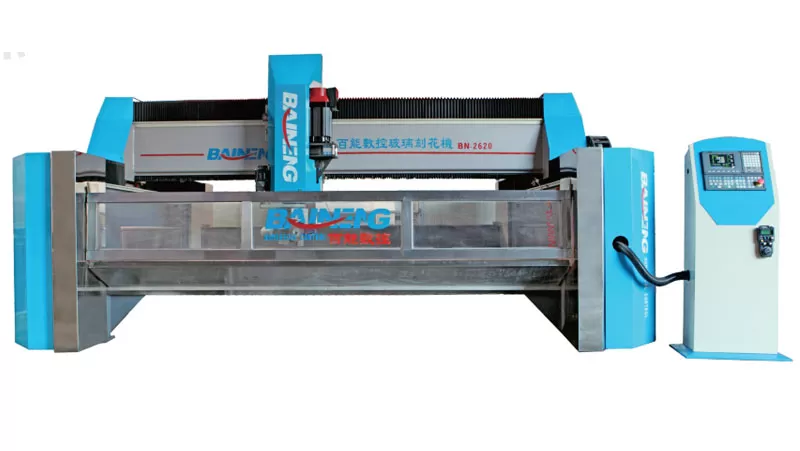
When investing in industrial glass engraving machinery, the manufacturer’s application engineering support is as important as the machine itself. BAINENG CNC focuses on three pillars: pre-sales process validation (sample engraving on customer-provided glass to verify surface quality and cycle time), on-site operator training covering tool selection, vacuum setup, and maintenance procedures, and spare parts availability for spindles, drives, and vacuum pumps. Their glass-specific engineering includes a patented Z-axis counterbalance system that eliminates drift during deep engraving passes, a feature not found in general-purpose routers. For buyers seeking a balance between precision and production throughput, BAINENG CNC’s 5-axis gantry series (working area up to 2500×4000 mm) offers sub-10 μm accuracy with 20-position ATC, making it suitable for high-mix architectural glass fabrication.
Frequently Asked Questions (FAQ)
Q1: What is the minimum spindle power recommended for daily production engraving on 10 mm float glass?
A1: For routine deep engraving (3–5 mm depth) on 10 mm glass, a 5.5 kW water-cooled spindle with a torque rating of at least 6 Nm at 12,000 RPM is required. Lower power spindles (≤3 kW) will require multiple shallow passes, significantly increasing cycle time and risking tool overheating. For occasional light etching (0.2 mm depth), 3 kW may suffice.
Q2: Can the same CNC engraving machine process both flat glass and curved glass (e.g., automotive windshields)?
A2: Standard 3-axis flatbed engravers cannot process curved glass because the Z-axis cannot follow complex bends. For curved glass, you need a 5-axis machine with a rotary axis or a dedicated gantry with a tilting spindle and a contour-following probe. Some manufacturers offer a retrofit laser scanning option to map the curve and adapt the toolpath. Always verify the maximum allowable curvature (radii) before purchasing.
Q3: How often should the vacuum table filter and coolant be replaced?
A3: Coolant should be changed every 2–3 months for 8-hour daily operation, or when pH drops below 7.5 (acidic coolant attacks diamond tool bonds). Vacuum table paper filters (if used) need replacement when pressure differential exceeds 0.03 MPa; typically every 40–60 hours of engraving. For cartridge-type coolant filters, change every 500 operating hours or if you observe fine glass particles settling in the tank.
Q4: What is the typical engraving feed rate for producing a matte frosted effect on a glass door panel?
A4: For a matte/frosted finish using a #400 diamond grit tool, typical parameters are: spindle speed 18,000 RPM, feed rate 3,000–4,500 mm/min, depth per pass 0.15–0.20 mm, stepover 0.12–0.15 mm. Lower feed rates produce a smoother, denser matte appearance; higher feed rates yield a more textured, satin finish. Always run a sample test, as glass hardness varies by manufacturer.
Q5: Does engraving before or after tempering affect the final product strength?
A5: Engraving must be performed before the tempering process. Tempering creates a surface compressive stress layer (approximately 60–80 MPa). If you engrave after tempering, you cut through this layer, leading to immediate fracture or spontaneous breakage later. When engraving on annealed glass prior to tempering, ensure the engraving depth does not exceed 15–20% of the glass thickness to avoid excessive stress concentration during heat treatment.
Q6: What maintenance tasks extend the life of linear guides on a glass engraving router?
A6: Weekly: Remove glass dust from guide rails using a vacuum and lint-free cloth, then apply low-viscosity linear guide oil (ISO VG 68). Monthly: Check wipers on the bearing blocks; replace if hardened or torn. Semi-annually: Perform a laser alignment of the axes to correct any geometric drift. Using an automatic lubrication system that pulses oil during machine operation reduces manual effort and ensures consistent film thickness.
Need a detailed specification comparison or a process validation test for your specific glass products? The engineering team at BAINENG CNC offers free consultation, including sample engraving on your supplied glass material with a full measurement report (surface roughness, edge chipping rate, and cycle time). We help you match the correct spindle power, worktable size, and automation features to your production volume—whether you require a single 3-axis engraver or an integrated cell with automatic loading and washing. Request your technical proposal and on-site or remote demo today.
Email: kobexu@bai-neng.com | Phone: +86-17185883788 (International sales support) | Send your glass drawings or DXF files for a fast turnaround analysis