
 FAQs
FAQs Factory Tour



Demand for personalized glass drinkware continues to surge across retail, hospitality, and luxury gift sectors. Beverage brands, high-end restaurants, and promotional merchandise suppliers now require precise, repeatable surface decoration on curved glass.
Selecting the right glass cup engraving machine requires an understanding of mechanical rigidity, rotational kinematics, spindle dynamics, and software integration. This comprehensive guide breaks down the essential technical criteria, operational costs, and machine configurations to help you make an informed capital investment.
The Growing Market for Custom Engraved Glassware in 2026
Consumer interest in customized products has shifted from simple flat prints to tactile, permanent surface carvings. Drinkware such as whiskey tumblers, crystal wine goblets, beer steins, and premium glass packaging demand sophisticated engraving that will not fade or peel in commercial dishwashers.
Manual glass cutting and handheld rotary carving cannot keep pace with commercial orders. Traditional artisanal methods suffer from high scrap rates, operator fatigue, and inconsistent depth of cut. When working with delicate soda-lime or lead-free crystal glass, minor hand tremors often result in chipping or catastrophic thermal fractures.
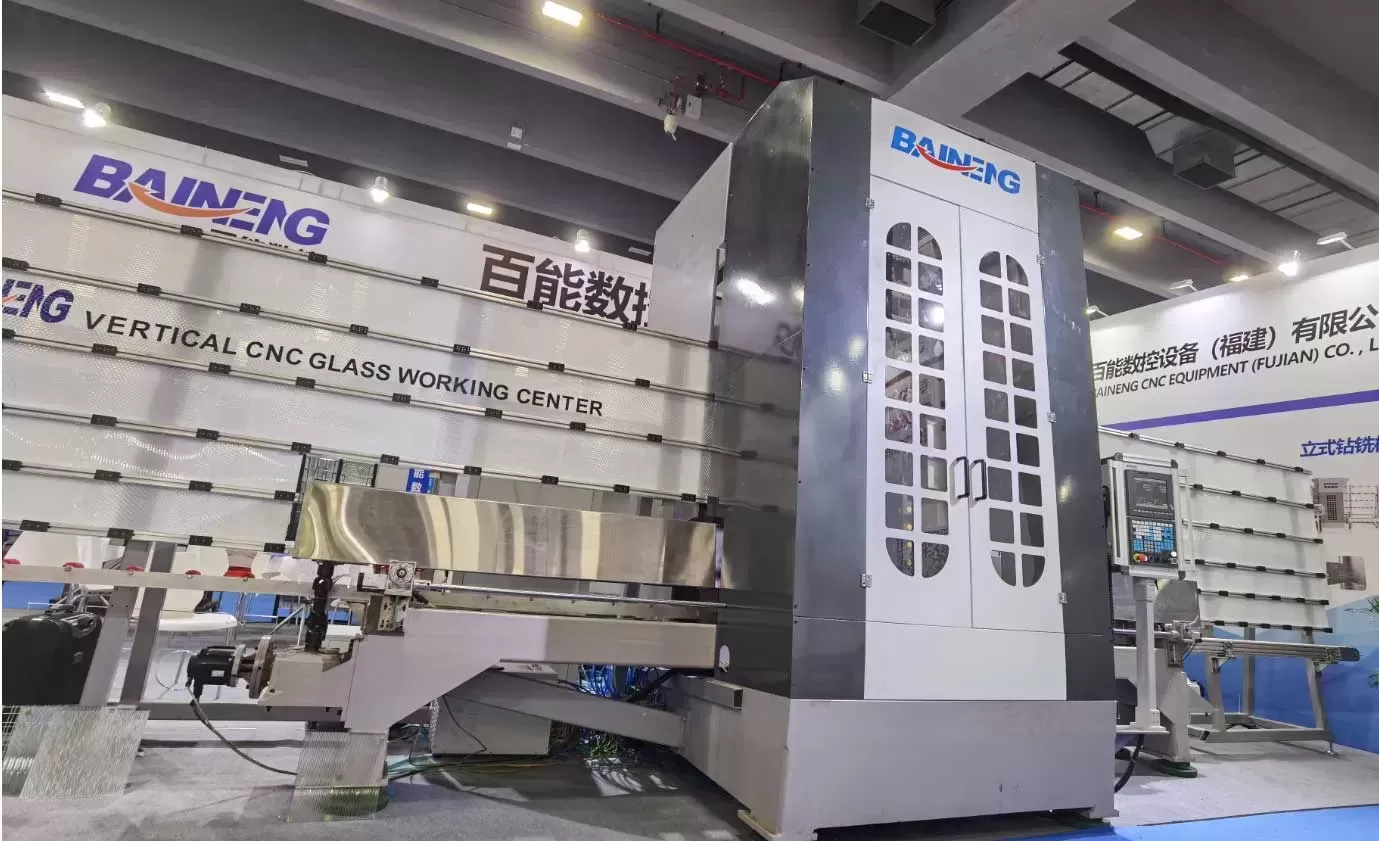
Modern production facilities rely on automated equipment to maintain tight dimensional tolerances. Implementing a commercial glass etching machine or an industrial CNC glass cup engraving machine allows factories to scale daily output while slashing reject rates. Companies like BAINENG CNC engineer advanced machinery tailored specifically to handle fragile, complex glass geometries without sacrificing cycle speed.
Core Technology Comparison: CNC Rotary vs. Laser Glass Engraving
Selecting the correct technology depends on your required engraving depth, glass composition, and aesthetic objectives. The two primary industrial methods are mechanical CNC milling and laser ablation.
1. CNC Rotary Glass Engraving
A CNC glass cup engraving machine uses high-speed diamond burrs or carbide milling tools mounted to an electric spindle. The workpiece rotates synchronously along a 4th axis as the cutter removes micro-layers of glass under continuous water cooling.
Engraving Depth: Capable of deep 2.5D and 3D relief cuts ranging from 0.5 mm to 3.0 mm.
Edge Finish: Delivers smooth, crisp, and tactile grooves that can be machine-polished to optical clarity.
Material Versatility: Ideal for thick-walled glassware, crystal barware, and high-value decorative decanters.
Tool Wear: Requires periodic diamond tool replacement depending on glass hardness.
2. Laser Glass Engraving
A laser glass cup engraver uses focused CO2 or UV laser beams to generate thermal micro-fractures on the glass surface. The laser pulse rapidly heats and vaporizes surface material without physical tool contact.
Engraving Depth: Primarily suited for shallow surface frosting (0.05 mm to 0.2 mm).
Processing Speed: Extremely rapid execution for serial numbers, barcodes, and fine 2D line art.
Material Constraints: High thermal stress can cause micro-cracking on heat-sensitive or thin crystal glass.
Maintenance: No mechanical cutters to wear out, though optical lenses require regular cleaning.
Technology Selection Matrix
| Feature | CNC Rotary Mechanical Engraving | CO2 / UV Laser Marking |
|---|---|---|
| Depth Capacity | Deep relief carving (up to 3.0 mm+) | Surface etching (0.05 mm – 0.2 mm) |
| Tactile Texture | Deep, clean V-grooves and smooth finishes | Frosted, sandblasted feel |
| Risk of Thermal Cracking | Extremely low (due to liquid coolant) | Moderate to high on thin/fragile glass |
| Best Applied To | Crystal stemware, whiskey glasses, luxury gifts | High-speed logos, bar codes, thin tumblers |
6 Essential Buying Factors for a Glass Cup Engraving Machine
Industrial glass machining places unique demands on machine tools. Glass does not shear like metal or plastic; it chips and fractures under incorrect feed loads. Consider these six technical specifications before purchasing your next machine.
1. Rotary Axis Rigidity and Clamping Systems
A reliable rotary glass engraving machine must support varied vessel shapes, including straight cylinders, steep cones, and stemmed glassware. Standard mechanical chucks often exert uneven point pressure, cracking thin rims.
Look for specialized 4-axis rotary units equipped with soft-jaw pneumatic chucks or dual-cone self-centering fixtures. The rotary headstock must utilize high-torque harmonic or direct-drive motors to eliminate backlash during rapid directional changes.
2. Spindle Precision and Micro-Feed Control
High runout on the machine spindle instantly shatters brittle glass edges. Your wine glass engraving equipment must feature a precision electro-spindle with dynamic runout below 0.003 mm.
Spindle speeds between 18,000 RPM and 40,000 RPM allow diamond points to grind rather than impact the substrate. Micro-feed resolutions along the X, Y, and Z axes guarantee consistent cut depths across undulating glass surfaces.
3. CAD/CAM Compatibility and Curved Surface Compensation
Real-world glassware is rarely perfectly round. Variations in wall thickness and wall taper are standard in blown or pressed glass. Without surface mapping, engraving depth will vary unevenly across the profile.
Advanced machines feature mechanical or laser surface scanning probes. The onboard CNC controller automatically compensates for glass runout in real time, adjusting the Z-axis toolpath to maintain a uniform engraving depth across the entire cup circumference.
4. Closed-Loop Cooling and Glass Slurry Management
Dry cutting glass damages tools and creates airborne silica hazards. An industrial glass carving machine requires a dedicated recirculating flood coolant system. Water flushes away abrasive micro-chips and prevents heat build-up at the contact point.
Choose systems featuring multi-stage filtration tanks with magnetic or sediment separators. Clean coolant extends diamond tool life and keeps the internal machine enclosure free of baked-on glass sludge.
5. Machine Base Construction and Vibration Dampening
Mechanical vibration is the primary cause of chipped engraving borders. Light aluminum extrusions cannot absorb the resonant frequencies generated by high-speed spindles.
Select machinery built with heavy cast iron beds or annealed steel tubular frames. High machine mass dampens vibrations, preserving tool life and producing mirror-smooth cut paths directly off the spindle.
6. Safety Compliance and Build Standards
Operating a high-speed glass cup engraving machine requires robust electrical and mechanical safeguards. Ensure the equipment carries CE and ISO 9001 certifications. Essential safety features include interlocking enclosure doors, emergency stop loops, and fully shielded cable carriers resistant to wet, abrasive slurry.
ROI and Production Economics: Measuring Equipment Payback
Transitioning from manual engraving or low-grade desktop plotters to an automated industrial glass carving machine radically alters unit economics. The return on investment stems from three core areas: cycle time, labor reduction, and scrap minimization.
A manual artisan may spend 20 to 30 minutes carefully carving a complex monogram on a crystal tumbler, running a scrap rate of 10% to 15%. An automated CNC glass cup engraving machine executes the identical pattern in 2 to 4 minutes with less than 0.5% scrap.
Consider a standard commercial setup running 8 hours per day:
Daily Output: Increases from 15–20 manual pieces to 120–180 automated pieces per shift.
Labor Cost Per Unit: Drops by over 70% as a single operator can oversee multiple CNC units simultaneously.
Material Savings: Eliminating rejects saves thousands of dollars monthly when processing expensive crystal or imported barware.
For most custom glassware processors, modern CNC engraving machinery pays for itself within 6 to 10 months of continuous production.
Why Industry Leaders Partner with BAINENG CNC
Founded in 2011, BAINENG CNC is a national high-tech enterprise specializing in the research, development, and manufacture of high-precision CNC glass processing machinery. With over 20 proprietary technical patents, the engineering team designs machinery specifically targeted at overcoming the material challenges of industrial glass.
Every glass cup engraving machine manufactured by BAINENG CNC undergoes rigorous quality testing and holds full CE and ISO certification. Heavy cast construction, premium electro-spindles, and proprietary motion control algorithms ensure that our machines deliver high-speed accuracy year after year.
BAINENG CNC machines are trusted by glass processing operations in more than 50 countries, including the United States, Germany, France, Italy, Canada, Poland, Romania, Turkey, South Korea, India, Saudi Arabia, and Egypt. From initial tooling selection to remote diagnostics and on-site training, BAINENG CNC delivers comprehensive lifecycle support for your glass production line.
Frequently Asked Questions (FAQ)
Q1: How do I prevent delicate wine glasses from cracking during
high-speed CNC engraving?
A1: Cracking occurs due to localized
thermal stress, mechanical vibration, or excessive tool pressure. Use a
continuous flood coolant system to dissipate friction heat immediately. Match
this with high spindle speeds (above 24,000 RPM), low tool feed rates, and
specialized pneumatic or soft-rubber rotary chucks that support the glass wall
from inside and outside without pinching.
Q2: Can a single machine engrave both flat glass panels and
cylindrical glass cups?
A2: Yes. Multi-functional CNC machining
centers can be configured with a removable 4th-axis rotary unit installed
directly on the main flatbed table. When processing flat architectural glass or
mirrors, the rotary chuck is deactivated or detached, allowing the machine to
function as a traditional 3-axis CNC router.
Q3: What international compliance certifications are necessary when
importing glass engraving equipment?
A3: Ensure the machinery
carries full CE certification for European and international safety standards,
covering Low Voltage Directives (LVD) and Electromagnetic Compatibility (EMC).
ISO 9001 certification confirms that the manufacturer follows strict quality
management systems throughout component sourcing and assembly.
Q4: What cutting tools work best for carving heavy crystal versus
standard soda-lime glass?
A4: Electroplated diamond burrs work best
for fast, aggressive material removal on softer lead crystal. Vacuum-brazed or
sintered diamond tools provide longer tool life when carving harder, denser
soda-lime glassware. For fine polishing within the engraved grooves,
rubber-bonded cerium oxide polishing wheels are recommended.
Q5: Is advanced CAD/CAM programming knowledge required to run a CNC
glass cup engraving machine?
A5: Modern machine interfaces simplify
this process significantly. Standard vector graphics (DXF, AI, PLT) or 3D models
(STL, STEP) can be imported directly into the software. The CAM software
automatically converts 2D artwork into 4th-axis rotary toolpaths, while
intuitive touchscreen interfaces allow shop-floor operators to set work offsets,
zero tools, and initiate cycles with minimal training.
Scale Your Glassware Production with BAINENG CNC
Investing in a high-precision glass cup engraving machine expands your product catalog, improves dimensional accuracy, and reduces operational waste. Whether your facility produces high-volume promotional drinkware or bespoke crystal art, selecting a rigid, well-engineered CNC platform is key to long-term profitability.
Ready to upgrade your glass engraving production? Contact the engineering specialists at BAINENG CNC today to request technical specifications, schedule a sample engraving trial, and receive a customized equipment quote tailored to your facility's exact requirements.