
 FAQs
 Factory Tour



Glass fabricators face a tough production environment. Architectural specs demand tighter tolerances, interior designers want irregular contours, and commercial clients expect lightning-fast turnarounds. At the same time, skilled glass masters are retiring faster than shops can replace them.
Relying on standalone manual drills, manual edging wheels, and disparate cutting tables creates operational bottlenecks. Many factory owners find that their current floor setup simply cannot deliver profitable runs on custom architectural glass or frameless shower doors.
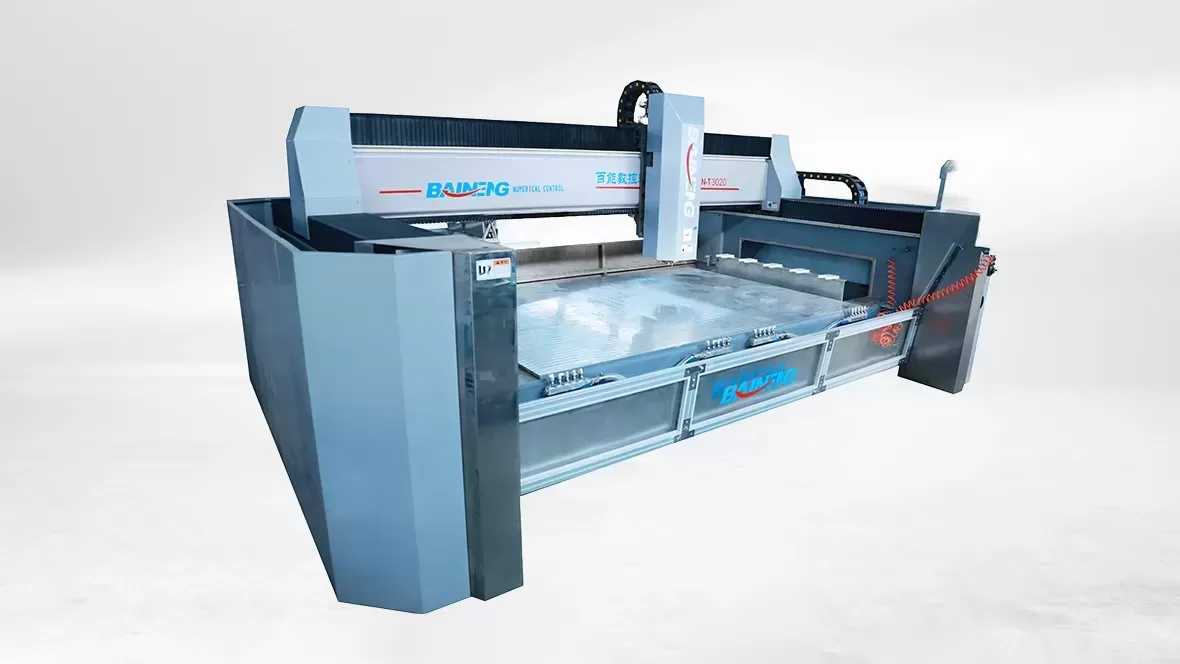
Modern industrial fabrication requires a shift toward automation. Investing in an advanced CNC glass working center transforms how fabricators process float, laminated, and tempered glass panels. Industry leaders like BAINENG CNC engineer these multi-axis systems to consolidate production into a single, high-output workstation.
If your shop is dealing with high scrap rates, slow turnaround times, or rising labor expenses, upgrading your machinery is the logical path forward. Contact our engineering team today for an in-depth machine consultation and a free plant ROI evaluation.
1. All-in-One Integration vs. Fragmented Workflows
Traditional glass manufacturing plants resemble an obstacle course. Raw sheets move from a cutting table to a manual drilling station, wait on an A-frame, move to a shape edger, wait again, and finally pass to an edge polisher. Every touchpoint consumes labor hours and risks damage.
Traditional Setup: The Hidden Costs of Material Handling
Each movement between independent machines introduces operational drag. Handling large, heavy lites requires two or more workers to lift, rotate, and align panels onto separate worktables. This fragmented method causes several distinct problems:
- Micro-fractures and Edge Shelling: Loading and unloading glass repeatedly creates contact points that chip edges before tempering.
- Wasted Transit Time: Glass sheets spend up to 60% of their floor time sitting on trolleys waiting for the next open machine.
- Increased Floor Space Requirements: Staging areas between machines consume valuable plant square footage that could otherwise hold revenue-generating equipment.
- Safety Hazards: Manual handling of unpolished, sharp edges increases the frequency of workplace injuries and associated liability claims.
High-End CNC Capability: Process Glass in a Single Clamping
An advanced CNC glass working center consolidates your entire secondary processing line onto a single machine bed. Once the vacuum suction cups secure the raw or rough-cut sheet, the machine carries out every remaining operation without operator intervention:
- Milling internal cutouts for shower door hinges and hardware.
- Drilling countersunk or straight holes with high-pressure internal water cooling.
- Rough grinding, fine grinding, and brilliant cerium polishing on external perimeter edges.
- Engraving architectural relief patterns or decorative surface work.
By eliminating manual transfers between cutting, drilling, and finishing, shops cut handling damage down to near zero while drastically shortening cycle times.
2. Precision, Repeatability, and Complex Geometry Processing
Architectural trends favor non-standard geometries: radius corners, trapezoids, complex cutouts, and multi-layered laminated assemblies. Traditional glass machinery struggles to replicate these designs consistently.
Beyond Human Limits: Micron-Level Positioning
Manual glass grinding depends heavily on operator fatigue levels and hand steadiness. A technician might produce pristine polished edges at 8:00 AM, but by 3:00 PM, pressure variations cause waviness and out-of-square edges. Even slight variations ruin assemblies when installing frameless railings or structural glass facades.
A CNC glass working center runs on industrial-grade digital servo drives paired with high-precision ball screws and linear guideways. These mechanical assemblies ensure positional accuracy within ±0.05 mm across the entire bed. The machine applies steady, continuous pneumatic and mechanical tool pressure against the glass edge, producing a flat, uniform profile from the first piece to the ten-thousandth.
Complex Shapes Made Easy with Multi-Axis Control
Fabricating complex shapes manually requires templates, hand tracing, and multiple passes on manual grinding wheels. This approach is slow and introduces dimensional errors that surface during final installation on the job site.
A multi-axis or 5-axis glass CNC works directly from digital CAD files. The operator imports a standard DXF drawing, the CAM software calculates the optimal tool paths, and the machine executes the profile:
- Complex Miters: Produce sharp bevels and variable-angle miter edges for structural corner joints.
- Interior Cutouts: Mill precise, chip-free sink cutouts and power socket openings in glass countertops.
- Tight Radii: Polish inside corners that manual peripheral wheels cannot reach without manual hand touch-ups.
3. Production Efficiency and the Power of Automation
Efficiency in glass processing centers on one metric: how many square meters of finished, defect-free glass exit your shop floor per shift. Traditional machinery bottlenecks production because human operators must constantly set up jobs and change tooling.
Automatic Tool Changer (ATC): Eradicating Setup Downtime
On legacy machinery, switching from a coarse diamond wheel to a fine resin wheel or drill bit requires the operator to halt the process, unbolt the tool holder, mount the new tool, and recalibrate reference points. This downtime erodes daily profit margins.
A modern CNC glass working center features a high-capacity automatic tool changer (ATC) carrying 12, 18, 24, or more tool stations. The controller commands automatic tool changes in seconds:
- Drills switch automatically between 6mm, 10mm, and 45mm coring bits.
- Grinding tools transition instantly through 80-grit, 140-grit, and 240-grit profiles.
- The spindle picks up specialized felt polishing wheels dosed with cerium oxide for optical-grade edge finishes.
The entire sequence runs uninterrupted, allowing your operators to stage the next panel rather than fiddle with wrenches.
Advanced CNC Spindle Performance
The core of any high-performing glass CNC router or machining center is its electro-spindle. Industrial machines use high-torque spindles (often rated between 9 kW and 15 kW) built with precision ceramic bearings to damp vibration. Balanced spindles prevent edge micro-chipping, which is the primary cause of glass breakage inside tempering furnaces.
Spindles featuring internal through-shaft water cooling pump high-pressure coolant directly to the tool-glass interface. This flush removes glass slurry instantly, cools the diamond matrix, speeds up cutting passes, and extends diamond tooling life by up to 40%.
4. Labor Shortage Relief and Long-Term ROI Analysis
The glass industry faces a persistent talent gap. Veteran glass grinders and edgers are commanding premium wages, while apprentice-level labor often yields high error rates and damaged stock. High-end systems from BAINENG CNC allow companies to scale production output without adding payroll overhead.
Reducing Dependency on Skilled Operators
Traditional machinery demands years of muscle memory and craftsmanship to produce consistent, optical-quality bevels and seams. If your master technician calls in sick, production lines stall, and delivery schedules slip.
In contrast, a high-end CNC glass working center shifts technical requirements into standardized software controls. A technician with basic digital literacy can master panel loading, program loading, and daily machine maintenance within a few days of training. One worker easily manages two automated CNC centers simultaneously, increasing your shop's revenue per employee.
The True Cost Comparison: CAPEX vs. OPEX
Business owners often hesitate at the upfront capital cost (Capex) of a CNC machining center compared to cheaper standalone drills or manual edgers. However, evaluating total cost of ownership (Opex) reveals a clear financial advantage:
| Production Factor | Traditional Machinery Setup | High-End CNC Glass Working Center |
|---|---|---|
| Labor Requirement | 3 to 5 skilled technicians across multiple manual stations | 1 operator manages 1 to 2 automated CNC machines |
| Material Scrap Rate | High (5%–9% due to manual handling chips and template slippage) | Extremely Low (Under 1% due to rigid clamping and closed-loop servos) |
| Processing Speed | Slow; intermittent pauses between cutting, drilling, and edging | High; continuous milling, drilling, and polishing in one run |
| Edge Finish Quality | Variable; depends on operator stamina and manual wheel adjustments | Consistent; automated wheel wear compensation maintains optical finish |
| Tool Lifespan | Short; irregular manual pressure causes uneven diamond wear | Long; controlled feed rates and internal water delivery preserve tools |
By slashing scrap, decreasing your headcount per shift, and accelerating order turnaround times, a busy glass fabrication line typically reaches full investment payback within 12 to 18 months.
5. Digitalization and Industry 4.0 Compatibility
Modern glass factories run on integrated data networks, not paper work-orders clipped to rolling carts. Standalone, mechanical glass machines cannot communicate with plant management software, leaving managers blind to line bottlenecks.
Smart Software Ecosystem and Seamless Data Flows
A cutting-edge CNC glass working center integrates cleanly into smart manufacturing lines. The CNC control system connects directly to factory ERP, MES, and nesting software packages:
- Barcode and QR Scanning: The operator scans an adhesive tag on the raw glass lite. The machine automatically pulls the matching DXF drawing, sets the vacuum suction cups, and loads the required tool sequence.
- Auto-Nesting and Positioning: The machine's CAD/CAM post-processor positions holding cups to avoid tool paths, eliminating manual cup layout errors that lead to broken vacuum pads.
- Production Tracking: Supervisors track real-time yield, cycle times per part, and spindle run-time hours from an office dashboard.
Remote Diagnostics and Predictive Maintenance
Unplanned machine downtime damages client relationships and wrecks shipping schedules. Premium CNC glass machinery incorporates digital sensors throughout the spindle, axis drives, and pneumatic manifolds.
Technicians can access the system remotely through secure industrial gateways to diagnose fault codes, update control software, and adjust servo tuning parameters. Predictive maintenance alerts notify operators when spindle bearings require grease or when diamond grinding wheels need automated re-profiling (dressing), preventing sudden breakdowns during peak production runs.
Is It Time to Upgrade Your Glass Processing Facility?
Staying competitive in the modern glass sector requires machines that turn custom architectural concepts into finished products quickly and accurately. Traditional glass processing machinery served its purpose in an era of cheap labor and loose tolerances, but it now constrains growing businesses.
If your shop faces any of the following challenges, it is time to upgrade to an advanced CNC solution:
- You reject or re-cut more than 3% of your panels due to edge chips, inaccurate holes, or surface scratches.
- You turn down profitable commercial jobs because you cannot execute complex shapes or tight radius polishes.
- Your edging and drilling stations run at maximum capacity while your cutting lines wait on hold.
- You struggle to find, hire, and retain experienced manual glass grinders.
BAINENG CNC builds rigid, high-speed, and accessible CNC glass machinery engineered to solve your biggest production bottlenecks. Our systems handle everything from heavy architectural lites to intricate appliance glass, helping you produce more square footage per day at a lower operating cost.
Ready to elevate your factory throughput? Send an inquiry to the BAINENG CNC technical team to receive a machine layout recommendation, run-time estimates for your parts, and a personalized ROI analysis.
Frequently Asked Questions (FAQ)
Q1: What types of glass can a CNC glass working center
process?
A1: A high-end CNC glass working center processes virtually
all commercial glass types, including float glass, ultra-clear low-iron glass,
laminated glass, mirrors, patterned glass, and tinted panels. Thickness
capabilities typically range from thin 3mm decorative glass up to heavy 19mm,
25mm, or multi-ply structural glass panels.
Q2: How does a CNC glass working center hold the glass securely
during aggressive milling?
A2: The machine bed uses high-efficiency
vacuum suction cups positioned strategically beneath the glass. A powerful
vacuum pump locks the glass panel firmly in place. Some advanced tables feature
segmented vacuum zones or magnetic pod bases, which allow quick repositioning
for odd geometries while maintaining complete stability during high-speed
milling.
Q3: How difficult is it for an operator to learn the programming
software?
A3: Modern systems use intuitive CAD/CAM graphical
interfaces specifically developed for the glass processing trade. Operators do
not need to write raw G-code. If a technician can use basic drafting software or
adjust parameters in Windows-based programs, they can run common door, mirror,
and countertop profiles within a few days of training.
Q4: How does a CNC machine compensate for diamond grinding wheel
wear?
A4: Top-tier CNC systems feature automated tool wear
compensation. After processing a set linear footage of glass, the software
automatically adjusts the axis offset by fractions of a millimeter to match
wheel loss. High-end machines also feature automated wheel dressing cycles,
keeping the diamond matrix open and sharp without manual removal.
Q5: What is the typical life expectancy of an industrial CNC glass
working center?
A5: When properly maintained with clean,
recirculated water filtration and regular axis lubrication, an industrial-grade
CNC glass working center operates reliably for 10 to 15 years or more. Heavy
cast-iron or stress-relieved steel machine beds prevent structural warping,
preserving high fabrication accuracy throughout the machine's operational
life.