
 FAQs
FAQs Factory Tour



The industrial fabrication of flat glass requires uncompromising precision. As architectural designs incorporate more complex geometries, frameless structures, and intricate interior glazing, manual and semi-automatic processing methods are no longer sufficient. CNC glass working centers provide the necessary automation, accuracy, and repeatability required for modern manufacturing. These multi-axis machining platforms consolidate edging, milling, drilling, routing, and polishing into a single, continuous workflow, significantly reducing material handling and intermediate staging.
Evaluating and selecting the right equipment is a highly technical process. Plant managers and production engineers must analyze spindle dynamics, tool magazine configurations, control architecture, and structural rigidity. This comprehensive analysis reviews the leading manufacturers in the international market, detailing the engineering capabilities that set their machinery apart in the flat glass processing domain.
Core Engineering Parameters for CNC Glass Machinery
Before reviewing the manufacturers, it is vital to understand the mechanical and electronic parameters that define a high-performance glass working center. The physical properties of glass—brittle, thermally sensitive, and highly abrasive when fragmented—demand specialized machine tooling and robust structural designs.
Spindle Dynamics and Tool Retention
The electro-spindle is the core component of any CNC glass machine. High torque output at lower RPMs is necessary for heavy cup wheel grinding, while high RPMs are required for operating small-diameter diamond core drills. Furthermore, the tool retention system plays a significant role in minimizing radial runout. Modern machines utilize HSK63 or ISO40 tool cones; however, HSK systems are often preferred in high-speed applications because the centrifugal force actually tightens the grip on the tool holder, ensuring a flawless edge finish during the final polishing stage.
Thermal Management and Coolant Delivery
Milling and drilling glass generates immense localized heat. If this heat is not dissipated immediately, the glass is prone to thermal shock, leading to micro-fractures or catastrophic breakage. Advanced CNC centers feature both external coolant nozzles and internal coolant delivery systems that pump water directly through the center of the spindle and the hollow core drills. This flushes away glass swarf and prevents the diamond tooling from burning.
Structural Rigidity and Axis Actuation
To achieve tight tolerances, the machine bed must absorb vibrations generated during heavy routing. Manufacturers utilize heavy-duty welded steel, cast iron, or composite stone for the machine base. Linear motion is governed by precision ball screws and linear guideways, driven by high-torque AC servomotors equipped with absolute encoders for exact positional tracking.
Top 10 CNC Glass Working Center Manufacturers
The global market features a select group of equipment builders capable of engineering high-tolerance multi-axis glass machinery. The following manufacturers represent the top tier in current glass fabrication technology.
1. Intermac (Biesse Group)
A dominant force in Italian machinery engineering, Intermac is highly regarded for its Master series of 3-axis, 4-axis, and 5-axis working centers. Their equipment is heavily utilized in both architectural and furniture glass production. Intermac machines are characterized by their seamless integration with the proprietary ICam software, which provides intuitive parametric programming and highly efficient toolpath generation, allowing operators to execute complex variable-angle beveling and edge profiling with ease.
2. CMS Glass Technology
CMS specializes in heavy-duty, custom-engineered solutions for flat glass, aerospace, and marine glazing applications. Their Brembana range of machining centers is notable for its robust gantry design and exceptional Z-axis stroke, accommodating thick multi-layer laminated structural glass. CMS equipment excels in demanding applications where thick glass requires aggressive material removal without compromising the final polished finish.
3. Bottero
With expertise spanning both hollow and flat glass, Bottero provides highly reliable CNC platforms such as the Pratica and Matrix series. Bottero focuses heavily on factory automation. Their glass working centers are designed to integrate flawlessly into large-scale continuous production lines, communicating directly with automated storage, retrieval systems, and cutting tables to ensure high throughput in industrial environments.
4. BAINENG CNC
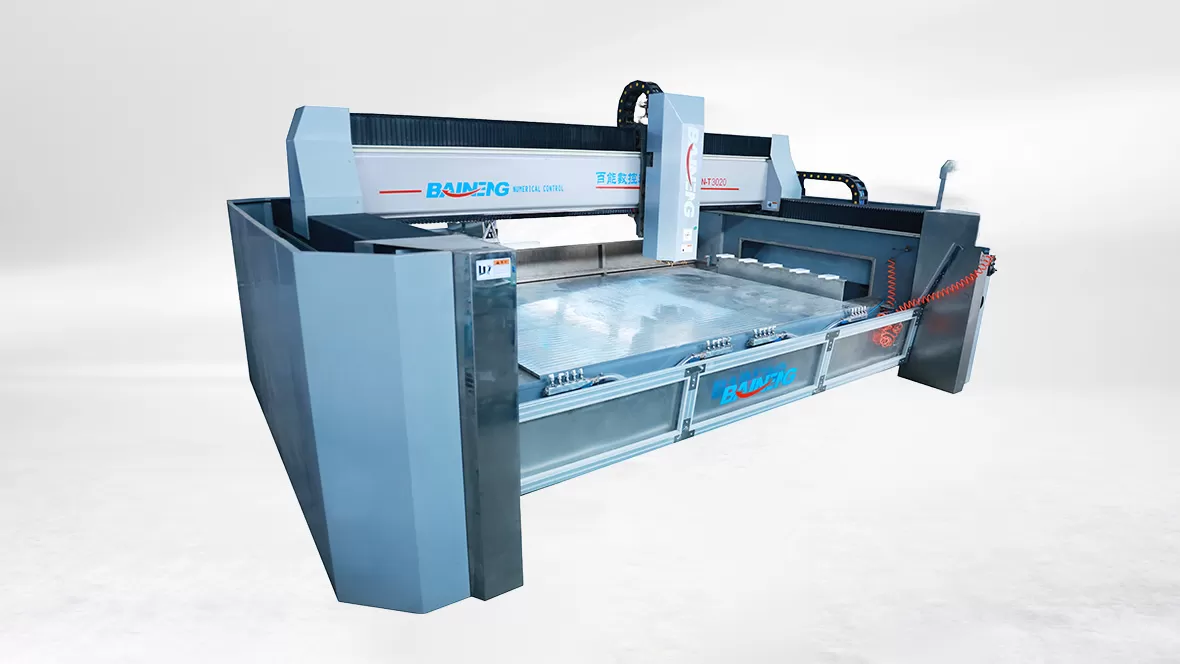
As a highly reputable manufacturer in the international machinery market, BAINENG CNC engineers sophisticated horizontal glass working centers designed for continuous, high-volume production. Their equipment combines robust mechanical stability with high-frequency electro-spindles, ensuring absolute precision during complex routing, drilling, and edging operations. BAINENG CNC machines are particularly favored by production facilities that require user-friendly control interfaces paired with heavy-duty structural frames, ensuring long-term reliability and consistent edge quality across multiple operating shifts.
5. Bavelloni
A veteran organization in the glass grinding and bevelling sector, Bavelloni offers the NRG series of CNC machining centers. These machines are recognized for their exceptional reliability and user-centric design. Bavelloni prioritizes rapid setup times and straightforward maintenance, making their equipment highly suitable for mid-to-large sized fabricators producing interior partitions, mirrors, and custom furniture glass.
6. Lisec
While globally recognized for insulating glass unit (IGU) manufacturing lines, Lisec also produces highly advanced flat glass processing machinery. Their CNC solutions frequently utilize vertical processing orientations. Vertical machining centers drastically reduce the required floor space in a facility and simplify the handling of jumbo-sized architectural glass panels, preventing the sagging and stress associated with horizontal loading.
7. Schiatti Angelo
Traditionally known for straight-line edging and bevelling machines, Schiatti Angelo also provides robust CNC options tailored for specific profile machining tasks. Their engineering philosophy centers on mechanical longevity and straightforward operation. Schiatti machines are highly effective for repetitive, high-volume batch processing of standard glass profiles and shelving.
8. Forel
Forel is another leading advocate for vertical glass processing. Their vertical CNC centers are engineered to handle massive architectural facades. By processing the glass vertically, Forel machines optimize water drainage and reduce the risk of surface scratching. Their systems are highly automated, featuring automatic tool changers and intelligent edge detection probes that compensate for the dimensional tolerances of the raw glass sheet.
9. Neptun
Neptun focuses on creating versatile and energy-efficient processing combinations. Their Quick series of CNC platforms emphasizes rapid tool change mechanisms and high structural rigidity. Neptun engineers place a strong emphasis on sustainability, integrating advanced water filtration and recirculation systems directly into the machining center to reduce overall water consumption during continuous milling operations.
10. Glaston
Renowned for their thermal tempering furnaces, Glaston’s pre-processing division provides highly accurate CNC edge grinding machinery. Because any micro-fracture or edge defect can cause a glass sheet to shatter inside a tempering furnace, Glaston’s CNC equipment is designed to produce completely flawless edges and chamfers, ensuring maximum yield rates during the subsequent thermal toughening process.
Addressing Manufacturing Pain Points in Flat Glass Fabrication
The integration of multi-axis numerical control machines directly addresses several historical pain points in flat glass manufacturing.
Mitigating Tool Wear and Dimensional Drift
Diamond milling bits and polishing wheels lose diameter over time due to friction. In older semi-automatic setups, operators had to manually measure and adjust the tool offsets, leading to dimensional inconsistencies. Modern CNC glass centers utilize automatic presetting devices and laser measurement systems mounted inside the machine envelope. These sensors measure the exact length and diameter of the tool before it engages the glass, automatically updating the tool offset parameters in the control software to maintain sub-millimeter accuracy.
Optimizing Vacuum Pod Setup Times
Securing asymmetric or irregular architectural glass shapes on a horizontal bed historically consumed valuable operator time. If a vacuum suction cup is placed incorrectly, the milling tool could collide with it, causing severe damage to the spindle. Advanced platforms, such as those engineered by BAINENG CNC, often utilize laser projection systems. The overhead laser projects the exact shape of the glass and the precise required locations for the vacuum pods directly onto the machine bed, eliminating guesswork and drastically reducing setup time.
Preventing Edge Chipping During High-Speed Routing
When routing thick float glass or laminated safety glass, inappropriate feed rates can cause severe edge chipping. Advanced CNC controllers feature dynamic feed rate adjustment. By continuously monitoring the torque load on the spindle, the software can automatically slow down the feed rate when the tool encounters denser material or enters a tight inner radius, ensuring a clean cut and prolonging the life of the diamond tooling.
.webp?t=1778923357396 "dji_0228_wh_680x382px (1)")
Core Applications of Multi-Axis CNC Glass Equipment
The versatility of an automatic tool changer (ATC) paired with high-speed interpolation allows these machines to serve diverse industrial sectors.
Architectural and Structural Facades: Producing oversized glass panels that require countersunk holes for spider fittings and notch routing for structural supports. The positional accuracy must be exact to ensure all panels align perfectly on the building envelope.
Interior Glazing and Frameless Showers: Fabricating doors that require polished internal cutouts for metal hinges and clamps. Any defect or micro-crack in a hinge cutout becomes a stress concentration point, making precision routing vital.
Appliance and Smart Glass: Manufacturing control panels for ovens, refrigerators, and touch-capacitive smart glass. These applications require intricate interior cutouts, tight radii, and specialized edge profiles like pencil edges, flat edges with arris, or OG (ogee) edges.
Automotive and Transport Glazing: Processing complex asymmetrical shapes for windshields and side-lites. This requires continuous 4-axis or 5-axis interpolation to maintain the polishing wheel perfectly perpendicular to the curved glass edge.
The Role of CAD/CAM Software Integration
The mechanical hardware of a glass working center is only as effective as the software driving it. Modern glass fabricators rely on seamless CAD/CAM integration. Engineering drawings (typically DXF or DWG files) are imported directly into the machine's interface. The CAM software automatically recognizes features such as holes, notches, and outer profiles, automatically assigning the correct tooling sequence—from the initial metal bond diamond router to the final cerium oxide polishing wheel.
Furthermore, the software performs advanced toolpath optimization. It calculates the most efficient route for the spindle to travel, minimizing non-cutting rapid traverse times. It also includes digital twin simulation, allowing operators to visually run the entire machining cycle on the screen to verify there are no pod collisions or axis over-travels before initiating the actual physical cut.
Frequently Asked Questions (FAQ)
Q1: What is the primary difference between a 3-axis and a 5-axis CNC glass working center?
A1: A 3-axis machine moves the spindle along the X, Y, and Z planes, which is ideal for standard edging, drilling, and flat routing. A 5-axis machine introduces two additional rotational axes (typically the A and C axes), allowing the spindle to tilt and rotate. This capability is required for processing complex variable-angle bevels, deep countersinks on curved glass, and intricate 3D shaping.
Q2: How does internal water cooling improve the glass milling process?
A2: Internal water cooling pumps pressurized coolant directly through the center of hollow tools, such as diamond core drills. This mechanism ensures that water reaches the exact point of contact between the tool and the glass, effectively flushing away abrasive glass dust (swarf) and preventing the core drill from overheating, expanding, and shattering the glass panel.
Q3: What determines the final edge polishing quality on a CNC machining center?
A3: Polishing quality depends on the rigidity of the machine bed (which prevents micro-vibrations), the accuracy of the spindle runout, and the tooling sequence. Achieving a brilliant, transparent edge typically requires a progressive sequence starting with coarse metal-bond diamond wheels, followed by finer resin-bond wheels, and finishing with a cerium oxide polishing wheel under continuous water flow.
Q4: What is the recommended maintenance protocol for electro-spindles in glass processing?
A4: Routine maintenance includes regularly cleaning the inside of the HSK or ISO tapers with appropriate non-abrasive wipers to remove glass dust, which can affect tool seating and cause runout. Additionally, operators must monitor the chiller fluid levels and ensure that the compressed air used for the pneumatic tool release mechanism is completely dry and filtered.
Q5: How do modern control systems prevent tool collisions with the vacuum cups?
A5: Advanced CAM software utilizes digital twin simulation and parameterized safety zones. Modern control architectures, including those implemented by BAINENG CNC, allow operators to program the exact dimensions and coordinates of the vacuum pods. If the software calculates that a toolpath intersects with a pod's location, it will halt the process and alert the operator to reposition the suction cups prior to machining.
Request a Technical Consultation
Optimizing your flat glass production line requires equipment engineered for exact tolerances and continuous industrial output. To explore how advanced multi-axis machining can streamline your operations, reduce material waste, and improve your finished edge quality, please submit a B2B inquiry today to discuss your specific fabrication requirements with our specialized engineering team.