
 FAQs
FAQs Factory Tour



Modern architectural glass production demands both structural integrity and precise aesthetic detailing. Achieving clean, crisp lines on flat glass panels requires machinery that can handle high-stress cutting environments while maintaining sub-millimeter accuracy. Traditional manual etching and basic mechanical carving methods often lead to micro-fractures, edge chipping, and high scrap rates. To address these production challenges, industrial manufacturers rely on specialized CNC platforms. Implementing a glass v groove machine within the production line allows fabricators to execute precise decorative grooves, bevels, and linear patterns on glass of varying thicknesses.
BAINENG CNC develops glass processing machinery designed to stabilize mechanical movements during high-speed cutting. By integrating robust mechanical bases with advanced motion control interfaces, these systems reduce vibration, which is the primary cause of glass breakage during deep grooving processes. Understanding the mechanical components, operational variables, and tooling dynamics of these machines allows production managers to optimize throughput and maintain consistent output quality.
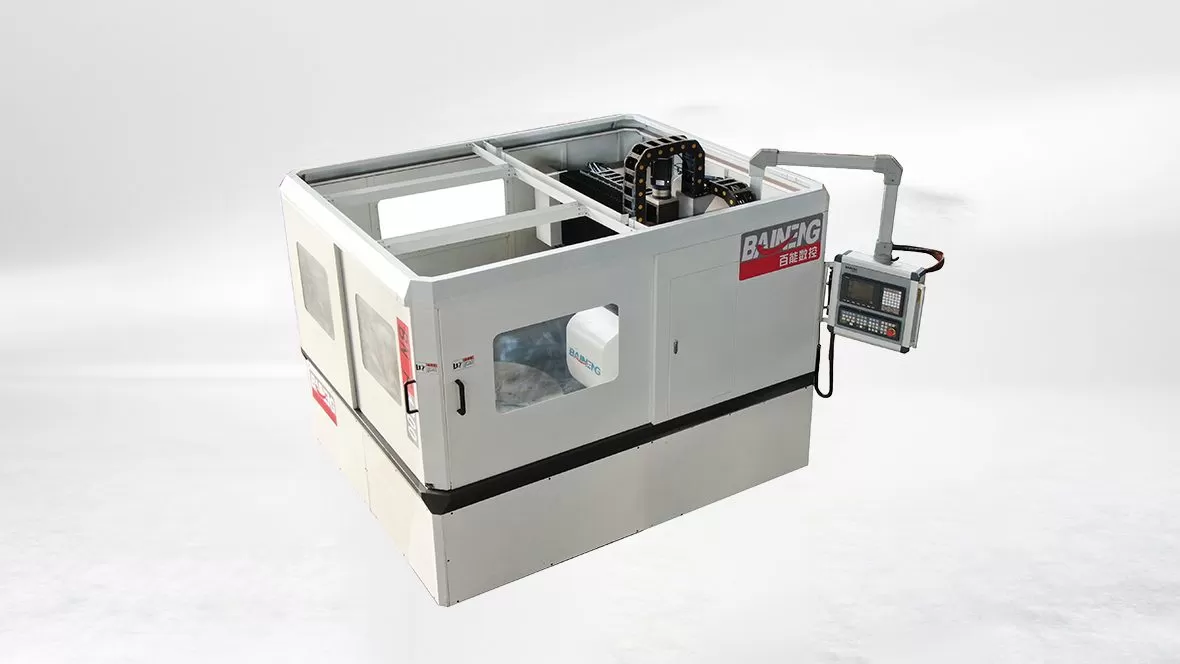
The Mechanical Architecture of CNC Grooving Systems
The performance of a glass v groove machine depends heavily on its structural rigidity and the quality of its motion-guiding components. Unlike cutting metals or plastics, processing glass introduces unique mechanical challenges. Glass is highly brittle, meaning any deflection in the spindle or the machine bed will translate directly into micro-cracks along the grooved edge. To prevent this, the machine frame is typically constructed from heavy-duty cast steel that undergoes thermal stress relief to ensure long-term dimensional stability.
Linear motion is handled by high-precision linear guide rails and ball screws or helical rack-and-pinion systems. These components ensure that the cutting head moves smoothly along the X, Y, and Z axes. Axis positioning is governed by high-resolution servo motors that operate in a closed-loop system, constantly reporting position coordinates back to the CNC controller. This feedback loop minimizes positioning errors, ensuring that parallel grooves remain perfectly aligned over large glass sheets, such as those used in office partitions or sliding door assemblies.
At the center of the carving process is the high-speed spindle. The spindle must provide stable torque across a wide range of rotational speeds, typically ranging from 6,000 to 12,000 RPM, depending on the glass thickness and the type of grinding wheel used. The spindle must also feature internal cooling or high-pressure external water nozzles to keep both the tool and the glass work-piece at a stable temperature, preventing thermal shock.
Tooling Configurations and Material Interactions
The quality of the finished groove is largely determined by the selection and sequencing of the grinding wheels. A typical glass v groove machine utilizes a multi-station tool changer or a sequential manual setup that utilizes different wheel compositions:
Metal-Bonded Diamond Wheels: These wheels are used for the initial rough cutting stage. The diamond particles embedded in the metal matrix quickly remove bulk glass material to establish the primary V-shape.
Resin-Bonded Diamond Wheels: Used for semi-finishing, these wheels refine the rough cut, smoothing out micro-ridges left by the metal-bonded wheel and preparing the surface for polishing.
Polishing Wheels (Cerium Oxide / Synthetic Rubber): The final stage involves polishing the grooved surface to restore transparency or achieve a uniform satin/matte finish, depending on the architectural specifications.
Operational Parameters for High-Precision Grooving
To prevent material failure, operators must balance several operational parameters based on the physical properties of soda-lime, borosilicate, or tempered-ready glass. The feed rate, spindle speed, depth of cut, and coolant flow rate must be synchronized precisely.
The feed rate—the speed at which the cutting wheel travels along the glass—must be adjusted based on the depth of the groove. Attempting to cut a deep V-groove in a single pass at a high feed rate increases the mechanical load on the glass edge, leading to immediate fracturing. Instead, deep grooves are often executed in multiple passes, with the depth of cut per pass carefully regulated. For instance, a 3mm deep groove might be processed in three separate passes of 1mm each, reducing the stress concentrated at the tip of the V-shape.
Coolant management is another variable that directly influences tool life and edge quality. Water acts as both a lubricant and a cooling agent. Without sufficient water flow directly at the point of contact between the diamond wheel and the glass, frictional heat rises rapidly. This heat causes localized thermal expansion of the glass, resulting in heat cracks. Additionally, water serves to flush away fine glass powder (swarf). If swarf is not continuously cleared, it acts as an abrasive paste that rapidly wears down the diamond wheels and scratches the surrounding polished glass surface.
| Operational Variable | Typical Range | Impact on Glass Quality |
|---|---|---|
| Spindle Speed | 6,000 - 10,000 RPM | Higher speeds reduce mechanical chipping but increase frictional heat. |
| Feed Rate | 1.5 - 5.0 m/min | Slower rates improve finish quality; faster rates increase throughput but risk edge wear. |
| Depth per Pass | 0.5 - 1.5 mm | Controlling depth prevents localized stress buildup and reduces breakage. |
| Coolant Flow Rate | 20 - 40 L/min | Continuous flow prevents thermal shock and flushes out abrasive glass swarf. |
Addressing Common Processing Bottlenecks
Glass fabricators frequently encounter specific bottlenecks when producing grooved glass panels. Addressing these issues requires a combination of robust machinery design and proper calibration of the CNC parameters.
One major challenge is maintaining a consistent groove depth across the entire length of a large glass sheet. Standard flat glass sheets often exhibit slight thickness variations or minor bowing. If a CNC machine operates on a fixed Z-axis coordinate, any dip in the glass surface will result in a shallower groove, while a raised area will result in a deeper groove, leading to visual inconsistencies. To solve this, advanced machines from BAINENG CNC can be configured with surface-sensing touch probes or pneumatic pressure-constant systems. These systems detect surface variations and dynamically adjust the Z-axis height in real time to maintain a uniform groove depth.
Another common bottleneck is wheel wear. As diamond wheels grind glass, the diamond grit gradually dulls, and the wheel profile can deform. If a V-groove wheel loses its sharp tip, the resulting grooves will have a rounded bottom instead of a sharp, clean angle. Regular dressing of the wheels using silicon carbide dressing stones is necessary to expose fresh diamond grit and restore the wheel's original profile. Incorporating automatic tool measurement systems helps operators monitor wheel wear and schedule maintenance before product defects occur.
Architectural and Decorative Applications
The output of a glass v groove machine is widely utilized across several sectors of the building and interior design industries. By creating clean, light-refracting lines, these machines add structural depth and aesthetic value to plain glass panels.
In architectural interiors, grooved glass is commonly used for partition walls, sliding doors, and shower enclosures. The grooves can be arranged in geometric patterns, gridlines, or custom artistic designs that diffuse light without completely blocking visibility. This is particularly desirable in commercial office layouts where both natural light transmission and privacy are required.
In the furniture manufacturing sector, V-grooving is applied to mirrors, cabinet glass doors, and tabletop glass. The sharp angles of the polished grooves catch the light, creating a decorative border that mimics traditional hand-beveled glass but with a level of dimensional consistency that can only be achieved through automated CNC processing. This consistency is highly valuable for high-volume furniture production lines where replacement parts must match original specifications precisely.
Selecting the Right Equipment Configuration
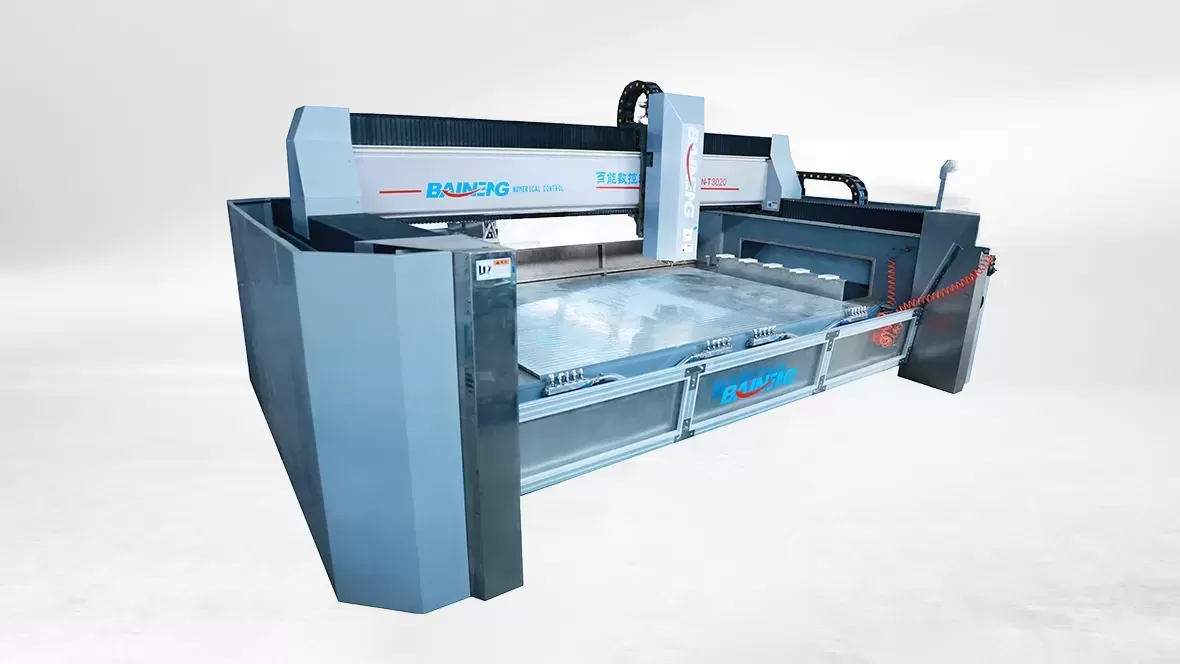
When investing in a glass v groove machine, manufacturers must evaluate several configuration options based on their specific product mix. Key considerations include the maximum glass sheet size the machine can accommodate, the number of spindles or tool stations available, and the software interface compatibility.
For operations processing a wide variety of custom designs, a machine with an automatic tool changer (ATC) is highly beneficial. The ATC allows the system to switch from a rough cutting wheel to a fine polishing wheel without operator intervention, reducing cycle times. For high-volume factories focusing on simple linear borders, a single-spindle machine with manual tool setups may offer a more cost-effective solution.
Software compatibility is another important factor. The CNC controller should seamlessly import standard CAD file formats (such as DXF or DWG). This allows design teams to transfer patterns directly from architectural plans to the machine shop floor, minimizing setup times and reducing programming errors.
Inquiry and Consultation
Selecting the appropriate CNC machinery configuration requires a detailed analysis of your production volume, glass thicknesses, and typical pattern designs. BAINENG CNC offers a range of glass processing solutions tailored to meet industrial manufacturing demands. To discuss your production requirements, obtain technical specifications, or request a custom quote, please contact our technical sales team for a detailed consultation.
Frequently Asked Questions
Q1: Can a glass v groove machine process tempered glass?
A1: No, tempered glass cannot be processed by a v-grooving machine. Any attempt to cut, groove, or drill tempered glass will cause the internal stresses to release, resulting in the immediate shattering of the entire sheet. All v-grooving, beveling, and cutting processes must be completed on annealed or raw glass prior to the tempering process.
Q2: How often do the grinding wheels need to be dressed or replaced?
A2: The lifespan of a grinding wheel depends on the glass hardness, feed rate, and the depth of the cuts. Metal-bonded diamond wheels last significantly longer than resin-bonded or polishing wheels. Typically, wheels require dressing every few hours of continuous operation to maintain their profile and cutting efficiency, while replacement intervals range from several weeks to months depending on production volume.
Q3: What is the minimum glass thickness required for safe v-grooving?
A3: It is generally recommended to use glass with a minimum thickness of 4mm to 6mm for v-grooving. The depth of the groove should never exceed one-third of the total glass thickness. For example, on a 6mm glass sheet, the groove depth should be kept under 2mm to ensure the structural integrity of the glass panel is not compromised.
Q4: How does the machine handle curved or circular groove patterns?
A4: A multi-axis glass v groove machine equipped with continuous path CNC control can easily process curves, circles, and complex organic shapes. The CAD/CAM software translates these shapes into precise X and Y coordinate movements while continuously adjusting the spindle orientation to keep the grinding wheel tangent to the curve.
Q5: What kind of maintenance is required to ensure machine longevity?
A5: Daily maintenance should include cleaning the glass swarf and dust from the guide rails, checking the coolant filtration system to ensure clean water supply, and verifying automatic lubrication levels. Weekly checks should focus on inspecting the spindle belt tension, examining the grinding wheels for uneven wear, and verifying the alignment accuracy of the motion axes.