
 FAQs
 Factory Tour



A glass machine is an umbrella term. It can mean an edger, a drilling center, an engraver, a beveling machine, or a working center that does several of those jobs. The machine name matters less than the process route.
Buyers often start with a model and then discover the route needs a different spindle, a different table, or a different control. BAINENG CNC builds CNC glass working centers, engraving machines, vertical drilling and milling machines, and 5-axis beveling machines. If you are comparing routes, send the drawing and the glass type to our team before you compare models.
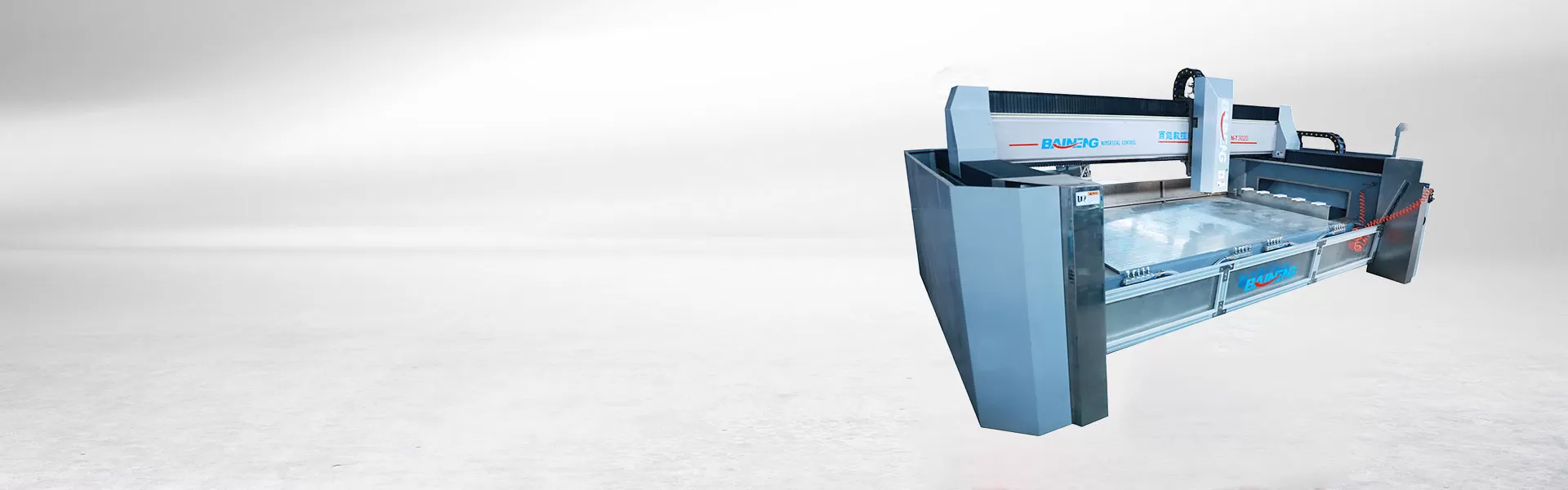
What the Machine Actually Does
A glass processing machine holds the sheet, moves a tool along the programmed path, and controls the cut or polish. The workholding is a vacuum table or a set of suction cups. The tool is a diamond wheel, a milling cutter, a drill, or a polishing wheel.
The machine does not decide the route. The drawing does. A hole, a bevel, a V-groove, and a polished edge need different tools and different kinematics. A working center can cover several routes, but it still runs them one at a time.
The glass type sets the limit. Float glass, laminated glass, and tempered glass behave differently. Mechanical edging, drilling, and engraving are normally done before tempering. Confirm the sequence with the tempering or laminating supplier before the first sheet is cut.
Route 1: Edging and Polishing
Edging removes the sharp arris and shapes the edge. A rough wheel cuts the shape; a fine wheel and a polishing wheel bring the edge to the required finish. The result is judged by flatness, chip size, and polish.
An edging route needs a stable table, a consistent wheel pressure, and enough water to cool the edge. A machine that is fast on a straight edge can still chip a curve if the feed rate is too high.
For a shop that only edges rectangular panes, a dedicated straight-line edger is efficient. For shaped parts, a working center with a contouring path is more flexible.
Route 2: Drilling and Milling
Drilling and milling cut holes, notches, and recesses. The tool path has to enter and exit without chipping the far side. A backing plate or a sacrificial layer can help on thin glass.
A vertical drilling and milling machine saves floor space because the sheet stands upright. A horizontal working center can handle larger panels and more complex shapes. The choice depends on the panel size, the hole pattern, and the loading method.
Check the spindle power, the tool holder, the coolant, and the vacuum hold-down. A small drill can walk on a slick surface if the sheet is not clamped evenly.
Route 3: Engraving and V-Groove
Engraving cuts a shallow pattern or a V-groove into the surface. It is used for decorative lines, logo fills, and the deep grooves that catch light in furniture and architectural glass.
The engraving route needs a rigid spindle, a precise depth control, and a tool magazine that can change from roughing to finishing. A vacuum table with a rubber surface grips the sheet without mechanical clamps.
Deep grooves put more load on the spindle than shallow lines. Ask for the depth, the width, and the number of passes. A machine that engraves a thin line may not hold a wide, deep groove without chatter.
Route 4: Beveling and 5-Axis Work
Beveling cuts an angled edge, often for a mirror, a tabletop, or a furniture panel. A 5-axis machine can tilt the tool to follow a shaped edge and produce a consistent bevel around a curve.
BAINENG’s 5-axis glass beveling machine uses four working heads and automatic switching in 0.3 seconds. It is aimed at special-shape glass where rough grinding, fine grinding, and polishing happen in one setup.
The trade-off is programming and setup time. A 5-axis route is efficient for complex or repeated shapes. For a simple straight bevel, a simpler machine can be faster and easier to justify.
| Route | Typical machine | Best for | Main limit |
|---|---|---|---|
| Edging | Straight-line edger or working center | Polished edges, rectangular panes | Shaped edges need contouring |
| Drilling / milling | Vertical drilling center or working center | Holes, notches, recesses | Chip control on thin glass |
| Engraving | CNC engraving machine | V-grooves, patterns, decorative lines | Depth and spindle rigidity |
| Beveling | 5-axis beveling machine | Angled edges, shaped parts | Programming and setup time |
The Sequence That Avoids Rework
Most glass processing follows a fixed order: cut to size, edge, drill or mill, clean, then temper or laminate. Engraving usually comes before tempering if the process is mechanical.
A glass machine is only one step in that chain. If the sheet is tempered before a hole is drilled, the hole cannot be added later without a high risk of breakage. If the edge is polished after lamination, the laminate can be damaged.
Write the route on the drawing. Mark the operations that must happen before tempering and the ones that can happen after. That single sheet prevents most of the rework in a glass shop.
Batch Size and Automation
One-off work rewards flexibility. A working center with CAD/CAM, a vacuum table, and a tool magazine can switch from a hole pattern to a bevel without a new fixture. The operator loads the drawing and the machine finds the route.
Repeat production rewards cycle time. A dedicated machine with a fixed route, a fast loader, and a short tool change can beat a flexible center on cost per piece. The right answer depends on the mix, not the machine size.
Ask for the tool change time, the rapid speed, the acceleration, and the real cycle on a sample. A machine with a high spindle speed can still lose time on tool changes and sheet loading.
A BAINENG CNC Example
The company was founded in 2011 in Fuding, Fujian. The company builds CNC glass engraving machines, glass working centers, vertical drilling and milling machines, laser machines, and 5-axis beveling machines. It lists more than 20 patents, CE and ISO certification, and customers in 50+ countries.
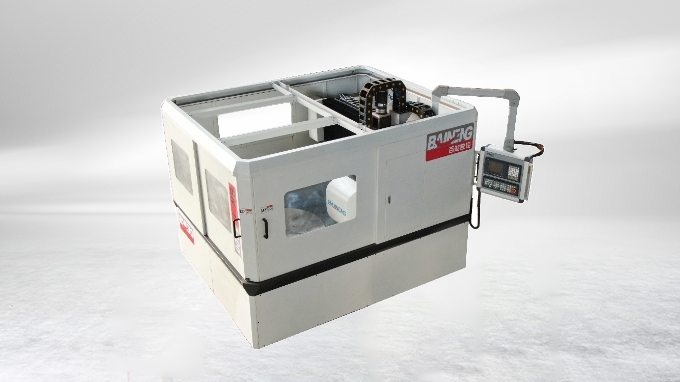
The CNC glass working center uses a Taiwan Syntec control system with BAINENG software. It can frost, edge, mill, drill, shape, bevel, write, and polish on one table. The machine weighs 4,800 kg, ships at 5,000 × 2,300 × 2,300 mm, and runs on 380 V.
The 5-axis beveling machine weighs 3,800 kg and needs 0.7 MPa air. Its four heads switch automatically, and the CAM software converts a CAD drawing into a processing file in one step.
Common Mistakes
- Buying a model before the route: the tooling and the table must match the drawing.
- Ignoring the glass type: tempered glass cannot be drilled or edged after processing.
- Comparing spindle speed only: rigidity, tool change, and hold-down decide the finish.
- No sample test: a demo on one pane may not repeat on a production sheet.
- No CAD/CAM check: the software must import the actual drawing format.
- No service plan: wheels, spindles, and vacuum systems need local support.
The Sample Route
Before you choose a machine, run the actual part through the route. Do not send a square sample if the production part has a curve, a hole, and a bevel.
- Cut: prepare the sample at the production size and glass type.
- Edge: check chip size, polish, and edge profile.
- Drill or mill: check hole position, chip damage, and cycle time.
- Engrave or bevel: check depth, angle, and surface finish.
- Temper or laminate: confirm the route is compatible with the downstream process.
Photograph each step and record the cycle time. The sample route shows whether one machine can cover the work or whether the shop needs two specialized machines.
Send the team the drawing, glass type, thickness, batch size, and target finish. The team can recommend a working center, an engraver, a drilling machine, or a 5-axis beveling machine for the route.
When you choose a glass machine, compare the process route, the sample result, and the service support, not only the price. Use the BAINENG CNC contact page or email kobexu@bai-neng.com. For the range, see the CNC glass working center page and the 5-axis beveling machine page.
Frequently Asked Questions
Q1: What does a glass processing machine do?
A1: It is a machine that cuts, edges, drills, mills, engraves, bevels, or polishes flat glass. The name covers several process routes, so the drawing and the glass type matter more than the category label.
Q2: Can one machine do edging, drilling, and engraving?
A2: A CNC glass working center can combine several routes on one table. The machine still needs the right tools and the right program for each route. A dedicated machine may be faster for a single high-volume operation.
Q3: Should I process glass before or after tempering?
A3: Mechanical edging, drilling, milling, and engraving are normally done before tempering. Tempered glass cannot be cut or drilled afterward without a high risk of breakage. Confirm laser or coating steps with the tempering supplier.
Q4: What should I check on a sample?
A4: Check chip size, edge polish, hole position, bevel angle, engraving depth, cycle time, and breakage rate. Use the production glass type and thickness, not a convenient sample.
Q5: How much does a glass processing machine cost?
A5: The price depends on the route, table size, number of axes, spindle power, tool magazine, control system, and automation. Compare the cost per finished part, including tooling, labor, and maintenance, not only the machine price.
Sources
- ISO 12100:2010, safety of machinery — general principles for design, risk assessment, and risk reduction.
- ISO 9001, quality management systems.