



Glass Laser Etching Technology Explained Simply
The glass laser etching technology explained simply is a story of focused light and thermal energy. This advanced, non-contact process uses a controlled laser beam to create a frosted, matte finish on a glass surface. It works by inducing microscopic fractures in the material. This creates a permanent mark without deep carving. This technology has revolutionized the decorative glass industry. It offers unparalleled precision, speed, and design flexibility. This definitive guide explains the science, mechanics, and applications of laser etching. It provides a clear understanding of how this innovative process works.
What is the Fundamental Principle of Glass Laser Etching?
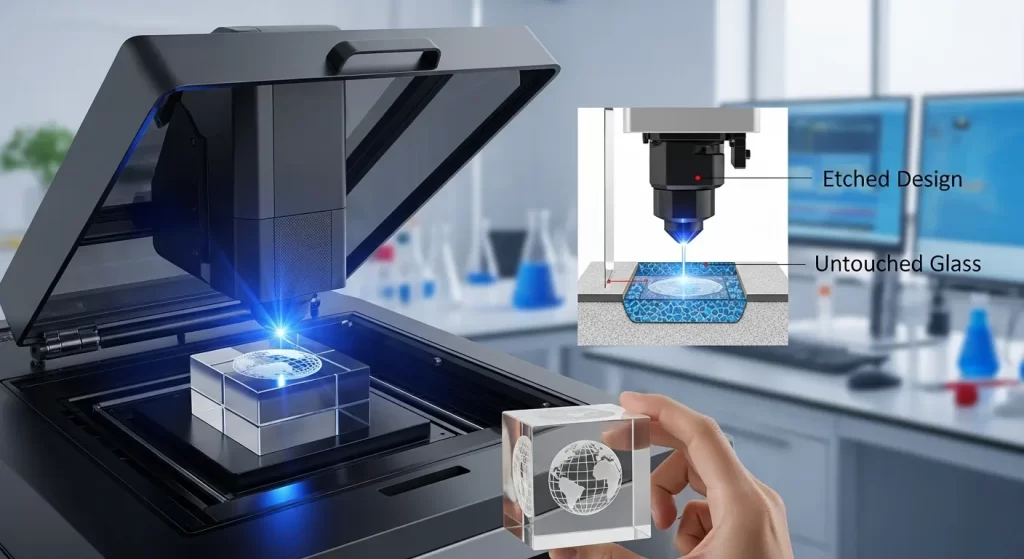
The fundamental principle of glass laser etching is the use of thermal stress to alter the glass surface. A highly focused laser beam rapidly heats a microscopic point on the glass. This intense, localized heat causes the spot to expand. The surrounding cool glass resists this expansion. This creates stress, which is relieved by the formation of a tiny fracture. The laser creates millions of these micro-fractures to form the final, frosted image.
How is it a Thermal, Non-Contact Process?
Laser etching is a thermal, non-contact process because nothing physically touches the glass except for a beam of light. The laser delivers energy in the form of heat. This heat does the work of creating the mark. Because there is no physical tool, there is no mechanical stress on the glass. This allows for the processing of very thin or delicate glass pieces without the risk of breakage from tool pressure.
What is the Science of Micro-Fracturing?
The science of micro-fracturing relies on the poor thermal conductivity of glass. When the laser strikes the surface, the heat does not spread out quickly. Instead, it becomes highly concentrated. This creates a steep thermal gradient between the hot spot and the cool surroundings. The resulting stress exceeds the glass's tensile strength at that microscopic point. This forces a tiny fracture to occur. The laser's power and speed are precisely controlled to ensure these fractures are very small and contained. This creates the frosted effect rather than a deep crack.
How Does Etching Differ From Engraving?
Etching differs from engraving in its method and resulting finish. The difference between glass engraving and etching is that etching is a surface-level abrasive or thermal process. It creates a frosted look with minimal depth. Engraving is a subtractive process. It uses a tool to physically carve a deep, clear groove into the glass. Etching creates a soft, diffused look. Engraving creates a brilliant, sparkling effect.
How Does Glass Laser Etching Technology Work?
The glass laser etching technology explained in its operation is a sophisticated dance of light and motion. A powerful laser beam is generated. It is then directed by a series of mirrors and a lens. A computer-controlled motion system moves this focused beam across the glass surface. This system accurately traces the digital design, creating the frosted mark one small area at a time.
What is the Role of the CO2 Laser Source?
The role of the CO2 laser source is to generate the powerful beam of light used for etching. CO2 lasers are the industry standard for working with organic materials like glass. They produce an infrared laser beam with a wavelength that is highly absorbed by glass. This efficient energy absorption is what allows for the rapid heating and micro-fracturing necessary for the etching process. The laser tube contains a mixture of gases that, when excited by electricity, produce the laser light.
How Does the Gantry and Optics System Function?
The gantry and optics system is the motion and delivery system for the laser beam. The laser beam exits the tube. It is then reflected by a series of mirrors. These mirrors are mounted on a moving gantry system. This gantry can move with high precision in the X and Y directions. The final mirror directs the beam downwards, through a focusing lens. The lens concentrates the beam to a very fine point. The gantry moves this focal point across the glass to draw the design.
What is Raster vs. Vector Etching?
Raster and vector are two different methods for creating the design.
- Raster Etching: This method works like an inkjet printer. The laser head scans back and forth across the glass, line by line. It fires the laser in a pattern of dots to build up the image. This method is ideal for etching filled areas, photographs, and complex, grayscale graphics.
- Vector Etching: This method works like a pen plotter. The laser follows the exact lines of a vector-based design file. It traces the outlines of shapes and letters. This method is faster for simple line art and text. It produces a very fine, sharp line.
How is the Design Transferred to the Glass?
The design is transferred to the glass through a digital workflow. First, the artwork is created or imported into a specialized graphic design program. These top glass engraving software tools allow the operator to prepare the file. The operator then sends the file to the laser's control software. They set the parameters for power, speed, and resolution. When the job is started, the laser's controller reads the file. It directs the motion system to reproduce the design on the glass surface.
What Are the Key Components of a Laser Etching Machine?
A laser etching machine is a complex system of integrated components. The quality and specification of each component contribute to the machine's overall performance, reliability, and safety. A professional-grade machine is defined by the quality of its laser source, motion system, and safety features. A good choice for a first machine is detailed in our guide on the best glass etching machines for beginners.
Why is the Laser Tube the Heart of the Machine?
The laser tube is the heart of the machine because it is the component that generates the laser beam. The two main types are glass tubes and RF (radio frequency) metal tubes. Glass tubes are less expensive but have a shorter lifespan. RF metal tubes are more expensive but last much longer. They also produce a finer, more consistent laser spot. The power of the laser tube, measured in watts, determines how fast the machine can etch. Higher wattage allows for faster production speeds. The market for industrial lasers is a key indicator of manufacturing trends.
What Defines the Motion Control System?
The motion control system is defined by its precision and speed. This system includes the gantry, guide rails, stepper or servo motors, and the controller. A high-quality system uses precision linear guides. These ensure smooth, stable movement. Servo motors offer higher speeds and greater accuracy than stepper motors. They are typically found on higher-end machines. The controller is the electronic brain. It translates the software's commands into precise motor movements.
How Does the Fume Extraction System Ensure Safety?
The fume extraction system is a critical safety component. The laser etching process vaporizes microscopic particles of glass, creating a fine silica dust. This dust is a serious respiratory hazard. The fume extraction system is a powerful vacuum. It pulls the air from the machine's enclosure through a series of filters. These filters, including a HEPA filter, capture the harmful particles. This prevents them from being released into the workshop environment. A proper extraction system is a non-negotiable part of how to engrave glass with laser safely.
What is the Importance of the Workbed and Material Support?
The workbed is the surface upon which the glass is placed. It must be perfectly flat and level. Many machines have an adjustable Z-axis workbed. This allows the operator to move the bed up and down to accommodate glass of different thicknesses and to set the correct laser focus. For cylindrical items like wine glasses, a rotary attachment is used. This device holds the glass and rotates it during the etching process. This allows for a continuous design to be etched around the circumference.
What Are the Main Applications of Glass Laser Etching?
The main applications of glass laser etching are incredibly diverse. The technology's precision, speed, and versatility have made it a popular choice for everything from industrial part marking to high-end architectural design. Its ability to create a permanent, high-resolution mark on glass has opened up a wide range of commercial and artistic possibilities.
How is it Used for Decorative Glassware and Awards?
Laser etching is widely used to personalize decorative glassware. This includes wine glasses, beer mugs, and decanters. It can be used to add monograms, logos, or intricate patterns. In the awards industry, it is used to etch text and graphics onto glass and crystal plaques. The high level of detail it can achieve makes it perfect for reproducing corporate logos and complex award information.
What is its Role in Architectural Glass and Signage?
In architecture, laser etching is used to create decorative patterns on large glass panels. These can be used for room dividers, privacy screens, or artistic wall features. It is also used for creating elegant, modern signage. Company names and logos can be etched onto glass panels for lobby signs or directional markers. The subtle, frosted look of the etch provides a sophisticated aesthetic. Some of these creative uses are explored in our guide to glass engraving ideas for architecture.
How Does it Apply to Branding and Product Serialization?
In industrial applications, laser etching is a fast and reliable method for product branding and serialization. It can be used to etch logos, part numbers, QR codes, and barcodes directly onto glass components. This creates a permanent, tamper-proof mark that is essential for traceability and quality control. This application is a key part of modern glass engraving for decor and branding in a manufacturing context.
What are Some Innovative Artistic Applications?
Artists are pushing the boundaries of the technology. They are using laser etchers to create highly detailed, photorealistic images on glass. They are also experimenting with multi-layered etching. In this technique, different power settings are used to create varying shades of frosting. This adds depth and subtlety to the artwork. The combination of digital precision and artistic vision is a key part of recent engraving and etching innovations.
How Does Laser Etching Compare to Other Methods?
Laser etching is just one of several methods for creating a frosted finish on glass. Its main competitors are traditional chemical acid etching and abrasive sandblasting. The laser offers significant advantages in speed, safety, and detail. However, each method produces a slightly different look and has its own set of advantages and disadvantages.
What is the Laser Etching vs. Chemical Etching Comparison?
The laser vs. chemical glass etching comparison is a trade-off between safety and finish. Chemical acid etching produces a very fine, smooth, and uniform frosted finish. It is often considered the highest quality traditional etch. However, it involves the use of highly hazardous hydrofluoric acid. This requires extensive safety precautions and is not suitable for a small workshop. Laser etching provides a very similar high-quality finish without the use of dangerous chemicals. It is a much safer and more environmentally friendly alternative.
How Does it Differ from Abrasive Sandblasting?
Laser etching differs from sandblasting in its level of detail and the texture of its finish. Sandblasting is a more aggressive process. It creates a deeper, rougher etch with a more granular texture. It is excellent for creating bold, high-contrast designs over large areas. However, it cannot match the fine detail and resolution of a laser. A laser can produce much finer lines and more intricate patterns than is possible with a sandblasting stencil.
What is the Laser Etching vs. CNC Engraving Distinction?
The laser etching vs. CNC engraving distinction is the most fundamental comparison. As detailed in our guide on laser engraving vs CNC engraving for glass, the difference is one of surface vs. depth. Laser etching creates a frosted mark on the surface. CNC engraving uses a physical tool to carve a deep, brilliant groove into the glass. One creates a soft, subtle effect. The other creates a bold, sparkling effect. They are two entirely different aesthetic choices.
What Are the Step-by-Step Operational Guidelines?
Following a professional, step-by-step workflow is essential for achieving high-quality results and for ensuring safe operation. This process moves from the digital design phase to the final execution on the machine. A methodical approach minimizes errors and maximizes efficiency. A list of professional glass engraving tips always starts with a disciplined workflow.
How Do You Prepare the Artwork for Etching?
The artwork preparation is a critical first step. The design should be a high-resolution image or a clean vector file. For photorealistic etching, the image should be converted to a grayscale bitmap. It may need to be dithered. Dithering is a process that converts the shades of gray into a pattern of black and white dots. This helps the laser to reproduce the tonal variations. The operator must also ensure the design is correctly sized for the final product.
What is Involved in Setting Up the Laser Machine?
Setting up the laser machine involves several key steps. The glass must be thoroughly cleaned to remove any fingerprints or oils. It is then placed on the machine's workbed. The most critical step is setting the correct laser focus. The distance between the lens and the glass surface must be set precisely. An out-of-focus laser will produce a blurry, low-quality etch. The operator must also set the "home" position or the starting point for the job.
How to Determine the Correct Laser Settings?
Determining the correct laser settings of power and speed is a process of testing and refinement. Different types of glass and different desired effects require different settings. A common practice is to use a small, scrap piece of the same glass to run a test grid. The grid is a series of small squares etched at various combinations of power and speed. The operator can then visually inspect the grid to find the setting that produces the best result.
How Do You Execute the Etching Process Safely?
Executing the process safely requires following a strict protocol. The operator must ensure the fume extraction system is running before starting the job. The machine's safety enclosure must be kept closed at all times during operation. The operator should never look directly at the laser beam. They should observe the process through the machine's protective viewing window. Following these rules is the core of how to engrave glass with laser safely.
What Are the Key Advantages of Using Laser Technology?
Laser technology offers a compelling set of advantages that have made it a dominant force in the decorative glass industry. Its combination of precision, speed, and versatility is unmatched by most traditional methods. These benefits translate directly into higher quality products and a more efficient workflow.
How Does it Achieve Unmatched Precision and Detail?
Lasers achieve unmatched precision because the "tool" is a nearly weightless beam of light. It can be moved and modulated with incredible speed and accuracy by the galvanometer system. The laser spot size can be focused down to a fraction of a millimeter. This allows for the creation of extremely fine lines and intricate details that would be impossible with a physical tool or a sandblasting stencil.
Why is it a Fast and Efficient Process?
It is a fast and efficient process because the laser can move at very high speeds. For raster etching, the laser head can scan across the glass at several meters per second. The setup time is also very low compared to chemical etching or sandblasting, which require the application and weeding of a mask. The ability to go directly from a digital file to a finished product in minutes is a major productivity advantage.
How Does the Non-Contact Nature Benefit the Process?
The non-contact nature of the process is a significant benefit. Since nothing physically touches the glass, there is no need for complex clamping systems. The glass simply needs to be placed on the workbed. This also means there is no tool wear. A diamond burr on a CNC machine will wear out over time. A laser beam does not. This reduces consumable costs and ensures a consistent result from the first piece to the last.
What is the Benefit of its Versatility?
The benefit of its versatility is that a single machine can produce a wide range of effects. By simply changing the software settings, a laser can be used to create fine lines, bold filled areas, and even photorealistic images. It can be used for surface etching. With a different setup, it can be used for deep engraving. On some specialized machines, it can even perform the sub-surface engraving detailed in our guide on how 3d glass engraving machines work.
Conclusion
The glass laser etching technology explained is a story of controlled energy. It is a process where a precise beam of light is used to create a permanent, beautiful mark on one of the world's oldest and most elegant materials. Its combination of speed, precision, and safety has made it an indispensable tool for artists, designers, and manufacturers. By understanding the principles of thermal stress and micro-fracturing, and by appreciating the sophisticated interplay of software and optics, one can see how this technology has truly mastered the art of etching glass with light.