



Engraving and Etching Glass: From Artistry to Industrial Precision
Engraving and etching glass are two distinct, yet often confused, techniques for permanently marking a glass surface.1 Both methods transform a simple, functional material into a work of art, a branded item, or a high-precision component. Though people often use the terms interchangeably, they are fundamentally different. Engraving involves cutting into the glass to create depth. Etching involves roughening the surface to create a frosted look.
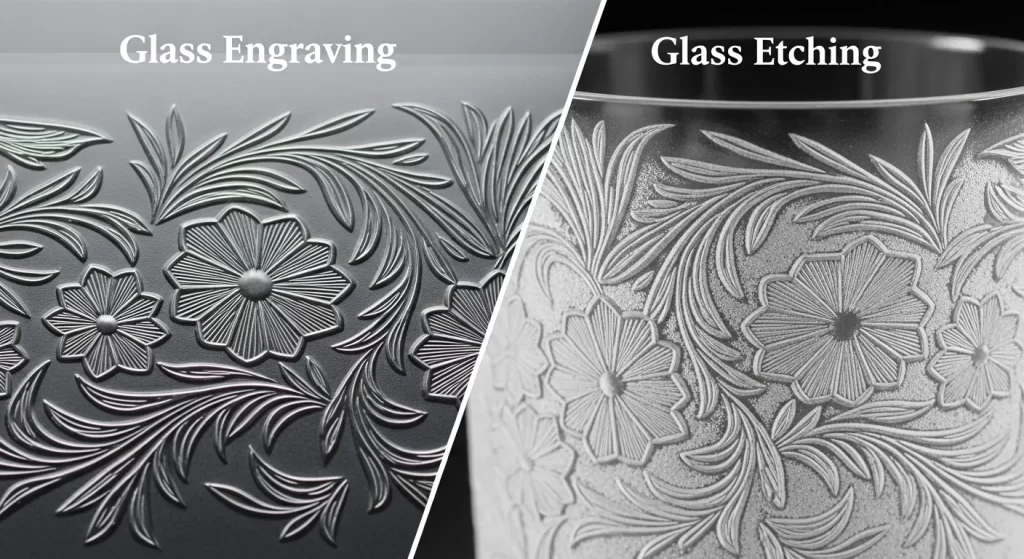
Understanding the difference is crucial for anyone in design, architecture, or manufacturing. The choice between them dictates the final look, feel, cost, and function of the finished piece. This guide provides a definitive comparison. We will explore the methods, from traditional hand-artistry to modern industrial machinery. We will cover the applications, technologies, and safety required. This is your expert resource for understanding how to add permanent, beautiful designs to glass.
What is the Core Difference Between Engraving and Etching Glass?
The core difference is mechanical versus surface-level.2 Engraving is a subtractive process that physically cuts grooves into the glass, creating real depth.3 Etching is an abrasive or chemical process that roughens the surface of the glass, creating a frosted, matte look with minimal depth.
Think of it this way: engraving is like carving, creating a 3D valley in the glass. Etching is like sanding, creating a 2D frosted texture on the surface. The resulting visual effects are complete opposites. An engraved line catches the light and sparkles. An etched surface diffuses light and provides privacy.4 This fundamental difference between glass engraving and etching is the most important concept to grasp.
What Defines Glass Engraving?
Glass engraving is a subtractive process. It uses a sharp tool or a focused laser to remove glass and create a groove. This groove has measurable depth and a distinct profile, often V-shaped or U-shaped.5 Because the cuts have angled facets, they catch and refract light. This gives engraved glass a brilliant, sparkling, jewel-like quality. It is a dimensional process that you can see and feel.
What Defines Glass Etching?
Glass etching is a surface-level process.6 It uses either corrosive chemicals or abrasive particles to roughen the top layer of the glass. This process, also known as Glass etching, creates millions of microscopic pits and fractures. These tiny imperfections scatter light as it passes through. This diffusion of light is what creates the classic translucent, "frosted" appearance. The surface feels slightly rough, but it lacks the significant depth of an engraving.
A Quick Comparison: Engraving vs. Etching at a Glance
| Feature | Glass Engraving | Glass Etching |
| Core Method | Subtractive (cutting/carving) | Abrasive or chemical (surface roughening) |
| Resulting Finish | Clear, brilliant, sparkling | Frosted, matte, translucent |
| Physical Depth | Significant, measurable depth | Minimal to no depth |
| Texture | A distinct groove you can feel | A slightly rough, sandy, or smooth matte surface |
| Light Interaction | Refracts light (sparkles) | Diffuses light (glows) |
| Primary Tools | Diamond burrs, laser (high power) | Sandblasting media, acid, laser (low power) |
What are the Primary Methods of Glass Engraving?
The primary methods are CNC rotary engraving, which uses a spinning diamond bit to carve the glass, and laser engraving, which uses a focused laser to create micro-fractures. A specialized third method, 3D sub-surface engraving, uses a laser to create images inside the glass.7
These high-precision methods have moved the craft from purely hand-held artistry to an industrial process. They allow for perfect repeatability and the creation of complex digital designs.8
How does CNC Rotary Engraving work?
CNC (Computer Numerical Control) rotary engraving is a physical, mechanical process.9 The machine uses a high-speed spindle to spin a cutting tool, called a burr. This burr is coated in fine industrial diamond particles. A computer controls the movement of the spindle, guiding the rotating burr across the glass surface. This action physically carves or grinds away the glass, creating a clean, deep groove.
This method is prized for its depth and brilliance. The shape of the diamond burr (e.g., a V-shape) determines the profile of the cut. This is what creates the classic, hand-carved look with sharp facets that sparkle. This process requires a constant stream of liquid coolant (like water) to prevent heat buildup and remove glass dust.
How does Laser Engraving work?
Laser engraving is a non-contact, thermal process.10 A high-power laser beam is focused onto a tiny spot on the glass surface. The intense energy rapidly heats the glass, causing localized thermal stress.11 This stress results in tiny micro-fractures, or "chips," in the glass.12 The laser moves at high speed, creating thousands of these small fractures per second to form the design.
The result is a mark that looks like a high-resolution frosted engraving. It has a slightly sandy texture and a bright, whitish appearance. While it has some depth, it is typically much shallower than a CNC rotary engraving. This method is exceptionally fast and precise, perfect for detailed text and logos. For more on this, see how to engrave glass with laser safely. The choice between these two main industrial methods is a key one, explored further in our laser engraving vs. CNC engraving for glass comparison.
What about 3D Sub-Surface Laser Engraving?
3D sub-surface laser engraving is a specialized technique that uses a high-frequency laser to create small points of fracture inside a solid block of glass or crystal. It leaves the outer surface completely smooth and untouched, creating a 3D image that appears to float.
This method is truly unique. The laser is calibrated to pass harmlessly through the surface. It only delivers its energy at a precise focal point within the material. A complex 3D digital model is converted into a "point cloud" of millions of coordinates. The machine then plots these points inside the crystal, one by one. This is how 3D photo crystals and high-end awards are made. You can learn more about this fascinating technology in how 3D glass engraving machines work.
What are the Main Types of Glass Etching?
The main types are abrasive etching (sandblasting), chemical (acid) etching, and laser etching. Sandblasting uses high-pressure media for a deep, frosted look. Acid etching uses corrosive chemicals for a smooth, satin finish.14 Laser etching uses a laser for a fine, surface-level frost.
Unlike engraving, which is about carving, etching is all about changing the surface texture. These methods are widely used in both artistic and industrial applications.
How does Abrasive Etching (Sandblasting) work?
Abrasive etching, or sandblasting, is a physical process. It involves propelling a fine-grained abrasive (like aluminum oxide or silicon carbide) at high pressure onto the glass surface. To create a design, a stencil or "mask" made of rubbery vinyl is applied to the glass first. The design is cut and "weeded" from the mask, exposing only the areas to be etched.
When the abrasive hits the exposed glass, it erodes the surface, creating a deep, frosted, and evenly textured finish. Sandblasting allows for "stage carving," where different areas can be blasted for longer periods to create varying depths and a 3D, sculptural effect on the surface.16
How does Chemical (Acid) Etching work?
Chemical etching is a corrosive process.17 It involves applying a substance containing hydrofluoric acid to the glass. This acid is one of the few chemicals that can actually dissolve glass.18 It reacts with the silica in the glass, removing a microscopic layer of the surface.
The result is an exceptionally smooth, fine-grained, satin-like frosted finish. It is often considered the most elegant and luxurious type of etch. However, this method is extremely hazardous. Hydrofluoric acid is highly toxic and dangerous to handle, requiring extensive safety equipment and professional facilities.19 This is a key point in the laser vs. chemical glass etching debate.
How does Laser Etching function?
Laser etching is similar to laser engraving but uses different settings. It is a fast, digital, and non-contact method. A CO2 laser beam moves back and forth over the surface (a raster motion). It uses lower power and high speed to just disrupt the very top layer of the glass. This creates a fine, frosted look that is very similar to a light acid etch.
This method is excellent for its precision and speed. It can reproduce highly detailed photographic images on glass, which is difficult with other methods. It is a clean process that does not use chemicals or abrasives. This makes it a popular choice for personalizing glassware or electronic screens. You can find a deeper dive in our article where glass laser etching technology is explained.
What are the Key Applications for Engraving and Etching?
Engraving is best for high-value items where depth and sparkle are desired, like crystal awards or fine art. Etching is ideal for privacy glass, shower doors, and branding on glassware, where a frosted, matte finish is needed over larger surfaces.
The choice of method is driven entirely by the desired final effect and the application. A high-end crystal award demands the sparkle of engraving.20 A bathroom shower door requires the light-diffusing privacy of etching.
When is Engraving the Best Choice?
Engraving is the best choice when the goal is a deep, brilliant, and dimensional mark. Its light-catching properties make it ideal for high-value items.
- Crystal Awards and Trophies: The V-carved text and logos sparkle brilliantly.
- Fine Art: Artists use diamond burrs to create detailed, dimensional artwork.
- High-End Signage: Deep-carved logos in thick glass for corporate lobbies.
- Detailed Text: Provides exceptional sharpness for small, fine print.To achieve these results, one must use professional glass engraving tips.
When is Etching the Best Choice?
Etching is the preferred method when the goal is a smooth, frosted finish that diffuses light and provides privacy.
- Privacy Glass: Used for bathroom windows, shower doors, and office partitions.21
- Architectural Elements: Creating large-scale frosted patterns on glass walls or balustrades.
- Glassware Branding: A common method for putting logos on pint glasses, wine glasses, and bottles.22
- Subtle Decoration: Creating elegant, muted borders or designs on mirrors.
How are these used for Decor and Branding?
Both techniques are workhorses for glass engraving for decor and branding. A brand might choose etching for its subtle, frosted logo on the glass door of its office. It might choose deep engraving for its high-end executive awards. For personalized gifts, like wine bottles, etching provides a soft, elegant look, while engraving provides a sharp, sparkling one.
What are some ideas for Architectural Glass?
In architecture, these methods create functional art.
- Etching: Used to create entire walls of privacy glass in offices. It can also be used to create anti-slip patterns on glass flooring.23
- Engraving: CNC engraving can be used to carve intricate patterns into thick glass panels for use as feature walls or artistic dividers.24There are many creative glass engraving ideas for architecture that blend both form and function.
What are the unique applications of 3D Glass Art?
3D sub-surface engraving is in a class of its own. Its applications are unique and cannot be replicated by any other method. These are explored in our guide to 3D glass art machine applications.
- 3D Photo Crystals: The most popular consumer product.
- Complex Corporate Awards: Engraving a 3D model of a new product inside a crystal block.
- Medical and Scientific Models: Visualizing 3D data, like a protein molecule or an MRI scan, inside glass.25
What Tools and Technologies are Required?
The required tools depend on the method. CNC engraving requires a rigid CNC router with a high-speed spindle and coolant. Laser engraving requires a CO2 laser machine with an appropriate lens and fume extraction. Etching requires a sandblasting cabinet or acid-etching supplies.
The transition from artistry to industrial precision is all about the machinery. Modern fabrication relies on sophisticated, computer-controlled equipment to achieve perfect consistency and complex designs.26
What defines a high-quality CNC Engraving machine?
A CNC machine for glass engraving must be extremely rigid.27 Glass exerts significant force on the tool. Any vibration in the machine will result in a poor-quality cut. Key features include:
- A heavy, stable frame (often cast iron or polymer concrete).28
- A high-frequency, water-cooled spindle for speed and thermal stability.
- A reliable coolant delivery system to flood the cutting area.
- Precision motion controls (ball screws and linear guides).29
What defines a Laser Engraving/Etching machine?
A laser machine for glass is almost always a CO2 laser. This is because the wavelength of CO2 lasers is highly absorbed by glass. Key features include:
- A reliable CO2 laser tube (glass or metal) with appropriate power (40W-100W is common).
- A high-quality lens (often a 2.0-inch focal length) for a fine spot size.
- A powerful fume extraction system to remove the fine glass dust.
- A rotary attachment for engraving cylindrical items like glasses.30
What are the best machines for beginners?
For beginners, the entry point is usually a desktop CO2 laser or a small, self-contained sandblasting cabinet. Desktop lasers offer an incredible range of capabilities for a relatively low entry cost. They connect directly to a computer. Small sandblasting cabinets are also affordable but require a separate air compressor. Our guide on the best glass etching machines for beginners compares these options in detail.
Why is Software so important for precision?
Software is the brain of the entire operation. It is what translates a creative idea into machine instructions.
- CNC Engraving: Requires CAD (Computer-Aided Design) software to create the vector paths. It also needs CAM (Computer-Aided Manufacturing) software to generate the toolpaths and G-code.
- Laser Engraving/Etching: Uses graphic design software (like CorelDRAW or Adobe Illustrator) to create designs.31 A specialized laser control software then takes that design and controls the laser's power, speed, and movement.32The capabilities of the top glass engraving software tools are critical for achieving professional, high-resolution results.
What are the Essential Safety and Maintenance Considerations?
Engraving and etching glass present significant safety hazards that must be managed with professional protocols. The main risks are airborne silica dust, chemical burns (from acid etching), laser light exposure, and the risk of cuts from handling glass.
What are the primary safety hazards?
- Silica Dust: Sandblasting and CNC engraving create a fine powder of crystalline silica.33 Inhaling this dust can cause silicosis, a serious lung disease. Water coolant systems (for CNC) and high-power dust collection systems (for sandblasting) are non-negotiable.
- Chemical Burns: Hydrofluoric acid used in chemical etching is extremely dangerous.34 It is toxic and can cause severe, deep-tissue burns that may not be immediately painful. This method should only be used in industrial settings with specialized ventilation and safety equipment.
- Laser Safety: Never look directly at a laser beam.35 A high-power CO2 laser can cause severe eye damage and skin burns.36 A machine with a fully interlocked safety enclosure is essential, as detailed in how to engrave glass with laser safely. Fumes from laser engraving must also be properly ventilated.37
- Glass Breakage: Always wear safety glasses and cut-resistant gloves when handling glass.38
How do you maintain the machines for longevity?
Proper maintenance is key to protecting your investment and ensuring consistent quality. Each machine type has its own critical needs.
- For Laser Machines: The most important task is keeping the optics (mirrors and lens) perfectly clean. Dust or residue on the lens will absorb laser energy, reducing power and eventually cracking the lens.39
- For CNC Machines: The primary task is managing the coolant system. Keep the coolant clean and free of excessive glass slurry. This protects the pump and ensures a good finish. Keep the precision guide rails clean and lubricated.
- For Sandblasters: Regularly sift the abrasive media to remove contaminants. Check the nozzle for wear. Inspect the dust collector's filters.Our general guide on the maintenance of glass engraving machines provides a more detailed checklist.
Conclusion
The choice between engraving and etching glass is a choice between two distinct artistic languages. Engraving offers the sparkle, depth, and brilliance of a physical cut. It is ideal for creating high-value, dimensional art. Etching offers the soft, subtle, and sophisticated diffusion of a frosted surface.40 It is the workhorse for privacy, large-scale patterns, and elegant branding.
By understanding the fundamental differences in their methods, technologies, and applications, you can make an informed decision. You can select the perfect technique to transform a simple piece of glass into a statement of purpose, whether for art, architecture, or industry.