
 FAQs
FAQs Factory Tour



Flat glass processing requires a balance between speed, surface integrity, and dimensional tolerance. Historically, factories relied on separate, dedicated machines to perform drilling and surface etching or frosting. This multi-stage approach introduced positioning errors during material transfers, increased the footprint of the production floor, and elevated labor costs. To address these operational challenges, the introduction of the GLASS LASER DRILLING SANDBLASTING MACHINE represents a significant shift toward consolidated CNC operations, allowing manufacturers to execute complex drilling and surface texturing sequences within a single workstation.
For industrial fabricators and machine operators, understanding the mechanics of this integration is vital. By combining laser-driven thermal ablation with automated abrasive delivery systems, companies such as BAINENG CNC have engineered platforms that mitigate the structural risks associated with traditional mechanical drilling. This article explores the technical configurations, operational parameters, and practical industrial applications of these integrated systems.
The Mechanical and Thermal Challenges in Traditional Glass Fabrication
Conventional glass drilling relies primarily on diamond-impregnated core drill bits. While effective for high-volume, uniform operations, mechanical drilling presents inherent physical limitations that affect overall yield and edge quality:
Tool Wear and Dimensional Drift: As diamond drill bits wear down, their cutting efficiency decreases, leading to changes in the inner diameter tolerances of the drilled holes. This requires frequent operator intervention for tool calibration or replacement.
Micro-Fracturing and Sub-Surface Damage: Mechanical force applied by a rotating drill bit induces localized tensile stress. This stress often results in micro-cracks around the entry and exit points of the hole, which can compromise the structural integrity of the glass during the subsequent tempering process.
Thermal Shock from Friction: Despite the continuous application of liquid coolants, mechanical friction generates substantial localized heat. If coolant distribution is uneven, thermal shock can cause immediate breakage during the drilling cycle.
Similarly, manual or offline sandblasting processes present substantial administrative and environmental hurdles. Standard sandblasting cabinets require manual loading, alignment, and masking. This manual masking process is labor-intensive and prone to human error, resulting in inconsistent etching depths and misaligned patterns. Additionally, managing dust emissions in non-integrated systems requires expensive extraction infrastructure to maintain safe working environments.
The Architecture of an Integrated GLASS LASER DRILLING SANDBLASTING MACHINE
An integrated GLASS LASER DRILLING SANDBLASTING MACHINE solves these challenges by combining non-contact thermal processing with a closed-loop sandblasting system under a unified CNC control system. This configuration allows a sheet of glass to be loaded onto the working table, positioned, drilled, and frosted without shifting the datum point or changing physical tooling.
Laser Drilling Subsystem
The drilling component typically utilizes a high-power CO2 laser source or, in specialized thin-glass applications, an ultraviolet (UV) or green laser source. CO2 lasers operating at a wavelength of 10.6 micrometers are highly absorbed by silicate glass, making them suitable for controlled thermal ablation. Rather than relying on physical abrasion, the laser beam rapidly heats a precise localized zone, causing the material to vaporize or undergo controlled thermal spallation. Advanced scanner heads control the laser path, enabling the system to cut circular holes, countersinks, and complex cutouts with sub-millimeter precision without applying mechanical pressure.
Automated Sandblasting Module
Following the laser processing stage, the CNC system directs the sandblasting nozzle to the designated areas. This module consists of a pressurized abrasive delivery system, a multi-axis CNC gantry, and a sealed extraction enclosure. The abrasive medium—commonly aluminum oxide or silicon carbide—is accelerated through a wear-resistant tungsten carbide nozzle onto the glass surface. Because the movement is controlled by the same CNC software that guides the laser, the sandblasted patterns, hinge cutouts, or decorative borders align with the laser-drilled holes, eliminating manual marking or physical masking steps.
Process Parameter Control for Optimal Output
To achieve high-quality results on different glass types, operators must calibrate several operational parameters. The table below outlines typical ranges for processing 6mm soda-lime glass using an integrated platform engineered by BAINENG CNC:
| Process Stage | Parameter Type | Standard Operating Range | Impact on Glass Quality |
|---|---|---|---|
| Laser Drilling | Laser Power (CO2) | 150W – 400W | Determines vaporization rate; excess power can cause thermal cracking. |
| Laser Drilling | Pulse Frequency | 5 kHz – 20 kHz | Controls heat accumulation; higher frequencies produce smoother edges. |
| Laser Drilling | Scanning Speed | 100 mm/s – 500 mm/s | Influences cycle time and depth per pass. |
| Sandblasting | Air Pressure | 0.3 MPa – 0.6 MPa | Controls impact velocity; higher pressure increases etching depth and roughness. |
| Sandblasting | Abrasive Mesh Size | 120 mesh – 240 mesh | Smaller mesh sizes yield a finer, satin-like frosted finish. |
Managing these variables prevents thermal stress accumulation. For example, during the laser drilling sequence, using pulsed emission rather than a continuous wave allows the surrounding glass matrix to cool between pulses, minimizing the heat-affected zone (HAZ) and reducing the risk of post-processing fractures.
Industrial Application Scenarios
The consolidation of drilling and sandblasting into a single CNC system serves several sectors within the glass fabrication industry. By removing secondary handling, factories can improve throughput and maintain consistency across large production runs.
Architectural and Facade Glass
Modern building designs frequently specify point-supported glass facades, balustrades, and structural canopies. These applications require precise, tension-free holes to accommodate heavy metal spiders and mounting hardware. Any micro-cracks inside the hole bore can propagate under wind loads, leading to spontaneous breakage. Utilizing a laser-based drilling system ensures the internal surfaces of the holes remain smooth and free of mechanical micro-fractures, while the integrated sandblasting unit can simultaneously apply non-slip borders or safety striping along the glass edges.
Interior Fit-Outs and Shower Enclosures
The manufacturing of frameless shower doors requires processing heavy, tempered glass sheets that need precise hinge cutouts, handle holes, and decorative privacy bands. In a traditional workflow, this requires transferring heavy sheets between a drilling machine, a cutting table, and a sandblasting booth. An integrated GLASS LASER DRILLING SANDBLASTING MACHINE processes these sheets in a single cycle. The glass sheet is loaded onto the machine bed, the hinge cutouts are drilled by the laser, and the specified frosted privacy panels are applied by the sandblasting nozzle in sequence, reducing handling times and labor requirements.
Home Appliance Glass
Control panels for ovens, microwave doors, and refrigerator shelving require precise cutouts for knobs, digital displays, and mounting brackets, often combined with satin or textured borders. Because appliance glass is relatively thin (typically 3mm to 5mm), mechanical drilling often results in high reject rates due to edge chipping. The non-contact nature of laser drilling combined with automated CNC sandblasting allows manufacturers to process these fragile panels with consistent yield rates and high edge quality.
Long-Term Operational and Environmental Benefits
Transitioning from separate manual and mechanical stations to an integrated CNC platform impacts the overall cost structure and environment of a glass processing factory.
First, resource allocation is streamlined. Reducing the physical footprint by replacing two distinct machine stations with a single integrated unit frees up valuable factory floor space. This consolidation also reduces energy consumption, as a single, coordinated CNC controller manages both processing steps, minimizing idle power consumption. Additionally, the elimination of physical drill bits reduces the inventory costs associated with consumable diamond tools, replacing them with long-lasting laser optics and recyclable abrasive media.
Second, environmental and safety compliance is improved. Traditional sandblasting booths pose respiratory hazards due to airborne silica dust. The sandblasting modules within modern CNC equipment are fully enclosed and operate under continuous negative pressure. Integrated dust collection systems automatically extract, filter, and separate the reusable abrasive grit from the fine glass dust, ensuring that operators are not exposed to hazardous particles and that the workspace remains clean.
Procurement and Engineering Integration
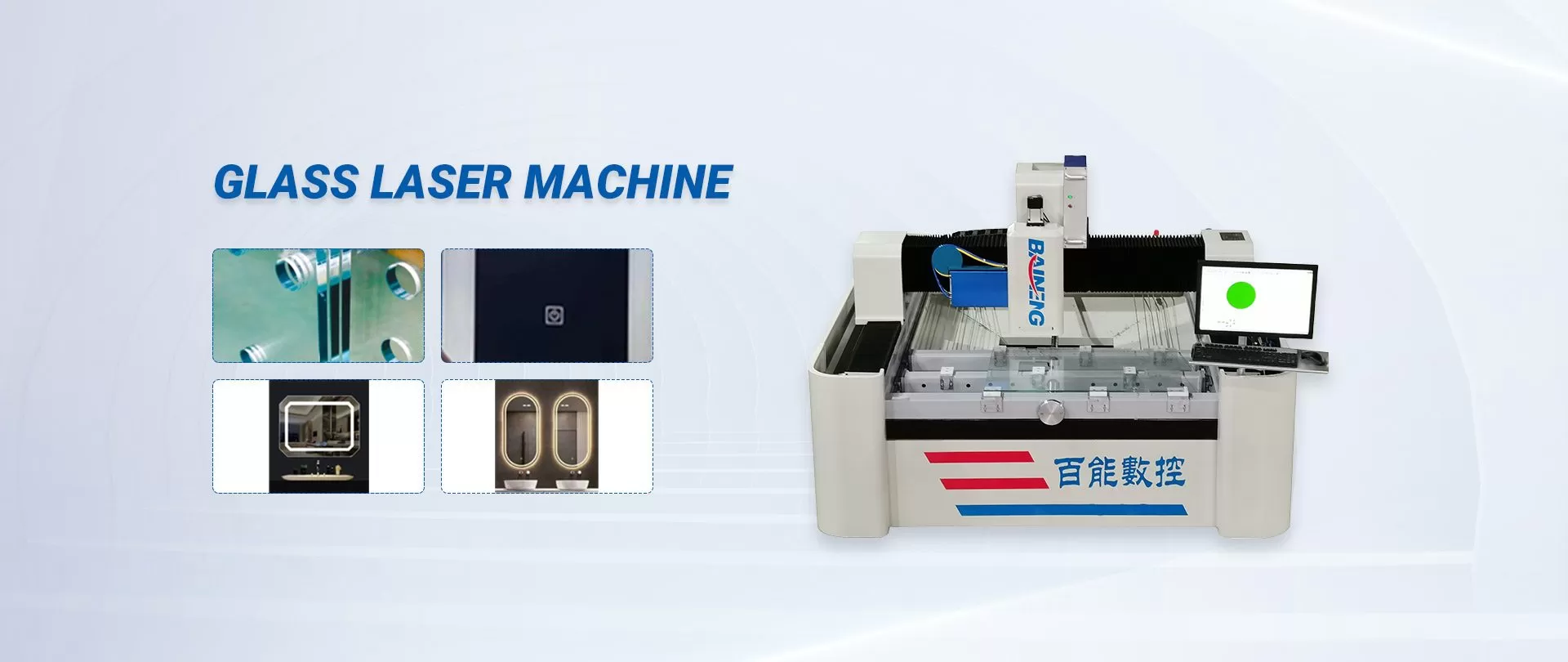
When evaluating a GLASS LASER DRILLING SANDBLASTING MACHINE for integration into an existing production line, engineering teams should assess several hardware and software specifications. It is important to verify compatibility between the machine’s CNC interface and existing CAD/CAM design programs, ensuring that files can be imported directly without manual conversion. Furthermore, the structural rigidity of the machine frame, the quality of the linear guide rails, and the dust-proofing of the motion control components will directly influence the machine's long-term operational lifespan in abrasive glass-dust environments.
As a manufacturer of specialized CNC glass processing equipment, BAINENG CNC develops solutions tailored to the production requirements of modern glass factories. If you are looking to update your current glass fabrication line, reduce manual processing steps, or improve overall edge quality on high-specification architectural projects, our engineering team is available to assist. We can discuss machine configurations, software integration, and custom work-table dimensions to fit your specific production demands.
Please contact our sales office directly for technical inquiries, customized quotations, or to schedule a demonstration of our processing equipment.
Frequently Asked Questions
Q1: What is the maximum glass thickness that a GLASS LASER DRILLING SANDBLASTING MACHINE can process?
A1: Standard systems are optimized for glass thicknesses ranging from 3mm to 19mm. For thicknesses exceeding 12mm, the laser drilling speed is managed through multi-pass scanning profiles to prevent excessive heat buildup while maintaining vertical hole geometry.
Q2: Does laser drilling require water cooling like traditional diamond drilling?
A2: No, laser drilling is a dry, thermal process that does not require continuous water cooling. However, some configurations use localized air or gas assist nozzles to cool the immediate area, clear vaporized glass debris, and protect the focusing optics from contamination.
Q3: Can the sandblasting unit handle different types of abrasive media?
A3: Yes, the system is designed to work with various abrasive media, including aluminum oxide and silicon carbide. The choice of grit size—typically ranging from 80 mesh for rapid material removal to 240 mesh for fine decorative frosting—allows operators to customize the surface texture and roughness.
Q4: How does the machine prevent abrasive dust from damaging the sensitive laser optics?
A4: The machine features a sealed cabinet design with separate working zones or automated physical barriers that isolate the laser head during the sandblasting cycle. Additionally, positive air pressure systems blow a continuous stream of clean air across the optical lenses to prevent dust settling.
Q5: What maintenance is required for the integrated CNC system?
A5: Routine maintenance involves checking the dust extraction filters, inspecting the sandblasting nozzles for wear, cleaning the linear guide rails, and verifying the condition of the laser protective windows. Regular calibration of the optical alignment ensures consistent drilling accuracy over long production cycles.