
 FAQs
FAQs Factory Tour



High-precision glass manufacturing requires processing methods that minimize material stress, reduce setup times, and maintain tight dimensional tolerances. Traditional horizontal processing centers have served the industry for decades, but modern requirements for architectural, shower-door, and structural glass have shifted the focus toward vertical configurations. The vertical glass drilling and milling machine represents a significant design evolution, addressing physical limitations inherent in horizontal setups, particularly regarding structural deflection, footprint management, and coolant efficiency.
BAINENG CNC has developed vertical machinery platforms to address these specific manufacturing demands. By examining the mechanical principles, structural dynamics, and tooling configurations of these systems, manufacturers can make informed decisions regarding their glass processing operations.
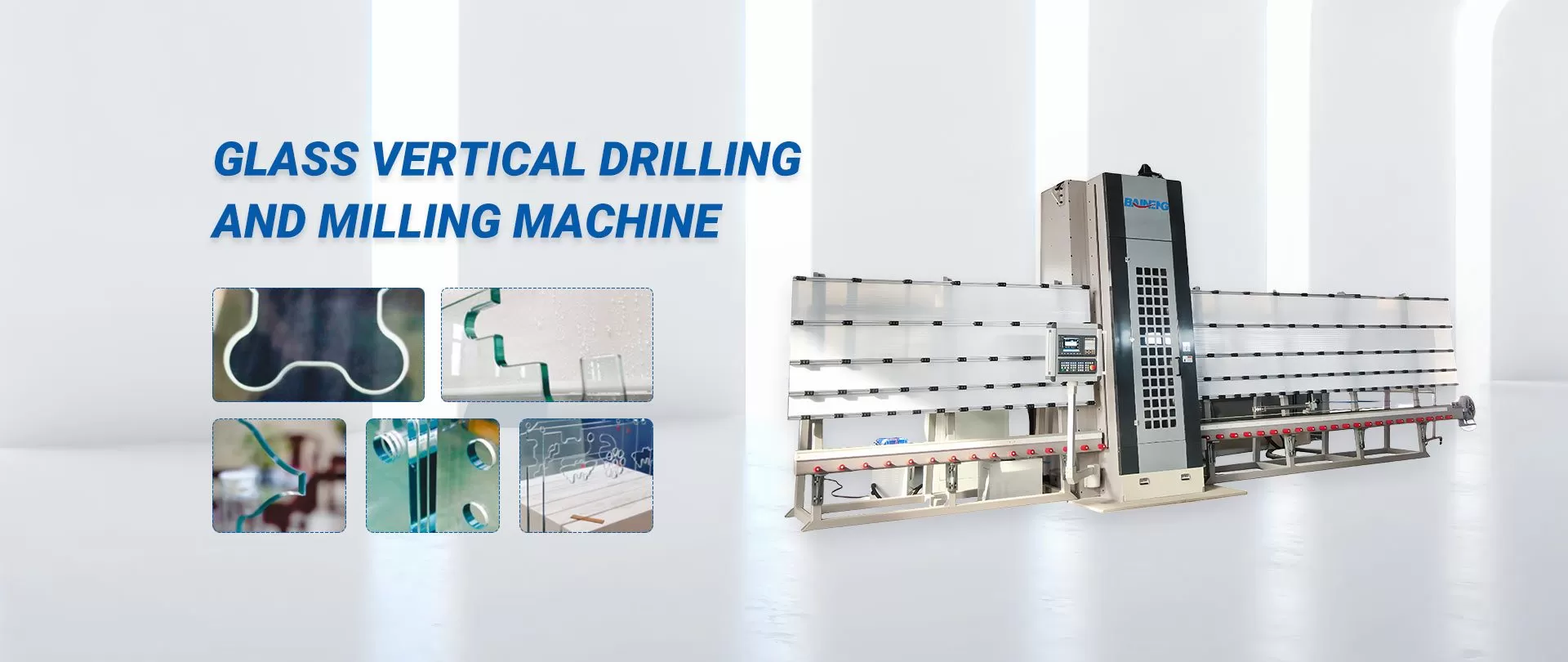
Mechanical Advantages of Vertical Glass Alignment
The primary distinction of a vertical glass drilling and milling machine lies in how the glass sheet is supported and processed. Rather than lying flat on a horizontal table, the glass stands on a support conveyor, tilted slightly backward at an angle typically between 3 and 7 degrees. This configuration alters the physical forces acting on the glass during mechanical operations.
Gravity-Assisted Waste and Coolant Management
In horizontal setups, glass fines (swarf) and coolant tend to pool on the glass surface, particularly in deep milling cuts or internal pocket routes. This pooling can obscure the tool-to-glass interface and cause micro-scratching as the grinding wheel grinds trapped glass particles back into the surface. In a vertical configuration, gravity naturally pulls water, glass dust, and core debris downward, away from the cutting zone. This continuous drainage extends tool life, prevents surface scratching, and ensures a cleaner working area without requiring high-volume blow-off systems.
Eliminating Sag and Flexure in Large Sheets
Large glass plates, especially thin sheets or laminated safety glass, exhibit mechanical flexure when supported horizontally on point-contact vacuum pads. This sag makes it difficult to maintain precise depth control across the entire sheet, often resulting in uneven beveling or incomplete drill holes. The vertical support backplate provides continuous support across the plane of the glass, neutralizing gravitational deflection. Consequently, the spindle maintains a consistent perpendicular orientation to the glass surface, preserving geometrical accuracy across large surface areas.
Structural Components and Spindle Mechanics
The operational performance of a vertical glass drilling and milling machine is determined by its structural stiffness and spindle design. BAINENG CNC utilizes high-tensile structural frames designed to absorb high-frequency vibrations generated during high-speed grinding and drilling cycles.
Double-Spindle Configuration for Zero-Breakout Drilling
Drilling glass requires a different approach than drilling metal or polymers due to the brittle nature of the material. To prevent edge chipping (breakout) when the drill bit exits the glass, vertical machines utilize a synchronized dual-spindle system:
The front spindle initiates the hole, drilling to roughly 50% to 60% of the glass plate thickness before retracting.
The rear spindle advances from the opposite side to complete the drilling operation.
Both spindles align precisely along a shared axis, ensuring the two drill paths meet perfectly without creating internal steps or concentricity errors.
This synchronized double-sided drilling method ensures clean, chip-free hole edges, which is a necessary prerequisite for glass tempering processes, as micro-cracks around holes can lead to breakage inside the tempering furnace.
High-Speed Spindle and Tool Cooling
Spindles in BAINENG CNC vertical machinery are engineered with internal water-cooling pathways. Diamond tools require continuous cooling to prevent thermal shock in the glass. Water is pumped directly through the center of the spindle and the core of the diamond drill bit or milling tool. This direct coolant path ensures that the cutting edge remains within safe thermal limits, flushing out glass slurry immediately and preventing the tool from binding.
Addressing Common Production Bottlenecks
Glass fabricators face ongoing challenges regarding cycle times, labor costs, and scrap rates. Implementing a vertical glass drilling and milling machine addresses these issues through structured automation and layout efficiency.
Minimized Footprint and Simplified Loading
Horizontal CNC centers occupy a large amount of floor space, requiring clear areas around the entire machine envelope for loading and unloading. A vertical machine reduces the physical footprint by up to 60% compared to a horizontal machine of equivalent processing capacity. This compact design allows manufacturers to optimize their factory floor layouts. Additionally, loading large glass sheets onto a vertical conveyor is significantly safer and requires fewer operators, as the glass is loaded almost upright, reducing the risk of manual handling damage.
On-the-Fly Tool Changes and Calibration
Modern vertical glass centers utilize automatic tool changers (ATC) mounted on the moving spindle carriage or on a dedicated lateral rack. When transitioning from a drilling operation to a milling or edging operation, the system switches tools in seconds. Combined with automatic tool length measurement devices, the machine automatically calibrates tool wear and adjusts the CNC program coordinates, reducing manual intervention and preventing errors associated with manual tool setup.
Process Flow: From Raw Glass to Finished Product
To understand the operation of a vertical glass drilling and milling machine, it is helpful to outline the sequence of events during a typical fabrication cycle for a tempered glass shower door with notch cutouts and hinge holes:
Loading and Positioning: The operator places the glass sheet on the inlet conveyor. The machine uses laser sensors to detect the leading edge and glass thickness, automatically adjusting the reference coordinates and the position of the vacuum holding cups.
Secure Clamping: Once positioned, suction cups on the vertical support structure engage, holding the glass firmly against the backplate. The clamping pressure is regulated based on the glass thickness to prevent cracking.
Double-Sided Drilling: The spindle carriage moves to the designated coordinates. The front and rear spindles execute the double-sided drilling cycle for the hinge holes, maintaining precise hole placement tolerances.
Milling and Notching: The ATC selects a diamond milling finger router. The machine executes the contour program to cut out the side notches for the hinges, using continuous outer and inner water-cooling.
Edging and Polishing: If required, the tool changer selects a peripheral grinding wheel to smooth and polish the milled edges, ensuring safe handling and aesthetic quality.
Unloading: The vacuum cups release, and the outlet conveyor transports the finished glass to the unloading station, ready for washing and tempering.
Comparative Analysis: Vertical vs. Horizontal Configurations
While horizontal CNC tables remain useful for certain flat-glass applications, comparing key operational metrics reveals the distinct advantages of vertical engineering designs:
| Feature | Horizontal CNC Processing Center | Vertical Drilling and Milling Machine |
|---|---|---|
| Floor Space Required | High (requires large rectangular area) | Low (linear profile along factory walls) |
| Glass Flexure/Sag | Common on thin or oversized sheets | Virtually eliminated due to backplate support |
| Coolant & Slurry Drainage | Pools on glass, requires manual cleaning | Gravity-assisted natural drainage |
| Loading Risk | Higher risk of scratching and glass breakage | Safe, low-stress loading on conveyor belts |
| Tool Accessibility | Requires manual setup for complex double-sided drilling | Simultaneous double-spindle access |
Software Integration and Operational Simplicity
Precision hardware requires responsive software control. Modern vertical systems from BAINENG CNC utilize industry-standard CAD/CAM interfaces that allow operators to import drawings directly in DXF or DWG formats. The control software translates these designs into G-code, automatically calculating tool paths, spindle speeds, feed rates, and coolant flow adjustments.
Furthermore, built-in diagnostic systems monitor spindle load and axis resistance during processing. If a diamond tool becomes worn or if the spindle encounters unexpected resistance, the controller immediately alerts the operator or pauses the cycle, preventing damage to the glass workpiece. This real-time monitoring plays a supportive role in high-volume production facilities where downtime must be kept to a minimum.
Frequently Asked Questions
Q1: What range of glass thicknesses can be processed on a vertical glass drilling and milling machine?
A1: Generally, these systems are engineered to handle glass thicknesses ranging from 3 mm up to 19 mm, and in some specialized heavy-duty configurations, up to 25 mm or more. The machine automatically adjusts its clamping mechanisms and Z-axis coordinates based on the measured thickness of the loaded sheet.
Q2: How does the machine prevent scratches on the back surface of the glass?
A2: The glass rests on specialized, non-abrasive roller tracks and backplate support pads. The continuous flow of water down the face of the glass flushes away micro-particles before they can get trapped between the glass and the support structures, protecting the rear surface from abrasion.
Q3: Is double-sided drilling required for all glass holes, or can it drill from one side?
A3: While single-sided drilling is possible for certain non-tempered or thin glass applications, double-sided drilling is highly recommended for tempered glass. Drilling from both sides meets in the center, avoiding the mechanical tension and micro-chipping that occur when a single drill bit exits the far side of the glass.
Q4: How does tool wear compensation work in these machines?
A4: The CNC software tracks the active operation time of each tool. Additionally, periodic automatic tool measurement cycles check the physical length and diameter of the diamond tools against a reference sensor, automatically adjusting the tool offset parameters in the control unit to maintain dimensional accuracy.
Q5: Can a vertical glass drilling and milling machine process shaped or non-rectangular glass?
A5: Yes, these machines can process shaped glass, provided the bottom edge has a straight reference line to travel along the conveyor. The laser scanning systems locate the boundaries of the shaped glass, allowing the milling head to trace and polish the contours accurately.
Connect with BAINENG CNC for Engineered Glass Processing Solutions
Selecting the right machinery configuration is a critical decision for your production facility. The engineering team at BAINENG CNC is available to assist you in analyzing your current operational layouts, throughput requirements, and material specifications. We welcome you to send us an inquiry regarding your specific production goals, and we will collaborate with you to configure a vertical glass processing system designed to improve your yield rates and long-term operational efficiency.