
 FAQs
FAQs Factory Tour



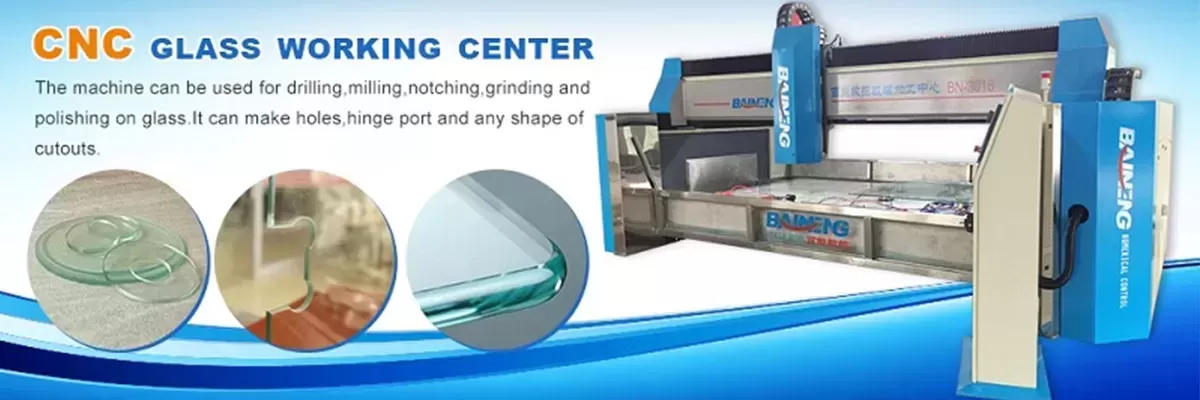
Industrial glass fabrication requires high precision, structural stability, and repeatable accuracy. As architectural and industrial designs demand more complex geometries, traditional processing methods often fall short. A modern CNC glass processing center serves as the primary system to meet these strict specifications, integrating milling, drilling, edging, and polishing operations into a single workstation. This integration reduces handling risks, improves throughput, and ensures consistent quality across production batches.
To understand the utility of these machines, one must examine their mechanical architecture, control software, and material interaction. Manufacturers like BAINENG CNC develop systems focused on minimizing mechanical vibrations and maintaining precise toolpath execution during heavy-duty operations. This analysis covers the structural design, tooling configurations, and operational factors that dictate the performance of modern glass machining systems.
The Structural Architecture: Mitigating Vibration and Stress
Glass is an amorphous solid with high hardness but extreme brittleness. Any vibration transmitted through the machine frame to the cutting tool can cause micro-fracturing along the glass edge, leading to structural failures during subsequent tempering processes. Therefore, the mechanical structure of a CNC glass processing center must be engineered to absorb dynamic forces.
Machine Bed and Gantry Design
Heavy duty welded steel structures or cast-iron bases form the foundation of these machines. After fabrication, these frames undergo thermal stress-relieving processes to prevent geometric distortion over years of operation. The gantry, which carries the spindle assembly along the Y-axis and X-axis, must be both rigid and lightweight enough to permit rapid acceleration without introducing inertia-induced errors.
Linear Guides and Motion Transmission
High-precision linear recirculating ball bearing guides facilitate smooth movement along all axes. These guides are paired with precision-ground ball screws or helical rack-and-pinion systems. Helical rack-and-pinion drives are typically selected for longer travel distances due to their high load capacity and minimal backlash, whereas ball screws are preferred for shorter axes where positional repeatability is the primary concern.
Pneumatic and Vacuum Worktables
Securing glass sheets during high-pressure grinding and milling requires a reliable clamping system. A vacuum matrix table utilizes adjustable suction cups positioned via pneumatic locking mechanisms. These suction cups hold the glass sheet in a perfectly horizontal plane, preventing vertical deflection under the downward force of the spindle. Water-resistant positioning pins assist the operator in referencing the glass datum points before initiating the machining cycle.
Spindle Engineering and Tooling Systems
The spindle is the core power component of a CNC glass processing center, directly influencing the surface finish of the processed edges. Glass fabrication requires variable spindle speeds and high torque at lower RPMs for heavy milling, alongside high-speed capability for fine polishing.
Electro-Spindle Characteristics
Modern machines employ liquid-cooled electro-spindles. Liquid cooling maintains a stable operating temperature, preventing thermal expansion of the spindle shaft, which could alter the tool position by fractions of a millimeter. Spindle speeds typically range from 0 to 12,000 RPM, depending on whether the machine is drilling, grinding, or polishing.
Automatic Tool Changers (ATC)
To perform multi-stage processing (such as drilling a hole, milling a cutout, grinding the edge, and polishing the final profile) without operator intervention, an automatic tool changer is integrated. These systems feature rotary or linear tool carousels containing up to 20 or more tool holders. The transition between tools occurs within seconds, reducing cycle times and maintaining continuous production.
Coolant Delivery Systems
Water cooling is vital during glass grinding to prevent localized thermal shock, which causes immediate cracking. The coolant must be delivered through the center of the spindle (internal cooling) directly to the contact point of the diamond tool, as well as via external adjustable nozzles. This dual-flow system flushes glass particles away from the tool-material interface, extending tool life and preserving edge quality.
Key Machining Processes Executed on a CNC Glass Processing Center
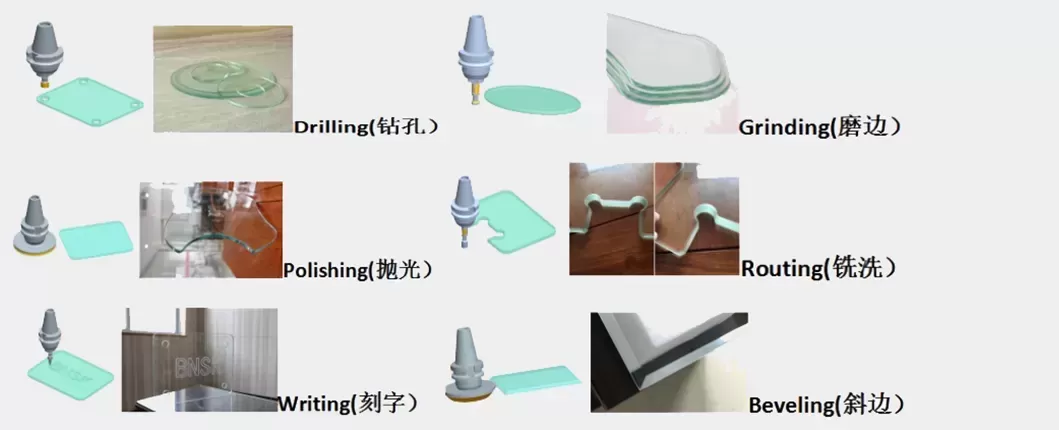
A multi-functional CNC glass processing center performs several sequential operations on a single machine bed, reducing material handling and minimizing the risk of scratching delicate coatings.
High-Speed Drilling and Countersinking: Utilizing coaxial diamond core drills, the machine drills holes from both the top and bottom of the glass sheet to prevent blowout or chipping when the drill exits the material.
Shape Milling and Routing: Utilizing diamond router bits, the system can execute internal cutouts, radius corners, and complex geometric shapes required for shower doors, balustrades, and structural glazing.
Peripheral Grinding and Edging: Grinding wheels remove the sharp edges of raw cut glass, forming profiles such as flat edges with arris, pencil edges, or mitered joints at specific angles.
Cerium Oxide Polishing: The final stage uses felt or synthetic wheels infused with polishing agents to restore optical clarity to the ground glass edges, rendering them smooth and aesthetically appealing.
Overcoming Common Production Bottlenecks in Glass Fabrication
Glass processing operations face routine bottlenecks that impact yield rates and cycle efficiency. Addressing these issues requires systematic mechanical and operational solutions integrated directly into the machinery.
Managing Tool Wear and Calibration
Diamond abrasive wheels wear down over time, altering their diameter and profile. If uncorrected, this wear leads to dimensional inaccuracies. Advanced machines feature automatic tool measurement systems. These systems utilize laser sensors or mechanical touch probes to measure tool wear after a set number of cycles, automatically updating the tool offset parameters in the CNC controller.
Preventing Glass Scratches and Surface Damage
During loading and unloading, glass sheets are highly susceptible to scratches. Modern B2B operations utilize transfer tables equipped with omnidirectional caster wheels or air-cushion tables. Furthermore, integrated water filtration systems ensure that recirculated cooling water is free of abrasive glass particles that could scar the glass surface under high pressure.
Optimizing CAD/CAM Integration
A common bottleneck is the translation of architectural drawings into machine G-code. Software solutions must import standard DXF or DWG files and automatically generate optimal toolpaths, tool sequences, and vacuum cup placement maps. This pre-production simulation identifies potential collisions between the spindle and the clamping system before the physical machining begins.
Evaluating the Role of Automation in Modern Facilities
As labor shortages and safety regulations influence the manufacturing sector, automation within the glass processing workflow becomes highly relevant. Connecting a CNC glass processing center to external loading systems and robotic arms minimizes physical handling, which is a primary source of workplace injuries and product breakage.
BAINENG CNC integrates structural stability with modern control interfaces, allowing their equipment to fit into larger automated production lines. By utilizing standardized communication protocols, these machines can synchronize with robotic loaders that position the glass on the vacuum table and remove it once the cycle is complete. This continuous operational flow reduces idle times, maximizes spindle utilization rates, and provides a predictable output rate necessary for large-scale commercial contracts.
Frequently Asked Questions
Q1: What types of glass can be processed on a CNC glass processing center?
A1: These systems can process a wide range of glass types, including float glass, laminated glass, low-emissivity (Low-E) glass, patterned glass, and extra-clear glass. The processing parameters, such as feed rate and spindle speed, are adjusted based on the hardness and thickness of the specific material.
Q2: How does the machine prevent the glass from cracking during high-speed drilling?
A2: The machine utilizes a double-sided drilling method where two opposing spindles drill the hole from both sides. First, the bottom drill penetrates halfway through the thickness, and then the top drill completes the cut. This balanced approach prevents the tensile stresses that cause edge chipping and breakout.
Q3: Why is internal water cooling necessary for the tooling?
A3: Glass grinding generates extreme friction heat. External cooling nozzles often cannot reach the internal cavity of a hollow drill bit or the contact point of a deep milling tool. Internal water cooling forces coolant through the center of the spindle and tool, ensuring constant temperature regulation and efficient removal of glass slurry.
Q4: How often do the diamond wheels require dressing or replacement?
A4: Tool life depends on the glass thickness, feed rates, and material type. Diamond wheels require periodic dressing using abrasive stone blocks to remove accumulated glass residue and expose fresh diamond grit. Automatic dressing cycles can be programmed into the CNC software to maintain cutting efficiency.
Q5: Can a CNC glass processing center handle irregular shapes and custom beveling?
A5: Yes, with multi-axis interpolation (typically 3-axis or 4-axis configurations) and CAD/CAM software compatibility, these machines can execute complex curves, internal cutouts, notch designs, and variable angle beveling according to precise digital drawings.
Inquire About Tailored Glass Processing Solutions
Selecting the right machinery configuration depends on your production volume, typical glass thicknesses, and the complexity of your finished products. For detailed technical specifications, customized layout proposals, or quotation options for your facility, please contact our engineering and sales department. Our team can assist in identifying the appropriate system parameters to match your operational requirements.