
 FAQs
FAQs Factory Tour



Glass is a foundational material across architectural, automotive, and appliance manufacturing. Its brittle nature presents unique challenges during secondary fabrication processes, particularly hole-making. To achieve high precision without structural damage, a specialized drilling machine for glass must be deployed. BAINENG CNC manufactures industrial machinery designed to meet these specific operational standards. By looking closely at the mechanical designs and operational variables, manufacturing facilities can select equipment that secures stable throughput and reduces raw material waste.
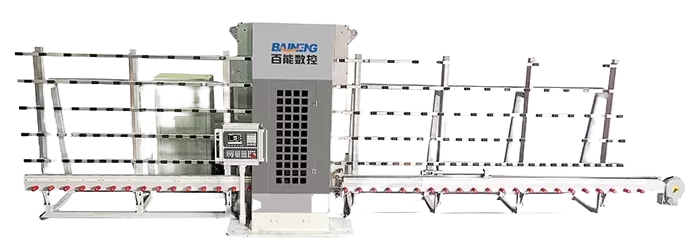
The Physics of Glass Drilling: Why Double-Sided Spindles Are Standard
Drilling glass is not a cutting process in the traditional metallurgical sense; it is a micro-grinding process. Diamond-impregnated core drills grind away the material. Because glass cannot deform plastically at room temperature, any excessive localized stress leads directly to micro-cracking and catastrophic failure. To mitigate these stresses, industrial designs utilize a dual-spindle configuration.
The process starts with the lower spindle advancing to drill partway through the glass thickness. Once the lower drill retracts, the upper spindle descends to complete the hole. This approach leaves the internal mechanical forces balanced, minimizing the blowout of the glass exit edge. If a single-sided drill were used, the pressure exerted as the bit exits the bottom of the glass sheet would cause severe fracturing and unusable parts.
Controlling the exact depth of the bottom drill penetration is a vital variable. Typically, the lower spindle should penetrate between 50% and 60% of the overall sheet thickness. If the lower spindle drills too shallow, the upper spindle must travel further, increasing the risk of exit-side chipping. Conversely, if the lower spindle drills too deep, the thin structural web left behind can collapse prematurely under the drill pressure, creating internal cracks.
Key Engineering Parameters of a Drilling Machine for Glass
To evaluate a drilling machine for glass for a high-volume production line, factory managers must look beyond basic dimensions and analyze specific engineering parameters that dictate precision, cycle times, and operational longevity.
Coaxial Alignment and Spindle Accuracy
A robust machine depends on precise spindle concentricity. Spindles must align along a shared vertical axis with tolerances under 0.03 millimeters. If the upper and lower spindles are even slightly misaligned, the entry and exit points of the bore will not meet perfectly, creating steps or concentric ridges inside the hole. This unevenness creates stress concentration points, increasing the likelihood of thermal breakage during the subsequent tempering phase. High-quality machinery utilizes rigid cast-iron frames to absorb vibrations and prevent thermal expansion from throwing the spindles out of alignment during continuous operation.
Rotational Speed and Feed Rate Control
The relationship between rotational speed (measured in RPM) and feed rate (measured in millimeters per minute) determines the quality of the finish. For standard soda-lime glass, spindle speeds typically range from 2,000 to 5,000 RPM, depending on the hole diameter. Smaller holes require higher rotational speeds to achieve the necessary linear grinding velocity at the tool edge. The feed rate must be variable rather than static. A sophisticated controller will slow down the feed rate at the initial contact point to prevent surface cracking, speed it up during the bulk grinding phase, and slow it down again as the two drill paths meet.
Cooling Fluid Delivery and Pressure
Friction during the grinding process generates high temperatures. Because glass has a low thermal conductivity rating, localized heating causes rapid thermal expansion, leading to immediate fracture. Continuous water delivery is necessary. A modern drilling machine for glass utilizes high-pressure internal cooling, where water is pumped through the center of the spindle directly to the cutting edge. This serves two purposes: it cools the immediate contact zone and flushes out the glass slurry. External nozzles alone are insufficient for deep drilling because the tool blocks the water from reaching the bottom of the cavity.
Mitigating Common Production Challenges in Industrial Glass Drilling
High-volume glass fabrication facilities face persistent challenges that affect profitability. Identifying these bottlenecks and deploying targeted mechanical solutions is key to maintaining consistent yields.
Preventing Edge Chipping: Chipping at the edge of the hole is often caused by blunt diamond tools or improper feed rates. Regular tool dressing is required to expose fresh diamond grit. CNC-controlled automatic dressing systems can perform this function without manual operator intervention, ensuring consistent drilling quality across thousands of cycles.
Glass Slurry Management: Glass dust suspended in water forms a highly abrasive slurry. If this slurry enters the spindle assembly or linear guideways, it accelerates mechanical wear. Machinery must be equipped with efficient multi-stage filtration systems, such as centrifugal separators or hydrocyclone filters, to ensure only clean water is recycled back into the spindles.
Sheet Positioning Errors: Large architectural panels are heavy and difficult to handle. Manual positioning introduces human error and increases cycle times. Integrating servo-driven positioning tables with vacuum suction pads allows for exact placement of the glass sheet beneath the drilling head, keeping positioning tolerances within ±0.1 millimeters.
Sectors Demanding Specialized Glass Drilling Solutions
Different industries place distinct demands on glass drilling equipment. Understanding these applications helps in configuring the correct machinery specifications.
Architectural and Structural Glass
Architectural glass, such as tempered shower doors, balustrades, and structural curtain walls, involves processing large, heavy panels. The machinery used in this sector must feature robust supporting tables, often equipped with pneumatic flotation systems. These air-cushion tables allow operators to move massive sheets with minimal physical effort, preventing surface scratches during handling. Precision in hole positioning is vital here, as these holes will host structural hardware that distributes load across the entire panel.
Domestic Appliance and Furniture Glass
Oven doors, refrigerator shelves, and tabletop glass are produced in much higher volumes but at smaller dimensions. In this sector, cycle time is the primary performance indicator. High-speed CNC drilling lines with multi-head configurations are often utilized. These systems allow multiple holes to be drilled simultaneously, significantly increasing hourly output. The tolerance for chipping in this sector is exceptionally low, as consumer-facing glass products must meet strict cosmetic standards.
Automotive and Transportation Glass
Automotive windshields and side windows require complex curved geometries and integrated holes for wipers, antennas, or mounting brackets. Drilling curved glass sheets requires specialized clamping mechanisms and flexible spindle heights to ensure the drill bit remains perfectly perpendicular to the glass surface at the point of contact. Standard flat-bed machines cannot handle these requirements without causing immediate fractures.
A Comparative Overview of Glass Drilling Systems
The table below outlines the primary differences between common configurations of glass drilling equipment used in manufacturing facilities today.
| Feature / Parameter | Manual / Semi-Automatic Drilling Machine | Automatic CNC Drilling Station | Integrated CNC Working Center |
|---|---|---|---|
| Spindle Operation | Manual lever or pneumatic feed control | Fully automated servo-driven dual spindles | Multi-axis servo control with automatic tool changer |
| Positioning Method | Manual positioning stops and mechanical clamps | Automatic CAD/CAM coordinate import, servo-guided positioning | CNC vacuum belt feeding and laser alignment check |
| Typical Production Volume | Low to medium batches; high operator involvement | High-volume continuous production lines | High-volume complex parts (drilling, milling, edging) |
| Cooling System | Standard external water spray | High-pressure internal spindle cooling | High-pressure internal spindle cooling with slurry filtration |
| Hole Geometry Capabilites | Simple circular holes only | Circular holes and basic countersinks | Circular holes, countersinks, notches, and custom profiles |
Maintenance Workflows for Structural Longevity
The combination of water and highly abrasive glass dust creates a harsh operating environment. Without a disciplined maintenance schedule, even the most robust machinery will suffer from premature component failure.
Daily cleaning is the first line of defense. Operators must wash down the working area to prevent glass slurry from drying and hardening on the guide rails and bellows. Linear guides and ball screws must be lubricated regularly, preferably via an automatic lubrication system that ensures a constant barrier of grease against water ingress.
Weekly checks should focus on spindle coaxial alignment. Using a dial indicator, technicians can verify that the upper and lower spindles remain perfectly aligned. Even minor deviations can lead to an increase in edge chipping and micro-cracking during the drilling process. Additionally, the diamond bits must be inspected for wear and dressed with aluminum oxide dressing stones to strip away glazed metal bonds and expose fresh abrasive particles.
Monthly inspections require checking the status of water seals and spindle bearings. A worn spindle bearing introduces rotational vibration (runout), which is the leading cause of premature tool wear and glass breakage. If any water leakage is detected near the spindle motor, seals must be replaced immediately to prevent motor burnouts.
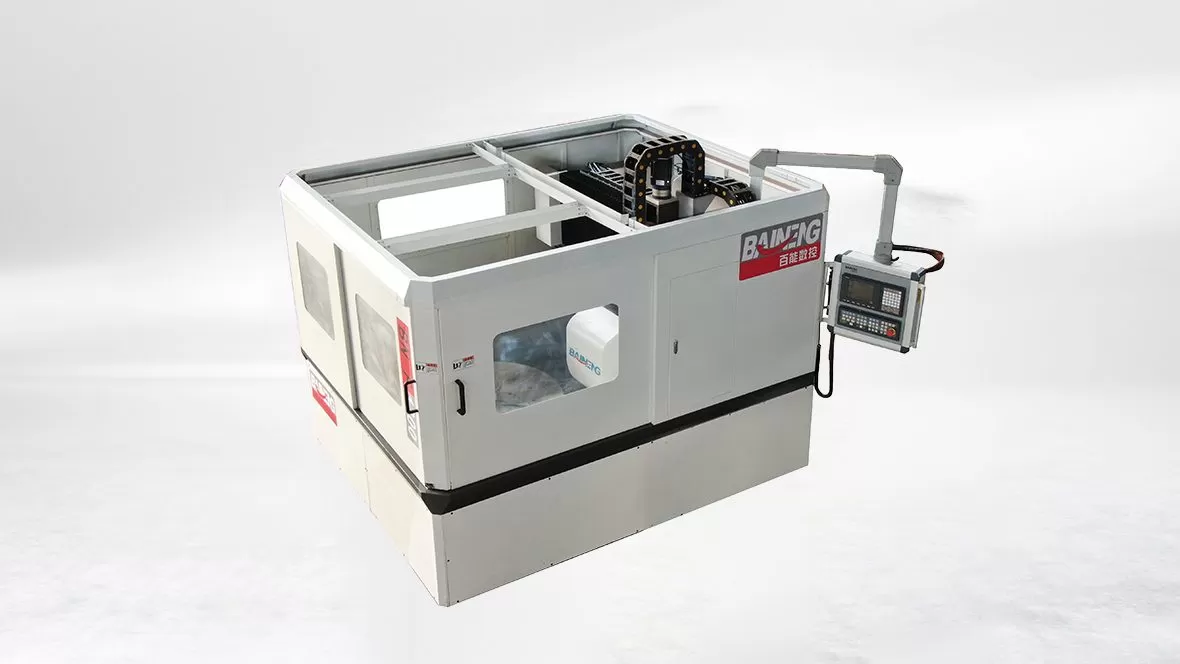
Acquiring Advanced Machinery from BAINENG CNC
Choosing the correct equipment is a long-term investment that dictates your plant's production capacity and scrap rates. BAINENG CNC engineers a comprehensive range of glass drilling machinery designed to meet the rigorous demands of modern fabrication facilities. Our machines combine mechanical rigidity with precise control systems to deliver reliable operation, even in high-throughput environments.
Our application engineering team is available to assist you in selecting the proper spindle configurations, table sizes, and automation integrations for your specific production goals. If you are planning to upgrade your facility, expand your manufacturing lines, or require detailed specifications and pricing for a drilling machine for glass, please contact BAINENG CNC to submit your inquiry. Our team will provide a comprehensive proposal tailored to your operational needs.
Frequently Asked Questions
Q1: Why does a drilling machine for glass use two spindles instead of one?
A1: Using a single spindle to drill completely through a glass sheet creates high tensile stress at the exit point, leading to severe chipping and blowout. A double-spindle design solves this by having the lower spindle drill halfway through the thickness first, then retracting. The upper spindle then descends to complete the hole from the opposite side, ensuring clean, chip-free edges on both surfaces of the glass.
Q2: How does coolant quality affect the lifespan of diamond drill bits?
A2: Coolant must be clean and free of recycled glass slurry. When glass particles remain suspended in the cooling water, they act as an additional abrasive that wears down both the spindle bearings and the metal bond holding the diamond particles on the drill bits. This continuous friction dulls the bits rapidly and can cause thermal cracking in the glass being processed. Using a dedicated water filtration system keeps the coolant clean and prolongs tooling life.
Q3: What causes spindle runout in glass drilling equipment, and how can it be resolved?
A3: Spindle runout is usually caused by worn bearings, accumulation of glass slurry inside the spindle housing, or mechanical misalignment over time. It can be resolved by replacing the high-precision bearings, cleaning the spindle assembly, and performing a dial-indicator calibration to align the upper and lower spindle axes to within 0.02mm.
Q4: Can a drilling machine for glass perform countersinking operations?
A4: Yes, specialized glass drilling machinery can perform countersinking. This is achieved by using stepped diamond bits or by utilizing CNC depth controls that allow the tool to chamfer the edge of the hole at a programmed depth. This is highly useful for architectural glass that requires flush-mounted hardware.
Q5: How often should diamond drill bits be dressed during production?
A5: The frequency of dressing depends on the glass hardness and feed rates, but a general industrial standard is to dress the bits after every 100 to 150 holes. Dressing uses an abrasive stone to strip away worn metal bonding, exposing fresh diamond grits to maintain optimal cutting efficiency and prevent glass chipping.