



Straight Line Beveling Machine Overview Explained
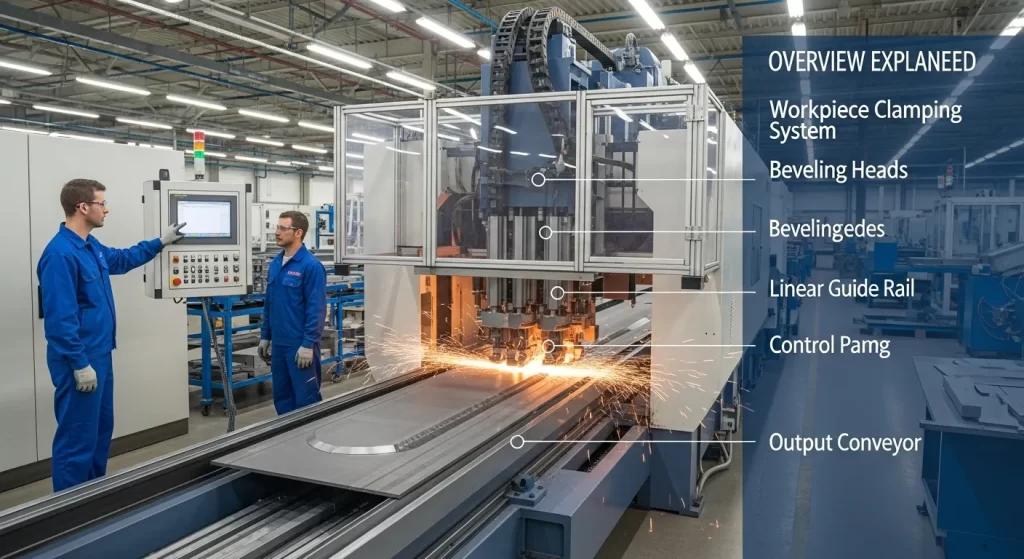
A straight line beveling machine overview reveals a piece of equipment that is a cornerstone of modern, high-volume glass fabrication. This machine is a model of industrial efficiency. It is designed for a single, specialized purpose: to create a perfect, consistent beveled edge on the straight sides of rectangular and square glass sheets. This guide provides a definitive and clear explanation of this powerful machine. It covers its core components, its step-by-step operation, and its vital role in the production of high-quality glass products.
What is the Fundamental Purpose of a Straight Line Beveling Machine?
The fundamental purpose of a straight line beveling machine is to automate the production of beveled edges on flat glass with exceptional speed and precision. A beveled edge is a decorative, angled finish ground into the face of the glass. This machine is specifically engineered to produce this finish on straight-edged pieces. It is the workhorse behind the mass production of beveled mirrors, glass tabletops, and architectural glass components. Its design prioritizes throughput and consistency above all else.
How Does it Differ from a Standard Glass Edger?
A straight line beveling machine differs from a standard edger in its primary function and the finish it creates. A standard edger works on the narrow perimeter or thickness of the glass. Its goal is to create a safe, smooth, and aesthetically pleasing profile, such as a flat or pencil polish. A beveling machine works on the face of the glass at an angle. Its sole purpose is to create a decorative, light-refracting border. The glass beveling vs edging difference is a critical distinction between a functional finish and a decorative art form.
What is its Key Advantage Over a Shape (CNC) Beveler?
Its key advantage over a shape or CNC beveler is speed. A straight line machine is a specialist. It is optimized for one task and performs it at a very high rate of speed. A CNC machine is a generalist. It offers the flexibility to bevel custom shapes and curves. However, its process is much slower. For a workshop that produces hundreds of rectangular mirrors per day, the straight line machine is exponentially more productive. This core difference is detailed in the guide on glass shape beveling vs straight beveling.
Why is Automation the Defining Feature?
Automation is the defining feature because it provides the consistency that is the hallmark of a quality bevel. The machine automates every critical variable. This includes the speed of the glass, the angle of the bevel, and the pressure of the wheels. This removes the inconsistencies of manual work. It ensures that the first piece and the thousandth piece are absolutely identical. The mechanics of this automation are a core topic in the article automatic glass beveling machine explained.
What are the Core Components of a Straight Line Beveling Machine?
The design of a straight line beveling machine is a testament to robust, purpose-built engineering. Each of its core components is designed for precision, durability, and high performance in a demanding, wet, and abrasive environment. Understanding these components is the key to understanding how the machine is able to produce a flawless finish so efficiently.
What is the Role of the Heavy-Duty Main Frame?
The heavy-duty main frame is the foundation of the entire machine. It is typically constructed from thick, welded steel that has been thermally stress-relieved. Its primary role is to provide a rigid, stable platform for all the other components. It must absorb the vibrations generated by the multiple high-speed spindles. This rigidity is essential for preventing "chatter." Chatter is a type of vibration that can be transferred to the glass, resulting in a poor-quality finish.
How Does the Conveyor System Transport the Glass?
The conveyor system is the machine's transport mechanism. It consists of two main parts:
- The Main Conveyor Track: This is a precision-guided chain or track system. It has durable, non-marking pads upon which the glass rests. It carries the glass through the machine at a constant, adjustable speed.
- The Top Clamping Track: This is a synchronized track that runs parallel to the main conveyor. It has a series of pressure pads that clamp down on the top surface of the glass. This holds it securely against the main track, preventing any slipping or rocking.
What is the Spindle Bank and How is it Angled?
The spindle bank is the heart of the machine. It is a series of powerful, independent electric motors, or spindles. Each spindle holds a single grinding or polishing wheel. The entire bank of spindles is mounted on a massive, heavy-duty carriage. This entire carriage can be tilted to a precise angle. The operator sets the desired bevel angle by adjusting the angle of this carriage. This ensures that every wheel in the sequence addresses the glass at the exact same angle.
What is the Function of the Coolant and Slurry System?
The coolant and slurry system is the machine's lifeblood. It is a closed-loop system that continuously floods the wheels and the glass edge with liquid. For the grinding and fining stages, this liquid is a water-based coolant. For the polishing stage, it is a cerium oxide slurry. The system includes a large reservoir tank, pumps, delivery lines, and a filtration system. The filtration system is critical for removing glass particles and allowing the expensive cerium oxide to be recirculated.
How Does the Control Panel (PLC) Work?
The control panel is the machine's brain. It is typically a Programmable Logic Controller (PLC) with a user-friendly touchscreen interface. From this panel, the operator can control and monitor all of the machine's functions. They can adjust the amount of glass to be removed, which sets the bevel width. Modern controllers automate many of these calculations. They provide a simple, intuitive interface for a complex process.
How Does the Step-by-Step Beveling Process Work?
The process of how glass beveling machines work is a model of linear, sequential efficiency. The glass enters one end of the machine raw and sharp. It exits the other end with a perfectly finished, brilliant beveled edge. This transformation happens in a series of carefully controlled steps. Each step is performed by a dedicated wheel in the machine's spindle bank.
Step 1: How is the Glass Loaded and Clamped?
The process begins with the operator placing the glass sheet onto the infeed section of the conveyor. They align the edge to be beveled with a guide rail. As the main conveyor track begins to move, it carries the glass into the machine. At this point, the top clamping track engages. It applies firm, even pressure to the top of the glass. This securely locks the glass in place for its journey through the machine.
Step 2: What Happens in the Rough Grinding Stages?
The first wheels the glass encounters are the rough grinding wheels. These are coarse-grit, metal-bonded diamond wheels. Their job is to perform the bulk of the material removal. They aggressively grind away the glass to establish the rough shape of the bevel. A machine may have two or three of these wheels. Each one might be slightly finer than the last. This stage is where the bevel's angle and width are physically created. It is the most aggressive stage of the process. This is the "grinding" in the glass edge grinding vs beveling equation.
Step 3: What is the Purpose of the Fining Stages?
After the rough grinding, the glass moves to the fining stages. These stages use resin-bonded diamond wheels with a much finer grit. The purpose of the fining wheels is to remove the deep scratches and fractures left by the coarse grinding wheels. They smooth the surface of the bevel. They transform it from a rough, opaque surface into a smooth, semi-transparent or "satin" finish. This intermediate step is absolutely crucial. It is the essential preparation for a flawless final polish.
Step 4: How is the Final Brilliant Polish Achieved?
The final stages of the process are the polishing stages. The glass passes by one or more felt polishing wheels. These wheels are continuously saturated with a cerium oxide slurry from the slurry system. The chemo-mechanical action of the felt wheel and the cerium oxide creates the final brilliant, transparent shine. This is the stage where the magic happens. The satin finish is transformed into an optically perfect, sparkling surface. The techniques behind this are detailed in the guide on polishing glass edges like a pro.
Step 5: What is the Optional Bottom Edging Stage?
Many straight line beveling machines have an additional spindle. This spindle is mounted at the end of the line. It holds a diamond wheel that is oriented to grind the thin bottom edge, or arris, of the glass. This is not part of the bevel itself. It is a final finishing step that can create a small, seamed edge on the bottom of the piece. This can improve the safety and handling of the finished product.
How Are Key Parameters Controlled for a Perfect Bevel?
Achieving a perfect bevel consistently requires precise control over several key machine parameters. The operator uses the machine's control system to set and adjust these variables. The ability to fine-tune these settings is what allows the machine to produce high-quality work on a variety of glass thicknesses and for different bevel specifications.
How is the Bevel Angle Set and Maintained?
The bevel angle is a critical parameter. It is set by physically tilting the entire spindle bank. The operator uses a hand crank or an electric motor to adjust the angle of the main carriage that holds all the spindles. The angle is displayed on a precise mechanical or digital scale. Once set, the machine's rigid construction and the secure clamping of the glass ensure that this angle is maintained perfectly along the entire length of the edge.
How is the Bevel Width Controlled?
The bevel width is controlled by the amount of glass that is removed by the first grinding wheels. The operator controls this by adjusting the position of the main conveyor track relative to the wheels. By moving the track closer to the wheels, more glass is removed, and the bevel becomes wider. By moving it away, less is removed, and the bevel becomes narrower. This adjustment is typically made through the PLC controller. The operator simply inputs the desired final bevel width.
What is the Impact of the Conveyor Speed (Feed Rate)?
The conveyor speed, or feed rate, is a critical trade-off between productivity and quality. A faster feed rate means more pieces of glass can be processed per hour. However, a rate that is too fast will not give the wheels, especially the polishing wheels, enough time to do their work. This results in a poor-quality finish. The operator must find the optimal feed rate for the specific job. This rate should be as fast as possible while still achieving the required level of quality. This is often a source of the issues discussed in the guide to common beveling problems and solutions.
How is Wheel Pressure Optimized?
Each spindle on the machine can typically be adjusted for pressure. This is often done pneumatically. The operator can set the amount of pressure that each wheel exerts on the glass. The grinding wheels require higher pressure to remove material effectively. The polishing wheels require a much lighter, more delicate pressure. Optimizing the pressure for each wheel in the sequence is key to achieving a good finish and maximizing the life of the tooling.
What Are the Primary Applications of This Machine?
The primary applications of a straight line beveling machine are found in industries that require the high-volume production of rectangular beveled glass. Its combination of speed and precision makes it the ideal tool for manufacturers of mirrors, furniture, and certain types of architectural glass. It is a machine designed for production, not for one-off custom jobs.
Why is it the Workhorse of the Mirror Industry?
This machine is the undisputed workhorse of the mirror industry. The vast majority of decorative mirrors produced are rectangular. A beveled edge is a standard feature on many of these mirrors. It provides a classic, framed look. A straight line beveler can process thousands of mirror edges per day. It delivers the consistent quality and high speed needed for this competitive market.
How is it Used in Furniture Manufacturing?
In the furniture industry, the machine is used to produce beveled glass for a wide range of products. This includes:
- Glass Tabletops: For dining tables, coffee tables, and console tables.
- Cabinet Doors: For kitchen cabinets, display cases, and curios.
- Shelving: For high-end glass shelving units. The machine's ability to produce perfectly straight, consistent bevels is essential for the high-quality fit and finish required in furniture manufacturing.
What is its Role in Architectural Glass Production?
In the architectural glass sector, the straight line beveler is used to produce standardized rectangular glass panels. These are often used in high-end residential and commercial buildings. Applications include decorative transom windows, sidelights for doors, and panels for interior partitions. For any project that requires a large number of identical, straight-sided beveled panels, this machine is the most efficient production method.
Conclusion
This straight line beveling machine overview reveals a piece of equipment that is a perfect example of specialized industrial efficiency. It is not a versatile, all-purpose tool. It is a specialist, designed and optimized to perform one task with exceptional speed and precision. By automating the complex, multi-stage process of creating a beveled edge, it has become an indispensable asset for any high-volume glass fabrication workshop. It is the technology that makes the brilliant, consistent beveled edges we see on everyday products not just possible, but profitable.