



Professional Glass Engraving Tips for Precision
These professional glass engraving tips are the bridge between basic operation and true craftsmanship. Achieving flawless, high-precision results on a material as unforgiving as glass is not a matter of luck. It is the direct outcome of a systematic and disciplined process. For the professional, engraving is a science. It involves meticulous preparation, a deep understanding of the technology, and precise control over every variable. This guide provides a definitive set of expert tips and techniques. It is designed to elevate your work from hobbyist-level to a standard of professional excellence, ensuring every piece is a testament to quality and precision.
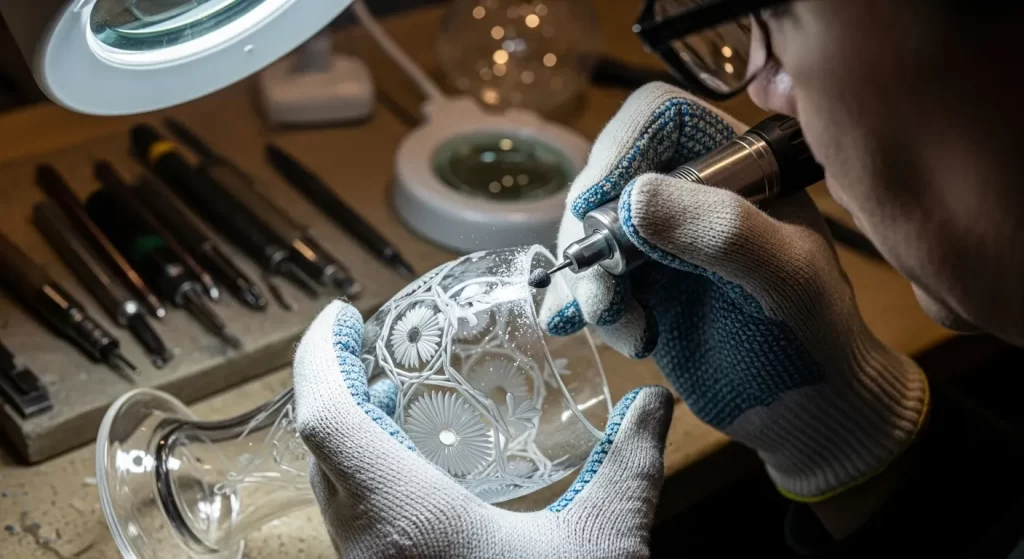
What is the Core Philosophy Behind Professional Glass Engraving?
The core philosophy behind professional glass engraving is a commitment to process over outcome. A professional understands that a perfect result is the inevitable conclusion of a perfectly executed process. This mindset shifts the focus from simply "getting the job done" to mastering each individual step. This includes flawless design preparation, meticulous material handling, a deep understanding of the machine's nuances, and a proactive approach to maintenance.
How Does a Professional Mindset Differ from a Hobbyist's?
A professional mindset differs from a hobbyist's in its focus on consistency and repeatability. A hobbyist may be satisfied with a single successful result. A professional must be able to produce that same high-quality result one hundred times in a row. This requires a move away from guesswork and "happy accidents." It demands a data-driven approach, where settings are tested, documented, and optimized. It is a commitment to a controlled and predictable manufacturing environment.
Why is Process Control the Key to Precision?
Process control is the key to precision because glass is a highly sensitive material. The slightest variation in any input can lead to a visible change in the output. A professional controls every variable possible. This includes the cleanliness of the glass, the temperature of the workshop, the power settings of the machine, and the condition of the tooling. By standardizing the process, the professional eliminates sources of error. This ensures that the only variable is the design itself. This commitment to control is a hallmark of all advanced manufacturing.
How Does Meticulous Preparation Set the Stage for Precision?
Meticulous preparation is arguably the most important stage of the entire engraving process. The quality of the final engraving is largely determined before the machine is even turned on. A professional understands that the machine can only reproduce what it is given. Therefore, both the digital design and the physical workpiece must be flawless. A perfect canvas is the prerequisite for a perfect work of art.
Why is a "Clean" Digital Design Essential?
A "clean" digital design is essential because the machine will interpret every line, node, and pixel literally. A poorly prepared file with open loops, overlapping lines, or jagged curves will result in a messy and inaccurate engraving. A professional invests time in optimizing their digital files.
- For Vector Designs: This means ensuring all paths are closed, there are no duplicate lines, and the number of nodes is minimized to create smooth curves.
- For Raster Images: This means starting with a high-resolution image and using the correct dithering algorithm to convert grayscale tones into a clean dot pattern. The choice of the right design software is a key part of this preparation, as detailed in our guide on the top glass engraving software tools.
What is the Professional Method for Cleaning Glass?
The professional method for cleaning glass is a simple but non-negotiable step. The glass must be cleaned with a high-purity isopropyl alcohol and a clean, lint-free microfiber cloth. Any fingerprints, oils, or residues on the surface can act as a barrier to the laser or a contaminant for a CNC tool. This can cause the engraving to appear inconsistent or blotchy. The glass should be cleaned immediately before it is placed in the machine. A clean surface ensures a uniform transfer of energy.
How Do Surface Masks Improve Engraving Quality?
Surface masks are a professional technique used primarily in laser engraving to improve quality. Applying a thin, damp mask to the glass surface before engraving serves several purposes. A common method is to use a single layer of a wet paper towel or a thin, even coat of liquid dish soap. This mask helps to dissipate the intense heat from the laser. This reduces the risk of unwanted chipping or "shelling" around the engraved edges. It also helps to trap the fine silica dust, resulting in a cleaner process and a smoother, brighter frosted finish. This is an essential part of how to engrave glass with laser safely and effectively.
What Are Advanced Techniques for Mastering Your Machine?
Mastering your machine means moving beyond the manufacturer's default or recommended settings. It involves developing an intuitive feel for how the machine interacts with the material. A professional actively experiments to find the "sweet spot" for every combination of material and design. This is a process of testing, observation, and documentation.
How Do You Find the "Sweet Spot" for Laser Settings?
Finding the "sweet spot" for laser settings involves a systematic testing process. The key variables are power, speed, and DPI (dots per inch). A professional will create a "material test grid" on a scrap piece of the same glass. This grid consists of a series of small squares, each engraved with a different combination of power and speed. By visually inspecting the grid, the operator can identify the exact setting that produces the desired contrast and clarity. This test should be performed for every new type of glass.
What is the Professional Approach to CNC Tool Selection?
The professional approach to CNC tool selection is based on the desired outcome. The shape of the diamond burr's tip determines the profile of the engraved groove.
- V-Bits: Used for creating classic, beveled-edge text and sharp lines.
- Ball-Nose Bits: Used for creating soft, rounded grooves and for 3D contouring. The grit of the diamond particles also matters. A coarser grit will remove material faster but may leave a rougher finish. A finer grit will be slower but will produce a smoother result. A professional's toolkit will include a wide variety of bit shapes and grits. This allows them to choose the perfect tool for any design. This is a key topic in the laser engraving vs CNC engraving for glass debate, where the tool's physical nature is a defining factor.
Why is Z-Axis Focus the Most Critical Laser Calibration?
The Z-axis focus is the most critical calibration for a laser because the beam's energy is only effective at its precise focal point. Even a slight deviation of a millimeter can cause the laser spot to become larger and less powerful. This will result in a blurry, weak, and inconsistent engraving. A professional checks and sets the focus before every single job using the machine's focusing tool or auto-focus feature. This simple, repetitive action is one of the most important habits for ensuring quality. The importance of this precision is a core concept of the technology.
What Are Professional Tips for Different Types of Glass?
Not all glass is created equal. A professional engraver understands that different types of glass have different chemical compositions and physical properties. They will react differently to the engraving process. Adjusting the technique and machine parameters for each specific type of glass is a hallmark of a true expert. The global glass market is diverse, and a professional must be adaptable.
How to Get a High-Contrast Mark on Standard Float Glass?
Standard float glass, the type used in windows, often has a slight green tint due to its iron content. It can sometimes be more challenging to get a bright, high-contrast mark on. A professional tip is to use the wet mask technique (a damp paper towel). This helps to dissipate heat and often results in a whiter, more uniform frosted finish. Slightly lower power and higher speed settings are often effective on float glass.
What Are the Special Considerations for Cast Glass?
Cast glass, which is often used for art and awards, typically has a softer composition and may contain tiny air bubbles. This structure causes it to react very well to a laser. It often produces a very bright, almost brilliant white engraving with excellent contrast. However, because it is softer, it may require slightly lower power settings than float glass to prevent excessive fracturing or "blowouts."
What Are the Safety and Technique Rules for Leaded Crystal?
Leaded crystal contains lead oxide, which gives it its characteristic weight and brilliance. This lead content makes it engrave very easily. It requires significantly lower power settings than standard glass. The primary consideration, however, is safety. The laser can vaporize the lead content, creating a toxic fume. It is absolutely mandatory to use a high-quality fume extraction system with specialized filters when engraving leaded crystal. The health risks of lead exposure are well-documented.
Why is Tempered Glass Unsuitable for Engraving?
A professional knows to always refuse jobs involving tempered glass. Tempered glass is glass that has been heat-treated to be four to five times stronger than standard glass. This process puts the glass under immense internal stress. The thermal shock from a laser or the mechanical force from a CNC tool will disrupt this stress balance. This will cause the entire sheet to catastrophically shatter into thousands of tiny, harmless pieces. There is no safe way to engrave tempered glass after it has been tempered.
How Do You Master Engraving on Curved and Cylindrical Surfaces?
Mastering engraving on curved surfaces is a key skill that opens up a vast market for personalized glassware and bottles. This requires specialized equipment and a new set of techniques. The primary challenge is maintaining a consistent distance and orientation between the engraving tool and the curved surface of the glass.
What is the Correct Way to Set Up a Rotary Attachment?
A rotary attachment is an essential tool for engraving cylindrical objects with a laser. The professional setup involves several key steps. First, the device itself must be perfectly level within the machine. Second, the glass object must be leveled within the device. For a tapered glass, this may require shimming up one end. Third, the center of rotation of the glass must be perfectly aligned with the laser's X-axis. This ensures that the engraving is straight and not skewed.
How Do You Compensate for Tapered Glassware?
Engraving on a tapered object, like a pint glass or a wine glass, presents a geometric challenge. If a rectangular design is engraved directly, it will appear distorted and "keystoned" on the curved, tapered surface. Professional software includes a feature that allows the operator to input the dimensions of the glass. The software then pre-distorts the artwork. This ensures that when it is "wrapped" around the tapered surface, it appears perfectly rectangular.
What is the Challenge of Out-of-Round Objects?
A common challenge, especially with lower-cost glassware, is that the objects are not perfectly round. They may be slightly oval-shaped. This means that as the object rotates, the distance to the laser's focal point changes slightly. This can result in an inconsistent or wavy engraving. A professional tip is to run the job at a slightly slower rotational speed. This gives the laser more time to create a consistent mark, even with slight variations in focus.
What Are Advanced Software and Design Techniques?
Advanced techniques are where technical skill meets artistic expression. A professional leverages the full capabilities of their software to create designs that have depth, texture, and a high level of sophistication. These techniques often involve combining different engraving methods or using specialized toolpaths to create unique effects. These are the engraving and etching innovations that push the boundaries of the craft.
How Does V-Carving Create a 3D Effect with a CNC?
V-carving is a powerful CNC technique. It uses a V-shaped diamond burr. The software generates a toolpath that varies the depth of the cut. In wide areas of a letter or design, the tool plunges deeper, creating a wide, beveled cut. In narrow areas, the tool rises, creating a thin line. This creates a stunning, hand-carved, three-dimensional look that cannot be achieved with a laser. This is a key point in the laser engraving vs cnc engraving for glass discussion.
What is Dithering and How Does it Enable Photo Engraving?
Dithering is a software process used in laser engraving to simulate shades of gray. The laser can only fire at one power level, creating a dot. Dithering algorithms, such as Floyd-Steinberg, convert a grayscale photograph into a complex pattern of black and white dots. The density of these dots creates the illusion of different tones. A professional will experiment with different dithering algorithms and DPI settings to achieve the best possible photographic reproduction on glass.
How to Combine Engraving and Etching for Dynamic Effects?
A highly advanced technique is to combine different decorative methods on a single piece. For example, a logo could be deep-carved with a CNC V-bit to give it a brilliant, dimensional outline. The interior of the logo could then be lightly etched with a laser to create a soft, frosted fill. This combination of textures creates a very dynamic and high-end look. This requires a deep understanding of the difference between glass engraving and etching.
How Does a Proactive Maintenance Routine Ensure Precision?
A proactive maintenance routine is the non-negotiable insurance policy for a professional engraver. A machine that is not perfectly maintained cannot be expected to produce precise results. Precision is a direct result of a machine that is clean, calibrated, and mechanically sound. A professional does not wait for something to break. They perform routine checks and preventative maintenance to ensure the machine is always in peak condition.
What is the Daily Optics Cleaning Protocol for Lasers?
For a laser engraver, the daily cleaning of the optics is the most important maintenance task. The final focusing lens and all the mirrors in the beam path must be gently cleaned with a specialized lens wipe and isopropyl alcohol. Any dust or residue on these surfaces can absorb laser energy. This reduces the power that reaches the glass. It can also permanently damage the delicate optical coatings. A clean beam path is essential for a clean engraving.
Why is Mechanical "Slop" the Enemy of CNC Precision?
For a CNC machine, any mechanical looseness, or "slop," is the enemy of precision. This can manifest as backlash in the drive screws or looseness in the linear guide bearings. This mechanical play means that the tool's actual position may not be exactly where the controller thinks it is. This leads to inaccurate cuts and poor finish quality. A professional regularly checks for and adjusts any mechanical looseness according to the manufacturer's specifications.
How Do You Create and Use a Maintenance Log?
A professional creates and diligently uses a maintenance logbook for each machine. Every maintenance task, from a daily cleaning to a major part replacement, is recorded with the date and the operator's initials. This log provides a complete service history of the machine. It is invaluable for troubleshooting problems, for tracking the life of consumable parts, and for scheduling future preventative maintenance. Our guide on the maintenance of glass engraving machines provides a detailed checklist for this log.
Conclusion
These professional glass engraving tips all point to a single, unifying theme: precision is the result of a deliberate and disciplined process. It is not an accident. It is the outcome of meticulous preparation, a deep mastery of the technology, a willingness to test and optimize, and an unwavering commitment to machine maintenance. By adopting this professional mindset, an engraver can move beyond the basics. They can transform a powerful machine into a true instrument of artistry, capable of producing work of exceptional quality, consistency, and precision every single time.