



How to Polish Edge of Glass Safely and Fast
Learning how to polish the edge of glass safely and fast is a paramount skill in glass fabrication. The process transforms a functional, ground edge into a brilliant, high-value finish. However, it is a process that carries inherent risks. A systematic approach to safety is not optional. It is the absolute foundation upon which speed and quality are built. This professional guide provides a detailed, step-by-step framework for safe glass polishing. It covers the essential safety protocols, the necessary preparation, and the techniques for both automated and manual methods. It is the definitive resource for achieving a perfect polish without compromising workshop safety.
What Are the Core Principles of Safe Glass Polishing?
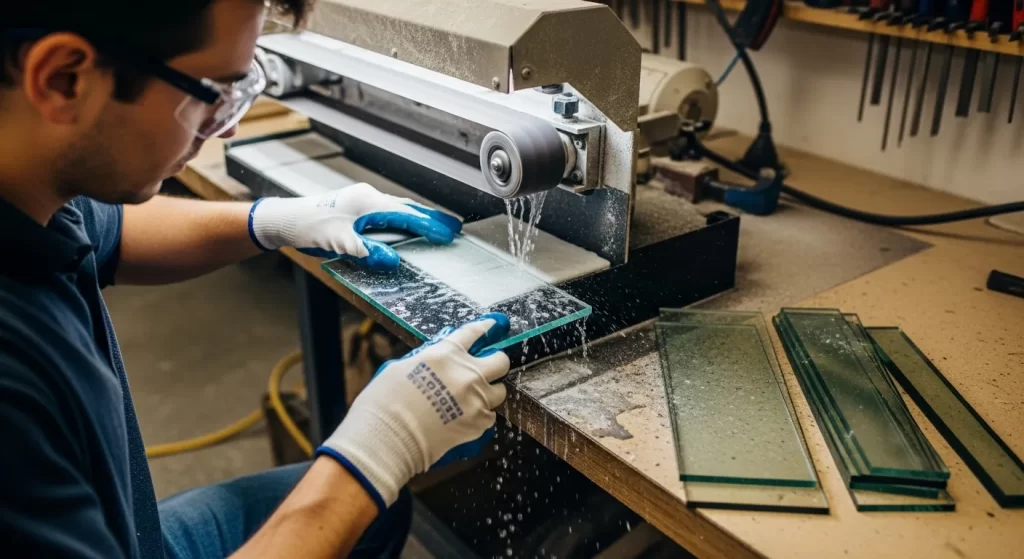
The core principles of safe glass polishing are centered on a proactive and disciplined approach. This involves a combination of personal protective equipment, a controlled work environment, and a methodical process. Safety is not a single action but a comprehensive culture. It underpins every decision and action, from the initial handling of the raw glass to the final inspection of the polished piece. These principles are designed to mitigate the risks associated with sharp edges, high-speed machinery, and a wet environment.
How Does Safety Underpin the Entire Process?
Safety underpins the entire process by creating a framework of non-negotiable rules. Every step is evaluated for potential hazards. This proactive risk assessment is crucial. It ensures that machine guards are in place, that operators are wearing the correct PPE, and that emergency procedures are understood. Without this foundation of safety, any attempt to increase speed will inevitably lead to accidents, injuries, and costly material waste. True efficiency is only possible within a safe operating environment.
What is the Role of a Controlled Environment?
A controlled environment is essential for safe polishing. This means the workshop must be clean, well-lit, and organized. The floor around the polishing machine must be kept free of water and slurry to prevent slips and falls. Adequate ventilation is required to manage any airborne particles or mists. Good lighting is critical for both safety and quality control. It allows the operator to clearly see the workpiece, the machine, and any potential hazards. A chaotic or cluttered workspace is an unsafe workspace.
Why is a Systematic Approach Essential?
A systematic approach is essential because it eliminates improvisation and reduces the risk of human error. Polishing is a multi-stage process. Each step, from grinding to fining to final polishing, must be performed correctly and in the proper sequence. Shortcuts are the primary cause of both defects and accidents. By following a standardized, step-by-step procedure, the operator ensures that every aspect of the process is addressed. This methodical approach is the key to achieving both safety and consistency.
What is the Essential Personal Protective Equipment (PPE)?
The use of appropriate Personal Protective Equipment (PPE) is the most direct and effective way for an operator to protect themselves from the hazards of glass polishing. This is not a matter of personal choice; it is a mandatory requirement for safe operation. Each piece of PPE is designed to protect a specific part of the body from a specific type of hazard.
How Do Safety Glasses and Face Shields Protect You?
Safety glasses with side shields are the minimum requirement for eye protection. They protect the eyes from coolant splash, slurry, and small, flying glass particles. For more aggressive grinding operations that precede polishing, a full-face shield worn over safety glasses is recommended. This provides an additional layer of protection for the entire face. The eyes are extremely vulnerable in a glass workshop. Proper protection is the most important safety rule.
What Type of Gloves Are Required for Glass Handling?
The correct type of gloves is crucial for protecting the hands. The primary hazard is severe cuts from sharp glass edges. Cut-resistant gloves, often made from materials like Kevlar or Dyneema, are essential for handling raw, un-edged glass. During the polishing process itself, waterproof gloves are necessary to protect the skin from the constant exposure to coolant and slurry. These gloves also improve the operator's grip on the wet glass.
Why is Respiratory Protection Important?
Respiratory protection is important to prevent the inhalation of fine glass dust and coolant mist. While the wet process of polishing keeps most dust down, some particles can become airborne. Over time, the inhalation of silica dust can lead to serious lung diseases. A properly fitted N95-rated dust mask or a respirator should be worn, especially during cleanup or when working with dry grinding processes.
What Are the Requirements for Protective Clothing and Footwear?
Protective clothing and footwear are the final barrier of defense. A waterproof apron is highly recommended to keep the operator's clothes dry and clean. Long sleeves can provide an extra layer of protection against minor cuts. The most critical requirement is proper footwear. Steel-toed, slip-resistant, waterproof safety boots are the industry standard. They protect the feet from falling glass and prevent slips and falls on the wet floor, which is one of the most common workshop accidents.
How Do You Prepare the Glass Edge for Polishing?
A perfect polish is only possible on a perfectly prepared edge. The preparatory stages are a crucial part of the process. They shape the edge and create a smooth, uniform surface that is ready for the final polishing wheels. Attempting to polish a raw, cut edge directly will result in immediate failure. This preparation is a foundational aspect of the guide polishing glass edges like a pro.
What is the Initial Step of Seaming or Sanding?
The initial step after the glass is cut is seaming or sanding. This is a basic safety and preparation step. It uses a hand-held sanding pad or a simple glass edge sanding machine. The purpose is to lightly dull the razor-sharp corners of the glass. This makes the glass much safer to handle during the subsequent stages. It also removes any small chips or "flare" from the cutting process. This provides a clean, stable edge to begin the grinding process.
How Does the Grinding Process Shape the Edge?
The grinding process is the formative stage. It uses coarse, metal-bonded diamond wheels to machine the edge into the desired profile. This could be a flat polish, a pencil polish, or another decorative shape. Grinding is an aggressive material removal process. It is responsible for establishing the final shape and dimensions of the edge. However, it leaves the surface rough and opaque. The distinction between this stage and the final goal is detailed in the glass edge grinding vs beveling comparison.
Why is the Fining Stage a Critical Prerequisite?
The fining stage is the critical bridge between rough grinding and final polishing. It uses a series of progressively finer, resin-bonded diamond wheels. The purpose of this stage is to remove the deep scratches and micro-fractures left by the coarse grinding wheels. The fining stage transforms the rough, opaque edge into a smooth, "satin" or semi-transparent finish. This smooth, honed surface is the ideal foundation for the final polishing stage. Skipping or rushing the fining stage is a primary cause of polishing defects.
How to Inspect the Edge Before Polishing?
Before beginning the final polishing stage, a thorough inspection of the fined edge is necessary. The operator should clean and dry the edge. They should then inspect it under a strong light. They are looking for any remaining deep scratches from the grinding stage. If any are found, the fining process must be repeated. The edge should have a uniform, smooth, satin appearance with no visible deep lines. Only when the edge passes this quality check is it truly ready for polishing.
What is the Step-by-Step Process for Automated Polishing?
Automated polishing on a straight-line or CNC machine is the fastest and most consistent method. The key to safety and success in this process is a methodical and precise setup. Once the machine is correctly programmed and loaded, the process itself is largely hands-off. The operator's role shifts to that of a supervisor, monitoring the machine to ensure everything is running smoothly.
How Do You Secure the Glass on the Machine?
Securing the glass is a critical safety and quality step. On a straight-line machine, the glass is clamped between two synchronized conveyor tracks. The operator must ensure the pressure is set correctly for the glass thickness. On a CNC machine, the glass is held down by a vacuum system. The operator must place the vacuum pods correctly to provide even support across the entire piece. An improperly secured piece of glass can shift during processing. This can ruin the part and potentially damage the machine.
How is the Machine Programmed for a Polishing Cycle?
The machine is programmed through its control panel or offline CAM software. For a straight-line machine, the operator inputs the glass thickness and the desired feed rate. For a CNC machine, the operator loads a G-code program that defines the toolpath and the sequence of tools. In both cases, the program controls the entire multi-stage process, from grinding to polishing. The operator must double-check that the correct program has been loaded before starting the cycle.
What is the Role of the Coolant and Slurry System?
The coolant and slurry system is the lifeblood of the automated process. Before starting, the operator must verify that the coolant and cerium oxide slurry tanks are full. They must check that the pumps are working and that the filters are clean. They must also check that the delivery nozzles are clear and aimed correctly at the wheels. An interruption in the flow of coolant or slurry during the automated cycle can cause catastrophic damage to the glass in a matter of seconds.
How Do You Monitor the Automated Process Safely?
Monitoring the automated process safely means observing from a distance. The operator should never reach into the machine while it is running. The machine's safety enclosure must be kept closed at all times during the cycle. The operator's job is to watch and listen. They should watch the glass to ensure it is tracking correctly. They should listen for any unusual noises from the spindles or motors.
What Are the Techniques for Manual Polishing on a Small Machine?
Manual polishing on a smaller machine, like those described in the guide on small glass beveling machine uses, requires a high level of operator skill. The machine provides the rotating wheels, but it is the operator's hands that guide the glass. Safety in this context is a combination of machine setup and operator technique.
How Do You Set Up a Small Glass Edging Machine?
Setting up a small machine involves installing the correct sequence of wheels on the machine's arbor. The work surface or guide fence must be adjusted to the correct height and angle for the glass being worked. The coolant system, which is often a simple water drip or a small recirculation pump, must be turned on and adjusted to provide a steady flow of water over the wheels. The machine should be securely bolted to a workbench to prevent it from moving during operation.
What is the Correct Technique for Guiding the Glass?
The correct technique for guiding the glass involves using a firm, two-handed grip. The operator holds the glass flat against the machine's work table. They then move it smoothly and steadily across the face of the rotating wheels. The motion should come from the shoulders and body, not just the wrists. This provides a more stable and consistent movement. The operator must always keep their fingers and hands away from the rotating wheels.
How Do You Maintain Consistent Pressure and Speed?
Maintaining consistent pressure and speed is the key to a uniform finish. The operator must apply a light but firm pressure, pushing the glass against the wheel. This pressure should remain constant throughout the pass. The speed at which the glass is moved across the wheel must also be consistent. Any hesitation or change in speed will result in an uneven polish. Developing this muscle memory and feel for the process requires practice. It is the core skill of manual polishing.
How to Manage Coolant and Slurry Manually?
On a small machine, the coolant and slurry management is often a more manual process. The operator must ensure the coolant drip is aimed correctly. For polishing, they may need to manually apply the cerium oxide slurry to the felt wheel. The work area will become wet and messy. The operator must be diligent about cleaning up spills to prevent slips. They must also manage the slurry waste according to local environmental regulations.
How Do You Handle and Transport Polished Glass Safely?
The safety procedures do not end when the polishing is complete. The finished product, with its perfectly smooth edges, must be handled and transported with care to prevent injury and to protect the high-quality finish that has just been created. Improper handling can undo all the hard work of the polishing process.
What Are the Best Practices for Lifting and Carrying Glass?
The best practices for lifting and carrying glass start with a plan. The operator should inspect the path for any obstacles. For large pieces of glass, a two-person lift is mandatory. The glass should always be carried in a near-vertical orientation. This is much stronger than carrying it flat. The operators should wear clean, cut-resistant gloves to protect their hands and to avoid leaving fingerprints on the clean glass.
How Do You Use Racks and Carts for Safe Transport?
For moving glass around the workshop, specialized racks and carts should always be used. A-frame carts are designed to hold glass vertically and securely. Harp racks have slots to hold multiple pieces of glass separately. Using these carts minimizes the amount of manual carrying required. It also protects the glass from being damaged during transport. The carts should have good-quality casters and should be moved at a slow, controlled speed.
What Materials Should Be Used to Protect Polished Edges?
The polished edges are the most valuable part of the finished piece. They must be protected. When stacking glass on a rack, separators should be used between the sheets. These can be made of cork, foam, or a soft polymer. For shipping, special corner protectors made of plastic or dense foam should be applied to all corners. The entire piece can then be wrapped or crated for further protection. This ensures the product arrives at its destination in perfect condition.
What Are the Key Machine Safety Features to Maintain?
The safety features built into modern polishing machines are there for a reason. They must be maintained in perfect working order. Bypassing or neglecting these features is a serious safety violation. A regular inspection of these systems is a critical part of any professional maintenance program. This is a core concept for any modern workshop.
How Do Emergency Stops and Interlocks Function?
Emergency stop buttons, or E-stops, are designed to immediately halt all machine motion. They should be tested at the start of every shift. Safety interlocks are switches on the enclosure doors. They prevent the machine from starting if a door is open. They will also stop the machine if a door is opened during a cycle. These interlocks must never be bypassed. They are a fundamental layer of protection.
What is the Importance of Proper Machine Guarding?
Proper machine guarding is essential. All rotating components, such as belts, pulleys, and motor shafts, must be covered by a physical guard. The main processing area of an automatic machine must be enclosed. This enclosure contains the coolant and slurry. It also provides a barrier against any potential tool or workpiece breakage. These guards must be kept in place and in good condition.
How Do You Maintain Electrical Safety Around Wet Processes?
Maintaining electrical safety is critical in a wet environment. All electrical cabinets must be kept closed and sealed. All wiring should be properly insulated and routed away from areas of direct water spray. Ground Fault Circuit Interrupter (GFCI) protection is recommended for any power outlets in the wet area. Operators should never attempt to perform electrical repairs unless they are qualified and have followed proper lockout/tagout procedures.
Conclusion
The process of how to polish the edge of glass safely is the hallmark of a professional glass fabricator. Speed and quality are not achieved by taking shortcuts. They are the direct result of a safe, systematic, and well-managed process. By embracing a culture of safety, using the correct PPE, meticulously preparing the glass, and respecting the machinery, a workshop can produce brilliant, flawlessly polished edges efficiently and without incident. Safety is not a barrier to speed; it is the only reliable path to achieving it.