



How Glass Beveling Machines Work – Expert Insight
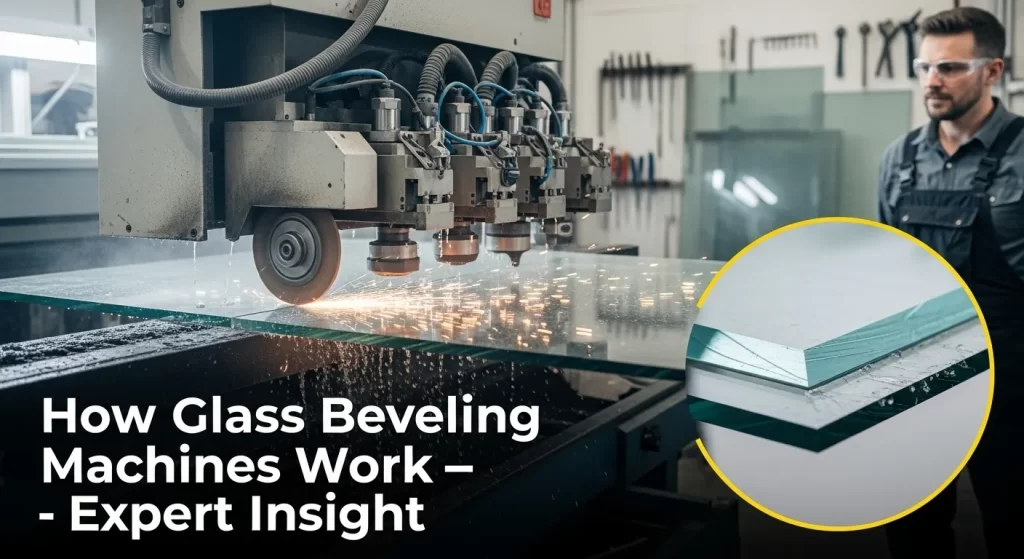
The process of how glass beveling machines work is a story of sequential, automated precision. These machines transform a raw, sharp glass edge into a decorative, angled finish through a multi-stage process of grinding, fining, and polishing. They use a series of diamond-impregnated wheels to systematically remove material and create a smooth, optically clear surface. Understanding this workflow is essential for any glass fabrication professional. It reveals how technology has mastered a craft that once required immense manual skill, delivering flawless consistency at production speeds.
What is the Fundamental Principle of Glass Beveling?
The fundamental principle of glass beveling is the controlled removal of glass material at a specific angle. This creates a sloped edge that refracts light. The process is not a single action but a carefully managed sequence. It starts with aggressive grinding to create the angle. It is followed by progressively finer stages to smooth and polish the surface. This systematic approach ensures the final bevel is not only beautiful but also structurally sound.
How Does Beveling Create its Distinctive Look?
Beveling creates its distinctive look by cutting an angled face onto the edge of the glass. This angled surface acts like a prism. When light passes through the bevel, it is bent and separated into its spectral components. This creates a beautiful, rainbow-like effect. This phenomenon is known as light refraction. The width and angle of the beveled glass determine the prominence of this decorative effect. A wider bevel will produce a more dramatic prismatic display. This brilliant, jewel-like quality is what makes beveled glass a premium decorative product.
Why is Beveling More Than Just Grinding?
Beveling is far more than just grinding. Grinding is only the first, formative step in the process. It uses coarse diamond tools to aggressively shape the angle. However, this leaves the surface rough, opaque, and filled with micro-fractures. The complete beveling process includes subsequent stages of fining and polishing. These stages use smoother wheels to remove the grinding marks and restore the glass's transparency. The guide on glass edge grinding vs. beveling details this distinction. Grinding achieves the shape; the full beveling process achieves the final, brilliant finish.
What is the Role of Automation in Beveling?
Automation is central to modern glass beveling. It provides the precision and consistency that is impossible to achieve by hand. Automated machines control every critical parameter. This includes the feed rate, spindle speed, tool pressure, and bevel angle. This guarantees that every piece is identical. This level of control is explained in the article automatic glass beveling machine explained. Automation has transformed beveling from a time-consuming craft into a highly efficient and reliable manufacturing process. This allows for high-volume production of flawless beveled glass products.
How Do Straight-Line Glass Beveling Machines Work?
Straight-line glass beveling machines work by passing a rectangular piece of glass through a series of fixed-position spindles. The glass is carried on a conveyor system. Each spindle holds a different grinding or polishing wheel. As the glass moves through the machine, each wheel performs its specific task in sequence. This assembly-line approach is highly efficient for producing perfectly straight beveled edges on square and rectangular glass panels.
What Are the Core Components of a Straight-Line Machine?
The core components of a straight-line machine include a robust machine base, a conveyor system, a clamping mechanism, and an array of angled spindles. The conveyor system consists of a long track with durable pads that carry the glass. The clamping mechanism uses pressure pads to hold the glass securely against the track. The spindles are powerful motors. They hold the diamond and polishing wheels at a fixed angle. The number of spindles directly correlates to the machine's speed and the quality of its finish. A detailed look is available in our straight-line beveling machine overview.
How is the Glass Transported and Secured?
The glass is transported by a precision conveyor system. The glass sheet is placed on the infeed side of the machine. It rests on a conveyor track. As the track moves, a parallel top track with rubberized pressure pads clamps down on the glass. This secures it firmly. This stable, continuous movement is essential for a consistent bevel. Any slip or vibration would result in a wavy or uneven finish. The speed of this conveyor, known as the feed rate, is a critical parameter that can be adjusted by the operator.
What is the Sequential Wheel Process?
The sequential wheel process is the heart of the machine's operation. As the glass moves down the line, it passes by each spindle in order. A typical sequence includes:
- Rough Grinding Wheels: The first few wheels are coarse-grit, metal-bonded diamond tools. They perform the bulk of the material removal, roughing in the angle and width of the bevel.
- Fining Wheels: The subsequent wheels are finer-grit, resin-bonded diamond tools. They remove the deep scratches left by the rough grinding stage. This prepares the surface for polishing.
- Polishing Wheels: The final wheels are typically made of hard felt. They are used with a cerium oxide slurry to create the final brilliant, transparent shine.
How is the Bevel Angle and Width Controlled?
The bevel angle and width are controlled by the physical setup of the spindles. The entire bank of spindles is mounted on a heavy-duty carriage that can be tilted. The operator adjusts the angle of this carriage to set the desired bevel angle. This angle is displayed on a mechanical or digital readout. The width of the bevel is determined by a combination of this angle and the amount of glass that is removed. The operator sets the removal amount by adjusting the position of the conveyor track relative to the wheels.
How Do Shape (CNC) Glass Beveling Machines Work?
Shape glass beveling machines, also known as CNC glass working centers, work by moving a tool around a stationary piece of glass. Unlike a straight-line machine, the glass is held firmly in place on a flat table using vacuum pods. A computer-controlled tool head, equipped with various grinding and polishing wheels, then travels around the perimeter of the glass. This method allows for the creation of perfect bevels on circles, ovals, and complex custom shapes.
How Does CNC Technology Adapt for Shaped Glass?
CNC technology adapts for shaped glass by providing multi-axis, programmable motion. The machine translates a digital design file from a CAD program into a precise toolpath. The machine's controller then directs the servo motors to move the tool head along this path. The key difference between glass shape beveling vs. straight beveling is this programmability. It allows the machine to follow any contour, from a simple arc to a complex free-form curve, with perfect accuracy.
What is the Function of the Vacuum Bed?
The function of the vacuum bed is to hold the glass workpiece absolutely still during the beveling process. The bed has a grid of ports. The operator places rubber-sealed vacuum pods over these ports, directly beneath the glass. A powerful pump creates a strong suction through these pods. This clamps the glass down onto the table. This secure clamping is critical. It prevents the glass from shifting or vibrating, which would ruin the bevel. This system is highly flexible. It can accommodate glass of almost any size or shape.
How Does the Machine Follow a Programmed Path?
The machine follows a programmed path using a digital workflow. First, a designer creates a 2D vector drawing of the glass shape. This file is then loaded into a CAM software program. The CAM operator defines the toolpath, selects the correct sequence of tools, and sets the machine parameters. The software then generates G-code. This is a set of coordinate instructions that the CNC machine's controller can read. The controller executes this code, directing the machine's axes to move the tool head along the precise programmed path.
What is the Role of the Automatic Tool Changer (ATC)?
The Automatic Tool Changer (ATC) is a crucial component for efficiency in shape beveling. The beveling process requires a sequence of different wheels, from coarse grinders to fine polishers. The ATC is a carousel or magazine that holds all of these pre-loaded tools. When the program calls for a new tool, the machine automatically stops, returns the current tool to the carousel, and picks up the next one. This allows the entire beveling process to be completed in a single, uninterrupted cycle. It eliminates the need for manual tool changes, which saves significant time.
What Are the Critical Tools and Consumables Used in Beveling?
The tools and consumables used in beveling are highly specialized. They are designed to work together in a sequence to transform the glass edge. The quality of these components, from the diamond wheels to the polishing compound, has a direct impact on the final finish. Using high-quality consumables is a key part of achieving a professional result. The global market for these industrial abrasives is significant, driven by industries that demand high-precision finishing.
What Types of Diamond Grinding Wheels Are Used?
The first tools in the sequence are diamond grinding wheels. These are typically metal-bonded wheels. This means the diamond particles are held in a hard, durable metal matrix. This allows them to withstand the high pressure needed for aggressive material removal. The wheels come in a progression of grit sizes. The process starts with a very coarse grit to rough in the bevel shape. It is followed by one or more wheels with a finer grit to begin the smoothing process.
What is the Purpose of Resin-Bond Fining Wheels?
After the initial grinding, the process moves to resin-bond fining wheels. These wheels use finer diamond particles held in a softer resin matrix. The purpose of this stage is to remove the deep scratches and fractures left by the metal-bond wheels. This intermediate "fining" or "honing" step is crucial. It creates a smooth, semi-transparent surface. This properly prepares the glass for the final polishing stage. Skipping this step would result in a poor-quality final polish.
Why Are Felt Wheels and Cerium Oxide Essential for Polishing?
Felt wheels and cerium oxide are essential for achieving the final brilliant shine. This is a chemo-mechanical process detailed in our guide on polishing glass edges like a pro. The cerium oxide, mixed with water to form a slurry, reacts chemically with the glass surface. This creates a softened microscopic layer. The rotating felt wheel then provides the mechanical action. It wipes this layer away, smoothing out the surface to an optical finish. This combination is the industry standard for high-quality glass polishing. Proper safety precautions are always necessary, as discussed in how to polish the edge of glass safely.
How Does Coolant Affect the Beveling Process?
Coolant, which is typically water or a water-based solution, is critical to the entire beveling process. It serves three vital functions. First, it prevents thermal shock by dissipating the intense heat generated by friction. Second, it lubricates the diamond wheels, which extends their life and improves the quality of the cut. Third, it washes away the glass powder, or slurry, that is created during grinding. This keeps the wheels clean and prevents the abrasive slurry from causing random scratches. An insufficient coolant supply will lead to immediate and catastrophic failure.
How is the Beveling Process Controlled for Quality?
Quality control in an automated beveling process is achieved through a combination of precise machine parameter settings, diligent tool maintenance, and operator oversight. The machine provides the potential for perfection. However, it is the careful management of the process variables that turns that potential into a consistent reality. A systematic approach to quality control is the hallmark of a professional fabrication workshop.
How Do Machine Parameters Impact the Final Finish?
Machine parameters like feed rate and spindle speed have a direct impact on the final finish. The feed rate, or the speed at which the glass moves, must be carefully controlled. A rate that is too fast will not give the wheels enough time to do their work. This results in a poor finish. A rate that is too slow can generate excess heat. Spindle speed must also be optimized for each type of wheel. These parameters are often set based on the manufacturer's recommendations and then fine-tuned through experience.
What is the Importance of Wheel Dressing and Maintenance?
Wheel dressing is a critical maintenance task. Over time, a diamond wheel can become "glazed." This means the metal bond has worn smooth over the diamond particles. A dressing stick, which is a coarse abrasive block, is used to remove this glazed layer. This exposes fresh, sharp diamond particles. This restores the wheel's cutting ability. Regular dressing ensures a consistent material removal rate and a better surface finish. It is a key part of preventing many common beveling issues.
How are Common Beveling Problems Prevented?
Many common beveling problems, such as scratches, white corners, or inconsistent bevel widths, are preventable. These issues are often caused by worn tooling, incorrect machine settings, or contaminated coolant. A proactive maintenance program and a well-trained operator are the best defenses. A detailed guide to common beveling problems and solutions provides a systematic approach to troubleshooting these issues. Regular inspection and consistent process control are key.
What is the Role of the Operator in an Automated Process?
Even in a fully automated process, the operator plays a vital role. The operator is responsible for loading and unloading the glass, selecting the correct program, and setting up the machine. They are also the first line of quality control. A skilled operator understands the nuances of the machine. They can make small adjustments to optimize the process and ensure the highest quality output.
What Are the Applications of Machine Beveling?
Machine beveling has a wide range of applications, particularly in the architectural and interior design industries. The decorative, light-refracting quality of a beveled edge adds a touch of elegance and perceived value to any glass product. The ability of machines to produce perfect bevels on both straight and shaped glass has made this premium finish more accessible and versatile than ever before.
How is Beveling Used in Interior Design?
In interior design, beveled glass is used extensively to create a sense of luxury and sophistication. Beveled mirrors are a classic application. They create a "frame within a frame" effect. Glass tabletops with beveled edges have a more finished and substantial appearance. Beveled glass is also used in cabinet doors, room dividers, and decorative wall panels. The guide to beveling glass for interior design explores many of these creative uses.
What is the Difference Between Beveling and Standard Edging?
The primary difference between beveling and standard edging is the purpose and appearance of the finish. Standard edging, like a flat polish, is primarily functional. It creates a safe, smooth, and aesthetically pleasing edge profile. Beveling is a purely decorative process. It creates an angled face on the glass that is designed to refract light. The article glass beveling vs. edging difference clarifies this distinction. Both are premium finishes, but they serve different design intentions.
What Are the Uses for a Small Glass Beveling Machine?
A small glass beveling machine is ideal for workshops that produce smaller decorative items. These machines are perfect for creating beveled components for stained glass windows, jewelry boxes, and custom picture frames. They are also used for producing glass awards and trophies. The guide on small glass beveling machine uses shows that while they have a smaller capacity, they offer the same high-quality finish as their larger counterparts. This makes them a great entry point into the decorative glass market.
How Does Beveling Compare to Other Edge Finishes?
Beveling is a premium decorative finish. It is more complex and visually striking than simpler edge finishes like a seamed or sanded edge. A basic glass edge sanding machine simply removes the sharpness of the edge for safety. A polished edge provides a clean, finished look. A beveled edge adds an extra layer of design and artistry. It is a deliberate choice made to enhance the beauty of the glass.
How Does a Beveling Machine Fit into a Workshop?
A beveling machine is a key asset in any workshop that aims to produce high-quality, finished glass products. It represents a significant step up in capability from basic cutting and edging. The choice of machine, whether straight-line or CNC, should be based on a careful analysis of the workshop's product mix and production volume. Integrating this technology is a strategic move towards offering higher-value products.
What Are the Key Considerations When Choosing a Machine?
When choosing a machine, a workshop must consider several factors. The first is the type of work. A shop that primarily produces rectangular mirrors would benefit from a high-speed straight-line machine. A custom fabrication shop would require the flexibility of a CNC shape beveler. Machine size, the number of spindles, and the quality of the control system are also critical factors. The guide on how to choose the best glass edger provides a framework for this important decision.
How is Mastery in Beveling and Edging Achieved?
Mastery in beveling and edging is achieved through a combination of technology, process control, and expertise. It requires a deep understanding of how the machines work. It also requires a commitment to using high-quality tooling and maintaining the equipment properly. Finally, it requires a culture of quality control, where every finished piece is inspected to ensure it meets the highest standards. The guide to glass beveling and edging mastery emphasizes that true mastery is a holistic approach. It integrates all aspects of the fabrication process.
Conclusion
The process of how glass beveling machines work is a clear demonstration of modern manufacturing precision. Whether through the linear efficiency of a straight-line machine or the programmable flexibility of a CNC working center, the core principle remains the same. A sequential application of grinding, fining, and polishing transforms a simple glass edge into a brilliant, decorative feature. This automated process, guided by digital control, consistently delivers the flawless finish that defines high-quality glass products. Understanding this intricate workflow reveals the remarkable technology behind the perfect polish.