



Glass Cutting Laser vs Traditional Cutting Facts
The glass cutting laser vs traditional cutting comparison is a critical analysis of two distinct manufacturing philosophies. Traditional cutting is a mechanical process of scoring and breaking. It is a mature, reliable, and highly efficient method for linear separation. Laser cutting is a thermal process of controlled fracturing. It is a modern, digital technology that offers unparalleled precision for complex shapes. While both methods serve to cut glass, they differ fundamentally in their mechanics, edge quality, speed, and applications. This definitive guide provides an expert overview of the facts. It explains the technology, benefits, and limitations of each method, providing the clarity needed to make strategic decisions in a modern fabrication environment.
What is the Fundamental Difference in Method?
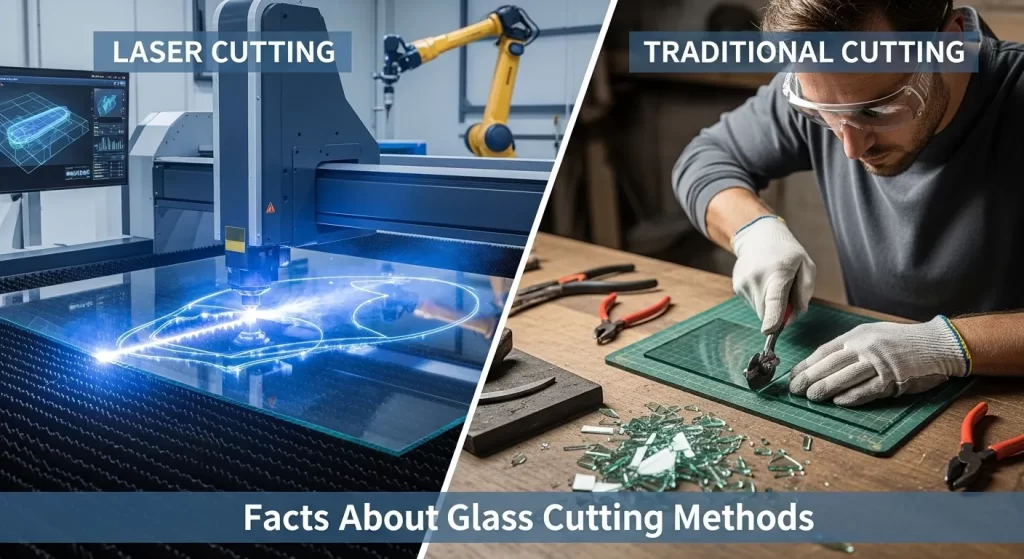
The fundamental difference between glass cutting laser and traditional cutting lies in the method of separation. Traditional cutting is a two-step mechanical process. It involves creating a controlled fissure on the surface (scoring) and then applying force to propagate a fracture along that fissure (breaking). Laser cutting is a single-step thermal process. It uses a focused beam of light to create intense, localized thermal stress, which induces a clean, controlled fracture through the material.
This distinction—mechanical force versus thermal stress—is the root of all other differences between the two technologies. It dictates the quality of the cut edge, the complexity of the shapes that can be produced, and the overall production workflow. One is a process of physical contact and force; the other is a non-contact process of focused energy.
How Does Traditional Cutting Work: The Score-and-Break Method?
The score-and-break method is the oldest and most common technique for cutting glass. The process is straightforward and effective. A small, very hard wheel, typically made of tungsten carbide or industrial diamond, is pressed onto the glass surface. It is then rolled along a line under consistent pressure. This action does not "cut" the glass in the traditional sense. Instead, it creates a microscopic line of stress and fractures, known as a score line. A mechanical force is then applied, either by hand or with an automated breakout bar. This force concentrates the stress along the score line, causing the glass to separate with a clean, predictable break.
In a modern production environment, this is automated on large CNC cutting tables. A computer-controlled gantry moves the cutting head with high speed and precision to create the score lines for an entire sheet of nested parts. The machine then uses an integrated breakout system to separate the pieces. These are the machines reviewed in our guide to the best glass cutting machine CNC models.
How Does Laser Cutting Work: The Controlled Fracture Process?
Laser cutting for glass works on a principle called thermal stress separation. The laser glass cutting vs mechanical methods guide explains this in detail. A highly focused laser beam, typically from a CO2 laser, rapidly heats a small spot on the glass. This intense heat causes the spot to expand. This expansion is resisted by the surrounding cool glass, which creates a significant amount of tensile stress. A secondary cooling jet, often of air or water mist, then rapidly cools the heated spot. This rapid heating and cooling cycle creates a controlled micro-fracture that propagates through the glass. The laser head moves along a programmed path, effectively guiding this fracture to create the desired cut.
This is a single-step, non-contact process. There is no physical scoring wheel and no separate breaking step. The laser creates a full-body separation through a precisely controlled application of thermal energy.
How Do They Compare on Precision and Geometric Complexity?
The comparison of precision reveals the primary strategic difference between the two technologies. Traditional cutting is highly precise for linear geometry. Laser cutting offers superior precision and freedom for complex, non-linear geometry. The choice between them often comes down to the complexity of the shapes being produced.
What is the Precision of Traditional Automated Cutting?
A modern, automated CNC cutting table is extremely precise for straight-line cutting. It can hold tolerances of a fraction of a millimeter over very long distances. These machines are optimized for nesting and cutting large numbers of rectangular parts from a jumbo sheet of glass. However, they have limitations when it comes to curves. While they can cut gentle arcs, they struggle with tight radii and sharp internal corners. The mechanical nature of the scoring wheel limits how tightly it can turn.
How Does Laser Cutting Achieve Superior Precision?
Laser cutting achieves superior precision due to two key factors. First, it is a non-contact process. There is no tool pressure or mechanical drag on the glass. Second, the "tool" is a beam of light that can be focused to an incredibly small spot size. This allows the laser to trace extremely fine and intricate patterns with an accuracy that is limited only by the quality of the motion control system. It can create sharp corners and very tight radii that are physically impossible for a scoring wheel to replicate. The digital nature of the process means that a design can be reproduced with perfect fidelity, time after time.
How Do They Handle Complex Shapes and Internal Cutouts?
This is where laser cutting has a decisive advantage. Traditional methods for creating internal cutouts are multi-step and inefficient. They typically require an operator to first drill a starting hole in the waste area. A cutting tool is then inserted into this hole to begin the cut. Laser cutting, being a non-contact process, can begin a cut anywhere on the surface of the glass. It does not require a starting hole. This makes it vastly more efficient for creating parts with internal cutouts. This capability is a cornerstone of improving drilling, cutting, and grinding efficiency.
What is the Difference in Edge Quality and Secondary Processing?
The difference in the resulting edge quality is one of the most significant factors in the glass cutting laser vs traditional cutting comparison. A laser-cut edge is fundamentally different from a mechanically broken edge. This difference has a profound impact on the need for secondary finishing processes. The market for industrial finishing equipment is large because secondary processing is a standard requirement for traditional methods.
What is the Edge Quality of Traditional Cutting?
A traditionally cut and broken edge is, by its nature, very sharp and potentially dangerous. The broken surface, while straight, is covered in microscopic flaws and fractures. This is known as a "raw" or "break" edge. This edge is structurally weak and unsafe to handle. For almost every application, a traditionally cut piece of glass must undergo a secondary finishing process. This could be a simple safety seaming, as performed by a glass edge sanding machine, or a full multi-stage grinding and polishing process. The necessity of this second step is a critical part of the workflow.
How is a Laser-Cut Edge Fundamentally Different?
A laser-cut edge is fundamentally different because it is a pristine, fire-polished surface. The controlled fracture process creates a new surface that has not been subjected to mechanical stress or abrasion. The intense heat of the process effectively polishes the edge as it is being created. The resulting edge is perfectly smooth, optically clear, and free of micro-fractures. It is also, in most cases, completely safe to handle, as there are no sharp arrises.
How Does Laser Cutting Reduce or Eliminate Secondary Processing?
Laser cutting can significantly reduce or even completely eliminate the need for secondary edge finishing. Because the laser produces a high-quality, polished edge directly during the cutting process, the time-consuming and labor-intensive steps of grinding and polishing can often be skipped. This is a massive advantage in terms of production efficiency. It eliminates the need to move parts from the cutting table to an edging machine. This reduces material handling, labor, and the potential for damage. This "cut-to-finish" capability is a major driver of laser technology adoption. It is a key part of improving production with automatic glass machines.
How Do Speed and Efficiency Compare in a Production Environment?
The comparison of speed and efficiency is not as simple as measuring the cutting speed of each machine. It requires a holistic look at the entire production workflow, from the raw sheet to the finished part. For simple, linear cutting, traditional methods are faster. For complex shapes with a high-quality edge requirement, the laser is often more efficient overall.
What is the Advantage of Traditional Cutting for High-Volume Linear Work?
For the high-volume production of rectangular parts, such as for windows or solar panels, an automated traditional cutting line is unmatched in its speed. The gantry-based scoring systems can move at very high speeds, often several meters per second. The integrated breakout systems are also extremely fast. These machines are highly optimized for this specific task. Their raw throughput of square meters of glass per hour is typically much higher than that of a laser system.
How is Laser Cutting's Efficiency Measured Differently?
The efficiency of laser cutting is measured not just by its cutting speed but by the total time it takes to produce a finished part. The laser's cutting speed (mm/sec) may be slower than a scoring wheel's travel speed. However, the laser completes the cut and the edge finish in a single operation. This eliminates the entire secondary processing cycle. For a complex part that would otherwise need to be moved to a CNC machine for shaping and then to a polishing machine, the laser's single-step process can be hours faster. This is a key principle of lean manufacturing.
What Are the Material and Thickness Limitations?
Both technologies are versatile, but they each have their own set of material and thickness limitations. Traditional cutting is a very mature technology. It has been adapted to work with a very wide range of glass types and thicknesses. Laser cutting is a more specialized technology. It excels in certain areas but faces challenges with others.
How Versatile is Traditional Cutting?
Traditional cutting is extremely versatile. It is the standard method for cutting nearly all types of flat glass. This includes:
- Float Glass: Standard window and architectural glass.
- Laminated Glass: This requires a special process where the top layer is scored, the glass is broken, the plastic interlayer is heated and cut, and then the bottom layer is broken.
- Coated Glass: Such as low-e or reflective glass. The cutting wheel and pressure must be adjusted for the specific coating.
- Thick Glass: Traditional methods can be used to cut very thick glass, often requiring multiple scoring passes.
What Are the Limitations of Laser Cutting?
Laser cutting, while precise, has some notable limitations.
- Thick Glass: Cutting very thick glass (e.g., over 10-12mm) with a laser can be challenging. Managing the thermal stress through the entire thickness of the glass becomes difficult. This can lead to an inconsistent edge quality.
- Laminated Glass: The plastic interlayer in laminated glass does not cut well with a laser. It tends to melt and char, creating a poor-quality edge. For this material, traditional methods are superior.
- Coated Glass: Some metallic or highly reflective coatings can reflect the laser beam. This can reduce the cutting efficiency and potentially damage the laser's optics. The technology is constantly evolving to overcome these limitations. However, they are important considerations for any workshop.
How Do the Costs and Operational Requirements Compare?
The financial and operational comparison is a critical part of the glass cutting laser vs traditional cutting decision. Traditional systems generally have a lower initial cost and simpler maintenance. Laser systems represent a higher capital investment and require more specialized knowledge to operate and maintain.
What is the Difference in Initial Investment and Consumables?
The initial investment for a high-quality automated traditional cutting table is typically lower than that for an industrial-grade laser cutting system of a similar size. The consumable costs for traditional cutting are also relatively low. They consist mainly of replacement cutting wheels and cutting fluid. The consumable costs for a laser are higher. They include the eventual replacement of the laser source (laser tube or resonator), replacement optics (lenses and mirrors), and the gases used for the laser itself.
How Do the Maintenance and Skill Requirements Differ?
The maintenance and skill requirements for each technology are quite different. A traditional cutting table is a largely mechanical system. Its maintenance involves routine cleaning, lubrication, and the replacement of mechanical wear parts. The guide on glass grinding machine maintenance covers many similar principles. A laser cutting system is a complex opto-mechanical system. Its maintenance is more specialized. It includes the cleaning and alignment of sensitive optics. It also involves the care of the laser source and its cooling system. The skill set required to operate and maintain a laser is generally considered to be higher.
What Are the Critical Safety Considerations?
Both technologies present significant workplace hazards that must be managed with strict safety protocols. The nature of these hazards is very different for each method. A comprehensive safety plan is a non-negotiable part of any professional glass fabrication operation.
What Are the Primary Hazards of Traditional Cutting?
The primary hazards of traditional cutting are mechanical and physical.
- Sharp Edges: The freshly cut and broken edges of the glass are razor-sharp and can cause severe lacerations.
- Manual Breaking: The act of manually breaking the glass can be hazardous if not done correctly.
- Handling: The manual handling of large, heavy, and sharp sheets of glass carries risks of cuts and musculoskeletal injuries. The use of proper PPE, especially cut-resistant gloves, is absolutely mandatory. A full overview is available in our guide on safety tips for glass cutting and grinding.
What Are the Primary Hazards of Laser Cutting?
The primary hazards of laser cutting are related to the laser beam and the byproducts of the process.
- The Laser Beam: The high-power infrared beam from a CO2 laser is invisible and can cause instantaneous, permanent eye damage or severe skin burns. This is why a Class 1 safety enclosure with interlocks is mandatory.
- High Voltage: The laser power supply operates at very high voltages.
- Fumes and Particulates: The process vaporizes glass, creating a fine silica dust that is a serious respiratory hazard. A robust fume extraction and filtration system is essential. The importance of this cannot be overstated.
Conclusion
The glass cutting laser vs traditional cutting comparison is not about declaring one method obsolete. It is about understanding that these are two different tools for two different jobs. Traditional automated cutting remains the undisputed champion of high-speed, linear production. It is the workhorse of the high-volume flat glass industry. Laser cutting is the master of complexity and the single-step finish. It is the tool that enables intricate designs, perfect curves, and a workflow with reduced secondary processing. The best choice for any workshop is a strategic one. It depends entirely on its product mix, its production volume, and its position in the market. In many modern, versatile workshops, these two powerful technologies do not compete; they coexist.