



CNC Glass Engraving vs. CNC Glass Etching: The Definitive 2025 Comparison
When it comes to adding intricate designs, crisp text, or custom branding to glass, the world of automated machinery offers two powerful contenders: CNC glass engraving and CNC glass etching. From the outside, they might seem similar—both use a machine to alter a glass surface. But as someone who has calibrated these machines and consulted on projects for over a decade, I can tell you they are fundamentally different processes with vastly different outcomes, costs, and applications.
Choosing the wrong one doesn't just affect the look; it impacts production time, durability, and the overall feel of the finished piece. A beautiful, deep-cut award (an engraving job) would look flat and unimpressive with a surface etch. Conversely, trying to engrave a large privacy panel for a shower door would be incredibly time-consuming and expensive.
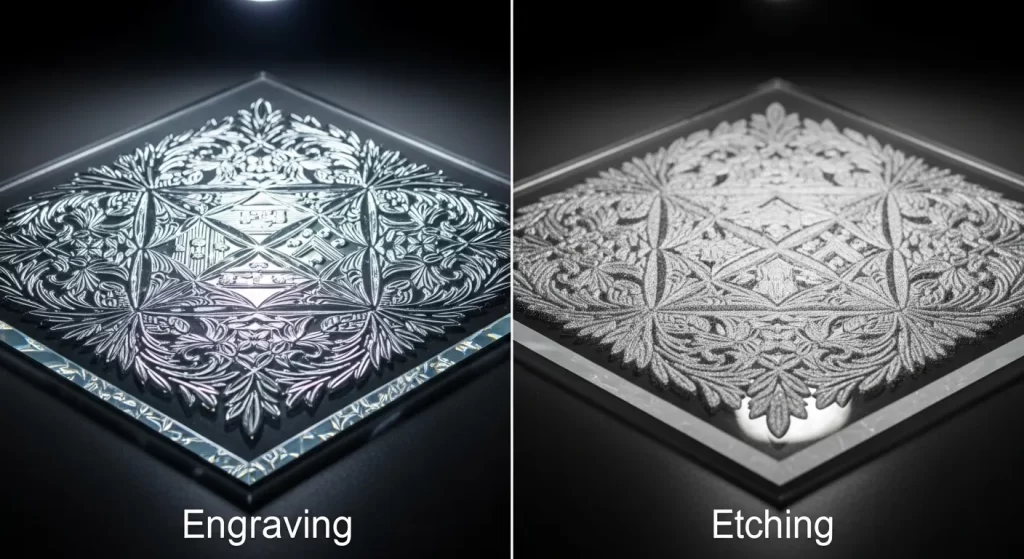
This guide will eliminate the confusion. We'll break down the core mechanics of each process, place them in a head-to-head comparison, and give you the practical knowledge to decide which technique is the perfect fit for your specific project. We’ll move beyond simple definitions and into the real-world factors that matter.
What's the Core Difference Between CNC Glass Engraving and Etching?
The core difference is that CNC engraving is a subtractive process that uses a rotating tool to physically cut grooves into the glass, creating depth and clarity.1 In contrast, CNC etching is an abrasive process that uses fine particles to create a frosted, matte finish on the surface of the glass without significant depth.
Think of it like this: engraving is like using a fine-tipped pen to carve a line into a clay tablet, creating a distinct, deep mark. Etching is like using sandpaper to gently rough up the surface of that same tablet, creating a textured, opaque area. The first removes material in a precise line, while the second abrades the surface for a different texture. This fundamental distinction influences every other aspect, from the final appearance to the tools required.
How Does CNC Glass Engraving Actually Work?
CNC glass engraving is a precision machining process that uses a rotating cutting tool, typically a diamond or carbide burr, to remove glass material and create a design. The CNC machine follows a digital path (G-code), controlling the tool's depth, speed, and position with extreme accuracy to produce sharp, V-shaped or U-shaped grooves.2
The process begins with a digital design file (like a CAD or vector file).3 This design is translated into instructions for the Computer Numerical Control (CNC) machine. The machine’s spindle, holding the diamond-tipped tool, then moves across the glass surface. As it rotates at high speeds—often thousands of RPM—it precisely chips away microscopic pieces of glass. A constant stream of coolant is essential to prevent heat fractures and wash away the glass dust. The result is a clean, permanent mark with tangible depth that brilliantly refracts light. This method is the foundation of many decorative glass applications and is a core function explored in our guide to CNC routers for glass engraving.
How is CNC Glass Etching Performed?
CNC glass etching creates a frosted, translucent finish by abrading the glass surface with fine particles rather than cutting deep into it. While traditional methods use acid, modern CNC etching is typically achieved through automated sandblasting or with specialized abrasive tools that gently wear away the surface layer of the glass.
In a CNC sandblasting setup, the machine directs a high-pressure stream of abrasive material (like aluminum oxide) onto the glass through a nozzle, following a programmed path.4 Areas not meant to be etched are protected by a mask. Another CNC method involves using a specialized tool bit that vibrates or rotates an abrasive pad against the surface. Unlike engraving, the goal isn't to create deep grooves but to produce millions of microscopic pits. These tiny fractures disrupt the glass's transparency, scattering light and creating that classic, elegant frosted look. The process is generally faster than engraving for covering large surface areas.
Head-to-Head Comparison: Engraving vs. Etching
To truly understand the best use for each technique, a direct comparison is essential. I've seen clients save thousands of dollars simply by choosing the right process for their production run. Here is a breakdown of the key differences you need to consider.
| Feature | CNC Glass Engraving | CNC Glass Etching |
| Core Method | Subtractive cutting (removes material) | Abrasive (roughens the surface) |
| Finish & Texture | Deep, clear grooves with a V-shape. Smooth to the touch inside the cut. | Shallow, frosted, matte finish. Slightly rough or textured surface. |
| Depth | Significant and controllable depth (from microns to millimeters). | Very shallow, surface-level effect with minimal depth. |
| Precision & Detail | Extremely high precision, capable of very fine lines and intricate text. | Good for bold designs and patterns, but less suited for ultra-fine details. |
| Light Interaction | Refracts light brilliantly, creating a sparkling, 3D effect. | Scatters and diffuses light, creating an opaque or translucent appearance. |
| Typical Tools | Diamond burrs, carbide cutters, rotating bits. | Sandblasting nozzles, abrasive pads, specialized etching tools. |
| Common Use Cases | Awards, trophies, fine art, detailed logos, text on bottles. | Privacy glass, shower doors, decorative patterns, surface logos on glassware. |
| Production Speed | Slower, especially for deep cuts or large, filled-in areas. | Faster for covering large surface areas with a uniform frosted look. |
| Durability | Extremely durable; the mark is as permanent as the glass itself. | Very durable, but the shallow frosted surface can show oils or scratches more easily. |
Which Technique Offers Better Detail and Precision?
For razor-sharp, intricate details and fine lines, CNC engraving is the undisputed winner. Because engraving uses a pointed cutting tool to physically carve into the glass, it can achieve a level of resolution that surface abrasion simply cannot match, much like the difference between a scalpel and a sanding block.
The precision comes from the direct control the CNC machine has over the tool tip. You can program cuts that are fractions of a millimeter wide and deep, allowing for complex filigree, readable micro-text, and photorealistic imagery. Etching, which relies on blasting or scuffing the surface, has a softer edge by nature. The transition from etched to un-etched glass is not as stark as the edge of an engraved groove. While perfect for bold logos, etching will struggle to reproduce the same delicate details as engraving. This precision is also a key component of CNC drilling and milling for glass, where accuracy is paramount.
What Are the Best Applications for CNC Glass Engraving?
CNC glass engraving is the go-to choice when the goal is to create a high-value, permanent mark with depth, brilliance, and a sense of quality. The way engraved glass plays with light makes it ideal for products where presentation and perceived value are critical.
Here are its primary applications:
- Corporate Awards and Trophies: The deep cuts and sparkling finish give awards a premium feel that surface etching can't replicate.
- Personalized Gifts: Engraving names, dates, and messages on wine bottles, perfume, or glassware creates a lasting, high-quality memento.5
- Architectural Glass and Signage: For detailed logos or text on glass panels in corporate lobbies, engraving provides unparalleled clarity and permanence.
- Fine Art and Sculptures: Artists use CNC engraving to create incredibly detailed and complex works of art on glass.6
- Component Marking: In industrial settings, engraving is used to add permanent serial numbers or logos to glass components.7 A recent study noted that laser engraving, a form of this process, has seen a compound annual growth rate of over 6%.
When Should You Choose CNC Glass Etching?
You should choose CNC glass etching when your project requires a soft, elegant, frosted finish, often over larger surface areas, or when the primary goal is to create privacy or diffuse light rather than create sharp details.
Etching excels in applications where subtlety and texture are more important than deep, sparkling lines. It's often a more practical and cost-effective solution for large-scale projects.
Common applications include:
- Privacy Glass: Think bathroom windows, shower doors, and office partitions where a translucent finish is needed.8
- Decorative Patterns on Glassware: Creating frosted bands, logos, or patterns on pint glasses, wine glasses, and plates.
- Company Logos on Doors: A frosted logo on a glass office door is a classic, professional look.
- Architectural Designs: Creating large-scale frosted patterns on glass railings, walls, and facades.
- Backlit Panels: Etched glass diffuses light beautifully, making it perfect for illuminated signs and decorative panels.9 The cost-effectiveness of etching for large surfaces is a major driver of its adoption in architecture.
Can the Same CNC Machine Perform Both Engraving and Etching?
Yes, absolutely. Most modern, high-quality CNC machines are versatile enough to perform both engraving and etching. The capability isn't in the machine's core structure but in the tooling and software parameters. By simply changing the tool in the spindle and adjusting the settings like speed, feed rate, and depth, a single machine can switch between tasks.
A robust CNC glass working center can be fitted with a diamond burr for engraving one moment and an abrasive head for etching the next. This versatility is crucial for workshops that serve a diverse clientele. The key is understanding how to choose the right CNC glass machine for your workshop in the first place, ensuring it has the required spindle speed range and rigidity to handle both delicate etching and powerful engraving. A common mistake is buying a machine optimized for only one process, limiting future business opportunities.
What Are the Cost Implications of Engraving vs. Etching?
Generally, CNC etching is faster and therefore more cost-effective for covering large surface areas, while CNC engraving is often more expensive due to longer machine times and higher tool wear, especially for deep or complex designs.
The cost calculation is a function of time, consumables, and labor.
- Machine Time: Etching a 12-inch square logo might take minutes. Engraving the outline of that same logo would be quick, but filling it in with deep engraved lines could take significantly longer, increasing the cost.
- Tooling Costs: Diamond engraving burrs are precision instruments and wear down over time, requiring replacement. Their cost can be significant. Etching consumables (like sandblasting media) are generally cheaper.
- Complexity: For an extremely detailed, fine-line design, engraving might actually be more efficient than the complex masking required for high-detail etching.
Ultimately, the most cost-effective method depends entirely on the design. For a simple frosted surface, etching wins. For a small, detailed piece of text, engraving wins.
How Does Maintenance Differ for Engraving and Etching Tools?
Maintenance for engraving tools is more demanding due to the high-stress nature of cutting into glass. Engraving burrs require frequent inspection for wear and chipping and must be replaced regularly to maintain cut quality.10 In contrast, etching components, like sandblasting nozzles, primarily require cleaning to prevent clogs.
Proper maintenance is non-negotiable for consistent results. Our complete guide to maintenance tips for CNC glass machinery covers this in depth, but here’s a quick summary:
- Engraving Tool Maintenance:
- Daily: Check the diamond tip for any signs of damage.
- Regularly: Clean the tool to remove glass residue.
- As Needed: Replace the tool immediately if cut quality degrades. Using a worn tool can ruin a valuable piece of glass. [Insert Statistic on Tool Lifespan Under Normal Use].
- Etching System Maintenance:
- Daily: Ensure nozzles are free from blockages.
- Weekly: Check abrasive media levels and quality.
- Monthly: Inspect hoses and seals for leaks in a sandblasting system.11
Neglecting maintenance on engraving tools is far riskier, as a failed tool can shatter the workpiece.
Frequently Asked Questions (FAQ)
Can you etch and engrave on the same piece of glass?
Yes, combining both techniques is a fantastic way to create stunning, multi-textured designs. For example, a company logo could be engraved with sharp, deep outlines and then have its interior lightly etched for a frosted fill. This creates a dynamic 3D effect that stands out.
Which method is more durable?
Both engraving and etching are permanent and will last as long as the glass itself. However, an engraved mark is a deep physical groove, making it exceptionally resistant to wear.12 An etched surface, being a collection of micro-fractures, can sometimes show fingerprints or oils more readily and could theoretically be polished away (though this would require significant effort).
Does glass thickness matter more for one process?
Glass thickness is a critical safety consideration for engraving.13 Because engraving removes material, you must ensure you don't compromise the structural integrity of thin glass. Etching is a surface treatment and is generally safe for any glass thick enough to handle the process without breaking.
What's the role of automation in these processes?
Automation is everything. The growth of CNC and automation in glass processing is what has made these intricate designs accessible and repeatable. Automation ensures that every piece is identical, reduces manual error, and dramatically increases production speed, transforming the capabilities of the entire glass processing industry.
Conclusion: Making the Right Choice for Your Project
The debate of CNC glass engraving vs. etching isn't about which is better overall, but which is right for your specific goal. The choice is a simple one once you define your priorities.
Let this be your guiding rule:
- Choose CNC Engraving for depth, detail, and brilliance. If you want a design that sparkles, has a tangible 3D feel, and conveys the highest quality—think awards, fine art, and intricate text—engraving is your answer.
- Choose CNC Etching for surface texture, privacy, and speed over large areas. If you need a soft, elegant frosted look for a shower door, a subtle logo on a glass panel, or decorative patterns, etching is the more practical and cost-effective solution.
By understanding these core differences, you can move forward with confidence, knowing you are using the right tool for the job. You can leverage the power of CNC technology to transform a simple piece of glass into something truly remarkable.