



Automatic Glass Beveling Machine Explained Clearly
The automatic glass beveling machine explained in its essence is a marvel of modern manufacturing. This equipment automates the intricate process of creating a decorative, angled edge on glass. It uses a sophisticated, multi-stage system of grinding and polishing. This transforms a simple, sharp edge into a brilliant, light-refracting feature. Understanding the mechanics and principles behind these machines is vital for any glass fabricator. It reveals how automation has brought unparalleled precision, speed, and consistency to a traditionally difficult craft. This guide provides a clear and detailed explanation of how this technology works.
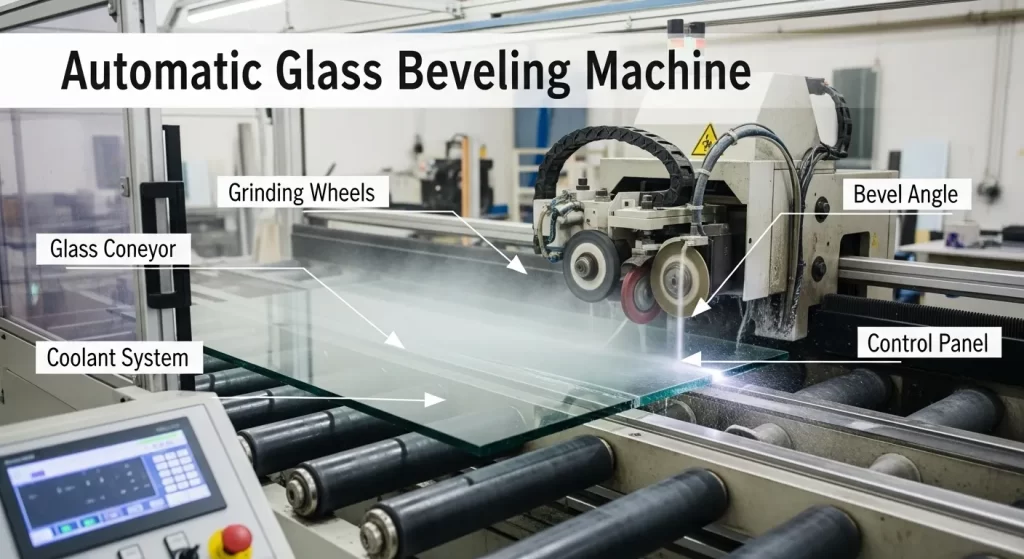
What is an Automatic Glass Beveling Machine?
An automatic glass beveling machine is a piece of industrial equipment. It is designed to create a beveled edge on glass sheets without direct manual intervention. The machine uses a series of rotating wheels to sequentially grind and polish the glass. An automated transport system moves the glass through these stages. The entire process is controlled by a programmable logic controller (PLC) or a CNC system. This ensures a consistent angle, width, and finish quality on every piece.
How Does Automation Define This Machine?
Automation is the defining characteristic of this machine. It replaces the variable skill of a human artisan with the infallible precision of computer control. Automation manages every critical aspect of the process. This includes the speed at which the glass moves, the pressure applied by the wheels, and the exact sequence of operations. This technological control is the key to achieving high-volume production of flawless beveled glass. It is the primary factor that separates modern equipment from traditional, manual methods.
What is the Primary Function of the Machine?
The primary function of the machine is to create a decorative angled edge. This process is far more complex than simple edge finishing. While a standard edger creates a safe, smooth profile, a beveling machine creates a distinct, angled face on the glass. This face is designed specifically to catch and refract light. This creates a prismatic, jewel-like effect. The machine’s function is to produce this high-value decorative feature efficiently and consistently. The guide on how glass beveling machines work provides a foundational overview of this core purpose.
How Does it Differ from Manual Beveling?
An automatic machine differs from manual beveling in every significant metric. These include speed, consistency, safety, and quality. Manual beveling is a slow, physically demanding craft. It relies entirely on the artisan's skill and can result in subtle inconsistencies. An automatic machine can produce a perfect bevel in a fraction of the time. It can also produce thousands of identical pieces. The automated process is also inherently safer. It contains the glass slurry and isolates the operator from the high-speed rotating components.
What are the Core Principles of Automatic Beveling?
The core principles of automatic beveling are rooted in a systematic, multi-stage approach to material removal and surface finishing. The process is not a single, aggressive action. It is a carefully orchestrated sequence of operations. Each stage prepares the glass for the next. This methodical progression is what allows the machine to transform a rough-cut edge into a flawless, transparent bevel.
How is the Bevel Created Sequentially?
The bevel is created sequentially by passing the glass edge across a series of specialized wheels. Each wheel in the series is progressively finer than the last. The process begins with coarse diamond grinding wheels. These remove the bulk of the material to establish the bevel's angle and width. It is then followed by finer diamond wheels that smooth out the rough surface. Finally, a series of polishing wheels are used. These create the final brilliant, transparent finish. This sequential method is fundamental to the technology.
What is the Role of the Multi-Stage Wheel System?
The multi-stage wheel system is the heart of the beveling process. It allows the machine to transition smoothly from aggressive grinding to delicate polishing. If a machine tried to polish a roughly ground edge directly, the result would be a hazy, low-quality finish. The intermediate fining stages are crucial. They systematically remove the microscopic damage created by the previous, coarser stage. This gradual refinement is the only way to achieve an optically perfect surface. A detailed look at the final stages can be found in our guide on polishing glass edges like a pro.
Why is Coolant Essential for the Process?
Coolant is essential for the entire automatic beveling process. The friction between the diamond wheels and the glass generates an immense amount of localized heat. This heat would cause the glass to fracture instantly from thermal shock. A continuous flood of coolant, typically water, serves three purposes. It also washes away the abrasive glass powder, known as slurry. Without a constant and reliable coolant supply, the entire process would be impossible.
What are the Main Types of Automatic Beveling Machines?
Automatic beveling machines are primarily categorized into two main types. These are straight-line beveling machines and shape (or CNC) beveling machines. Each type is designed for a specific range of applications. A straight-line machine excels at high-speed production of rectangular pieces. A shape beveling machine offers the flexibility to work with custom curves and non-rectangular designs. The choice between them depends on a workshop's product mix.
How Does a Straight-Line Beveling Machine Operate?
A straight-line beveling machine operates like a highly specialized assembly line. The glass sheet is fed into one end of the machine. It is then carried by a conveyor system past a series of fixed-position grinding and polishing wheels. Each wheel performs one specific task. The machine is optimized for processing the straight edges of squares and rectangles at high speeds. This makes it ideal for producing items like mirrors and rectangular tabletops in a high-volume setting. A complete look at this machine is available in our straight-line beveling machine overview.
How Does a Shape (CNC) Beveling Machine Operate?
A shape beveling machine operates by moving the tool around a stationary piece of glass. The glass is held securely on a flat table using a vacuum system. A computer-controlled tool head, which can hold a variety of wheels, then travels around the perimeter of the glass. The machine follows a programmed path from a digital design file. This allows it to create a perfect bevel on circles, ovals, arches, and other complex, non-linear shapes. This versatility is its key advantage.
What are the Key Differences in Their Operation?
The key operational difference lies in what moves. In a straight-line machine, the glass moves, and the tools are stationary. In a shape machine, the glass is stationary, and the tools move. This fundamental difference is explored in our guide on glass shape beveling vs. straight beveling. The straight-line machine is built for speed and efficiency on a single type of task. The shape machine is built for flexibility and the ability to handle custom, one-of-a-kind jobs.
How Does a Straight-Line Automatic Beveling Machine Work in Detail?
To understand the automatic glass beveling machine explained clearly, a detailed look at the straight-line model is essential. This machine is a model of industrial efficiency. Its design is honed for one purpose: to produce perfect, straight bevels at the highest possible speed. Every component, from the conveyor to the spindles, is engineered for reliability and high performance in a demanding production environment.
What are the Key Components of the Machine?
The key components of a straight-line machine are the main frame, the infeed and outfeed conveyors, the synchronized clamping track, and the bank of angled spindles. The frame is a heavy, rigid structure that supports all the other components and dampens vibration. The conveyors provide the transport mechanism. The clamping track holds the glass securely during processing. The spindles are the powerful motors that drive the grinding and polishing wheels. The number of spindles, which can range from a few to more than a dozen, determines the machine's speed and quality.
How is Glass Fed Through the Machine?
Glass is fed through the machine on a precision conveyor system. The operator places the glass edge against a guide on the infeed conveyor. As the main conveyor chain moves, it carries the glass into the machine. Simultaneously, a top clamping track with rubberized pads engages. It applies firm, even pressure to the top surface of the glass. This synchronization between the bottom conveyor and the top clamp is critical. It ensures the glass moves smoothly and without slipping at a constant speed.
What is the Spindle and Wheel Configuration?
The spindle and wheel configuration is the heart of the machine. Each spindle is a high-power motor that holds one wheel. The entire bank of spindles is mounted on a single, heavy-duty support beam that can be tilted. The operator sets the desired bevel angle by adjusting the angle of this entire beam. Each spindle is individually adjustable for height and pressure. This allows for fine-tuning of the process. The wheels are arranged in a specific sequence, from coarse diamond grinders to fine felt polishers, to perform the complete beveling operation as the glass passes by.
How is the Process Controlled by the Operator?
The process is controlled by the operator through a central control panel. This panel typically features a PLC (Programmable Logic Controller) with a touchscreen interface. From this panel, the operator can control several key parameters. They can set the conveyor speed (feed rate). They can adjust the amount of glass to be removed, which controls the bevel width. Modern machines automate many of these settings. The operator simply inputs the glass thickness and desired bevel width, and the machine adjusts its parameters accordingly.
How Does a Shape (CNC) Automatic Beveling Machine Work in Detail?
A shape, or CNC, automatic beveling machine represents a leap in flexibility and creative potential. It replaces the linear, fixed-tool approach of a straight-line machine with the programmable, multi-axis motion of a computer-controlled system. This allows it to create beautiful, consistent bevels on virtually any shape. This capability is essential for the custom glass fabrication market.
What Defines its CNC Control System?
The CNC control system is the brain of the machine. It is a sophisticated computer that reads a program file (G-code) and translates it into precise electrical signals. These signals are sent to the servo motors that drive the machine's axes. This system provides complete control over the tool's position, speed, and path. The controller can execute complex, curved toolpaths with exceptional accuracy. This allows it to perfectly follow the contour of any custom glass shape. This level of control is what makes sophisticated glass beveling and edging mastery possible.
How is the Glass Secured for Shaped Beveling?
The glass is secured using a flatbed vacuum system. The machine's table has a grid of vacuum ports. The operator places rubber-sealed suction pods over these ports, directly under the glass sheet. A powerful vacuum pump then creates a strong suction force. This pulls the glass down and holds it firmly in place. This method is highly effective. It can securely clamp glass of any size or shape without inducing mechanical stress. A stable workpiece is absolutely critical for achieving a smooth and accurate bevel.
What is the Function of the Automatic Tool Changer (ATC)?
The function of the Automatic Tool Changer (ATC) is to automate the entire sequence of wheel changes needed for the beveling process. The ATC is a magazine or carousel that holds a variety of pre-loaded grinding, fining, and polishing wheels. When the program requires a different wheel, the machine automatically moves the tool head to the ATC. It deposits the current tool and picks up the next one in the sequence. This allows the machine to complete the entire beveling process, from rough grinding to final polishing, in a single, uninterrupted operation.
How is a Complex Path Programmed and Executed?
A complex path is programmed using a CAD/CAM software workflow. First, a technician creates a precise 2D vector drawing of the desired glass shape in a CAD (Computer-Aided Design) program. This file is then imported into a CAM (Computer-Aided Manufacturing) program. The CAM operator defines the toolpath. They specify which side of the vector line to follow. They also assign the correct sequence of tools from the ATC to the path. The CAM software generates the final G-code program. This program is then loaded into the CNC controller for execution.
What is the Detailed Grinding and Polishing Process?
The grinding and polishing process is a systematic journey from a rough, opaque surface to a brilliant, transparent one. This process is fundamentally the same for both straight-line and shape beveling machines. It involves a carefully planned progression of abrasive tools. Each step is designed to remove the damage from the previous step. This gradual refinement is the only way to achieve a flawless finish.
What Happens During the Rough Grinding Stage?
The rough grinding stage is where the shape and angle of the bevel are established. This is an aggressive material removal process. It uses one or more metal-bonded diamond wheels with a coarse grit. These wheels are durable and can withstand the high pressure needed to quickly grind the glass to the desired shape. This stage removes the bulk of the material. However, it leaves the surface of the bevel with a very rough, opaque finish. It is a process of formation, not finishing. The guide glass edge grinding vs. beveling highlights this important first step.
What is the Purpose of the Fining Stage?
The purpose of the fining stage is to act as an intermediate step between rough grinding and final polishing. This stage uses one or more resin-bonded diamond wheels. These wheels have a much finer grit than the grinding wheels. Their job is to remove the deep scratches and micro-fractures left by the initial grinding process. The fining stage smooths the surface of the bevel. It turns it from a rough, opaque surface into a smooth, semi-transparent one. This step is crucial. It properly prepares the glass for the final polish.
How is the Final Brilliant Polish Achieved?
The final brilliant polish is achieved using specialized polishing wheels in conjunction with a cerium oxide slurry. The polishing wheels are typically made of a very hard, compressed felt or a synthetic rubber compound. The cerium oxide, a fine rare earth powder mixed with water, is the polishing agent. A chemical reaction between the cerium and the glass softens the surface. The mechanical action of the wheel then smooths this softened layer to an optical finish. This chemo-mechanical process creates the final, brilliant shine. Proper safety protocols, as detailed in how to polish the edge of glass safely, are essential during this stage.
How Does the Machine Manage the Slurry System?
The machine manages the slurry system through a closed-loop recirculation and filtration process. The cerium oxide slurry is a valuable consumable. Therefore, it is captured and reused. The slurry is delivered to the polishing wheels from a central tank. The runoff is collected in a drain pan. It is then pumped back to the tank through a series of filters. These filters remove the glass particles that have been polished off. This keeps the slurry clean and effective. It also significantly reduces operational costs.
What are the Key Operational Parameters and Controls?
Controlling the key operational parameters is essential for achieving a high-quality bevel consistently. An automatic beveling machine provides the operator with precise control over several variables. These include the bevel angle and width, the feed rate, and the condition of the wheels. The ability to fine-tune these parameters allows the machine to be adapted for different glass thicknesses and desired finishes.
How is the Bevel Angle and Width Set and Maintained?
The bevel angle and width are set differently on the two types of machines. On a straight-line machine, the angle is set by physically tilting the entire spindle bank. The width is controlled by adjusting the position of the conveyor. On a CNC shape beveler, the angle is often controlled by the shape of the specialized tools. The width is controlled by the programmed toolpath. On both machines, maintaining these parameters requires the machine to be rigid and the workpiece to be held securely.
How Does Feed Rate Impact Quality and Speed?
The feed rate, or the speed at which the glass moves past the wheels, is a critical trade-off between quality and speed. A faster feed rate increases productivity and output. However, a rate that is too fast will not give the wheels enough time to work properly. This results in a poor-quality finish with visible lines or haze. A slower feed rate allows for a higher-quality finish. The operator must find the optimal balance. This balance maximizes speed while still meeting the required quality standard.
What is the Importance of Wheel Dressing and Maintenance?
Wheel dressing and maintenance are vital for consistent quality. Over time, the surface of a diamond wheel can become loaded with glass particles or glazed over. This reduces its cutting efficiency. Dressing the wheel with an abrasive stick removes this buildup. It exposes fresh diamond particles. Regular wheel dressing ensures a consistent material removal rate. It also helps to prevent many common issues, such as scratches or burn marks. A full guide to common beveling problems and solutions often starts with proper wheel maintenance.
How Do Modern Machines Automate Parameter Setting?
Modern machines automate parameter setting through their advanced control systems. The operator can simply input the key variables. These include the glass thickness, the desired bevel angle, and the desired bevel width. The machine's controller then uses a pre-programmed library of settings to automatically adjust the feed rate and other parameters. This reduces the need for operator guesswork. It also helps to ensure that the optimal settings are used for every job. This level of automation simplifies operation and improves consistency.
How Does This Machine Fit into a Modern Workshop?
An automatic glass beveling machine is a cornerstone of a modern, full-service glass fabrication workshop. It represents a significant enhancement of a workshop's capabilities. It allows the business to move beyond simple cutting and edging. The integration of this technology can be a powerful driver of growth and profitability.
How Does it Integrate with Other Glass Processing Equipment?
An automatic beveling machine integrates smoothly into a larger production workflow. In a high-volume setting, a straight-line machine might be placed in-line after a washing machine and before a tempering furnace. In a custom shop, a CNC shape beveler acts as a versatile work center. It often works in conjunction with a CNC cutting table and a waterjet machine. A seamless flow of material and data between these machines is the hallmark of an efficient, modern workshop.
What are the Considerations for Choosing the Right Machine?
Choosing the right machine is a critical strategic decision. The primary consideration is the workshop's product mix. A shop that produces hundreds of identical mirrors per day needs a straight-line machine. A shop that produces custom, one-of-a-kind tabletops needs a CNC shape beveler. Other factors include the required glass size capacity, the available floor space, and the budget. The guide on how to choose the best glass edger provides a useful framework that can be adapted for choosing a beveler.
What are the Applications for a Small Glass Beveling Machine?
A small glass beveling machine is an excellent choice for workshops specializing in smaller decorative items. These compact machines are ideal for the stained glass industry, for creating beveled components for awards, and for producing decorative items for furniture. The guide on small-glass-beveling-machine-uses shows that these machines offer the same high-quality finish as larger models. They simply have a smaller size capacity.
How is Mastery in Automated Beveling Achieved?
Mastery in automated beveling is achieved through a deep understanding of the entire process. It requires technical knowledge of the machine's operation. It also requires a commitment to using high-quality tooling and performing diligent maintenance. A master operator understands the subtle interplay between the machine, the tools, and the glass itself. They can troubleshoot problems effectively and optimize the process for both quality and efficiency. The path to glass beveling and edging mastery is a journey of continuous learning and improvement.
Conclusion
The automatic glass beveling machine explained is a testament to the power of precision engineering. Whether through the linear efficiency of a straight-line model or the programmable flexibility of a CNC system, these machines execute a complex, multi-stage process with flawless consistency. They have transformed a difficult manual craft into a reliable and highly efficient manufacturing operation. By understanding the intricate mechanics of how these machines work, from the conveyor systems to the sequential wheel process, one can truly appreciate the sophisticated technology behind every brilliant, beveled edge.