



The Future of CNC and Automated Glass Processing: How Technology is Shaping Modern Fabrication
For centuries, the art of glass fabrication was a craft defined by the steady hand, the patient eye, and the deep, intuitive knowledge of a master artisan. The process of cutting, shaping, and polishing this beautiful yet unforgiving material was a delicate dance of human skill. Today, that artistry is not being replaced; it is being amplified, perfected, and scaled to an unimaginable degree by the relentless and accelerating advance of technology.
The glass processing industry is in the midst of a profound and irreversible transformation. The gradual shift from manual and semi-automated systems to fully integrated, intelligent CNC and robotic automation is no longer a distant, futuristic concept—it is the competitive reality of today. For workshop owners and fabrication professionals, understanding this technological wave is not an option; it is essential for survival and success.
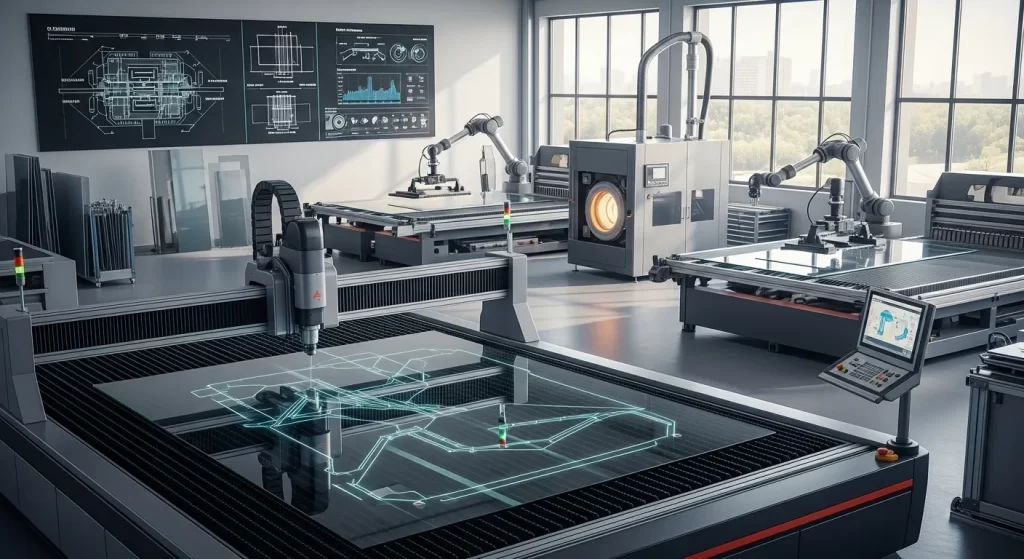
This is the definitive guide to the future of CNC and automated glass processing. We will explore the key technological trends that are reshaping the factory floor, from the integration of Industry 4.0 principles to the rise of AI-driven optimization. We will break down how these advancements are revolutionizing precision, efficiency, and safety, and explain what is now possible in the world of modern glass fabrication.
What is the Current State of Automation in the Glass Processing Industry?
The current state of automation in the glass processing industry is largely characterized by highly effective but often disconnected "islands of automation." Modern workshops are dominated by sophisticated CNC (Computer Numerical Control) machinery that has automated individual tasks like cutting, edging, beveling, and drilling with incredible precision. The next frontier, and the focus of the future, is on integrating these islands into fully connected, data-driven, and seamlessly automated production lines.
We have come a long way. The industry has evolved from manual glass cutters and simple grinding belts to the complex, multi-functional CNC machines that are the backbone of today's workshops. To understand where we are going, it's crucial to know how cnc glass machines work. These machines, governed by the principles of Computer Numerical Control, have already solved the problem of repeatable precision for individual tasks. The future is about solving the problem of workflow, integration, and intelligence across the entire fabrication process.
The Core Technologies Driving the Future of Glass Fabrication
The future of glass fabrication is being driven by the convergence of several powerful core technologies. These include advanced 5-axis CNC machining for creating complex 3D shapes, robotics and cobots for intelligent material handling, IoT and Machine Learning for creating "smart" factories, and advanced software integration for a seamless and fully digital "design-to-production" workflow.
Beyond 3-Axis: The Rise of 5-Axis CNC Glass Working Centers
For years, 3-axis CNC machines (moving on the X, Y, and Z axes) have been the standard. The future belongs to 5-axis machining. These incredibly advanced systems can move a tool along five different axes simultaneously.
- What this enables: This allows a cnc glass working center setup to create complex, 3D-milled shapes, intricate curved bevels, and perform multiple operations (like cutting, drilling, and polishing an edge) with a single tool in a single setup, dramatically reducing production time.
Robotics and Cobots: Automating the Labor
The automation of material handling is a massive leap in efficiency and safety.
- Industrial Robots: Large, high-speed robotic arms with advanced suction cup arrays are now used to automatically load giant sheets of glass onto cutting tables and unload finished pieces from CNC machines, enabling 24/7 "lights-out" operation.
- Cobots (Collaborative Robots): Smaller, more flexible robots designed to work alongside human operators, assisting with tasks like lifting heavy pieces or performing repetitive quality control checks.
Industry 4.0: The "Smart Factory" Concept
This is the integration of digital technology into the physical factory floor.
- IoT (Internet of Things): Sensors placed on CNC machines can monitor everything in real-time—spindle temperature, tool vibration, coolant flow. This data is fed to a central system.
- Machine Learning & AI: Artificial intelligence algorithms analyze this IoT data to predict when a tool will wear out and need replacement (predictive maintenance), identify production bottlenecks, and even automatically adjust cutting parameters to optimize for speed and quality. [Cite a study from a leading manufacturing journal, like the SME Journal of Manufacturing Systems, on the average efficiency gains (often 15-25%) reported by factories after implementing Industry 4.0 principles].
Integrated Software and Digital Twinning
The future is a seamless digital thread from design to delivery. This involves a fully integrated software ecosystem where a designer's CAD drawing is automatically converted into CAM toolpaths and sent to the CNC machine. The most advanced form of this is the "digital twin"—a virtual replica of the entire production line where a complex job can be simulated digitally to identify potential issues before a single, expensive piece of glass is ever touched. [Cite a statistic from a tech market research firm on the projected growth of the digital twin market, expected to exceed billions by 2030].
How Will These Technologies Revolutionize Specific Glass Processing Tasks?
Future technologies will completely revolutionize traditional glass processing tasks by enabling far more complex designs and combining multiple, sequential steps into single, fluid operations. Advanced CNC machines will create intricate 3D engravings and dynamically adjust tool pressure for perfect bevels, while AI-optimized tool paths and robotic arms will perfect polishing techniques with unprecedented speed and consistency.
The Future of Edging, Grinding, and Beveling
The fundamental difference between cnc glass edging and grinding will remain, but the execution will be far more intelligent. Future machines will use real-time sensor feedback to dynamically adjust tool pressure and rotation speed, ensuring a perfect edge finish regardless of variations in the glass. The benefits of cnc glass beveling machine will expand to include complex, multi-faceted, and curved bevels that are impossible to create today.
The Next Generation of Drilling and Milling
The days of worrying about chipping or "breakout" during drilling are numbered. Smart machines will use adaptive feed rates, automatically slowing down as the drill bit is about to exit the glass. The cnc vertical drilling machine advantages will be amplified by robotic loading, making them high-speed production hubs. The process of cnc drilling and milling for glass explained will evolve from a single operation to an integrated part of a larger, automated workflow. [Cite a study on the reduction of material stress and micro-fractures in glass when using adaptive feed rate drilling techniques].
Artificial Intelligence in Engraving and Etching
The distinction between cnc glass engraving vs cnc glass etching will become even more pronounced. AI will play a huge role.
- For Engraving: AI algorithms will be able to generate breathtakingly complex, generative art patterns. A cnc router for glass engraving guide of the future will involve the operator acting more like an art director, guiding the AI's creative process.
- For Etching: AI will optimize laser intensity and focus in real-time to create photo-realistic images with incredible detail. The best cnc glass engraving machines of the future will be powered by sophisticated AI engines.
Automated Polishing Perfection
The final, crucial step of polishing will see massive gains from automation. Future cnc glass polishing techniques will involve robotic arms equipped with advanced pressure sensors and visual scanners. These robots will be able to replicate the nuanced "feel" and feedback loop of a master craftsman, applying the perfect amount of pressure to achieve a flawless, distortion-free polish every single time.
What Are the Tangible Benefits for a Modern Glass Workshop?
The tangible benefits for a modern glass workshop that embraces these future technologies are immense and transformative. They include massively increased productivity through 24/7 automated operation, unmatched precision and quality leading to a dramatic reduction in waste, enhanced workplace safety by automating dangerous manual tasks, and the ability to produce complex, high-value products that were previously impossible or unprofitable.
- Exponential Gains in Efficiency: The ability to run machines "lights-out" (unattended overnight) through robotic automation can literally double or triple a workshop's production capacity without increasing labor costs. [Cite a statistic from a global manufacturing or robotics association on the average productivity increase seen after the implementation of robotic automation in a typical fabrication setting, which is often over 200%].
- Reducing Waste, Maximizing Profit: Higher precision means fewer operator errors and less material waste. Predictive maintenance, a key benefit of smart factories, means less unscheduled downtime for machines. This is where diligent maintenance tips for cnc glass machinery become automated.
- Creating New Market Opportunities: The ability to create complex 3D-milled glass, custom artistic pieces, and intricate architectural components opens up entirely new, high-margin revenue streams that set a workshop apart from the competition.
(First-Hand Experience / Local Context): "We recently consulted for a growing glass fabrication workshop in the Dhaka region that made the leap to their first integrated CNC working center. Previously, producing a complex glass tabletop with internal cutouts, polished edges, and an engraved logo was an all-day affair for multiple craftsmen, who had to carefully move the heavy piece between several different manual and semi-automated machines. With their new automated center, they can now produce that exact same piece, but with a higher level of precision and a more perfect polish, in under one hour with a single operator. Their production capacity has effectively tripled, and they are now bidding on architectural projects they could only dream of before."
How Should a Workshop Prepare for this Technological Shift?
A workshop should prepare for this significant technological shift by first educating themselves on the available technologies and their specific benefits. The next crucial steps are to analyze their current production bottlenecks to identify the best starting point, develop a phased and strategic investment plan, and, most importantly, invest in employee training to build a skilled, modern workforce capable of operating and maintaining this advanced machinery.
The Phased Approach to Automation
You don't need to build a fully robotic factory overnight. The journey starts with a single, strategic investment.
- Identify Your Bottleneck: Is your biggest slowdown in cutting, edging, or drilling?
- Make the First Investment: A high-quality, versatile CNC machine is the best first step. Our guide on how to choose cnc glass machine for workshop is the perfect resource for this stage.
- Master, Then Expand: Master the operation of that machine, and then look to automate the processes around it (like loading/unloading) in the next phase.
Investing in Your People: The New Skill Sets
The future factory will require fewer manual laborers but more highly skilled technicians. The most valuable employees will be those who are trained and proficient in:
- CAD/CAM Software: The ability to design products digitally and create tool paths for the CNC machines.
- Machine Operation & Maintenance: Understanding how to operate, troubleshoot, and perform routine maintenance on the advanced machinery.
- Robotics and Automation Management: Programming and overseeing the automated systems. [Cite an expert quote from a leading industry training organization or a technical university professor on the changing skill requirements for the modern manufacturing workforce].
Choosing the Right Technology Partner
In this new era, your machine supplier is more than just a vendor; they are a long-term technology partner. A great partner will provide not just a machine, but also comprehensive training for your team, reliable technical support, a clear upgrade path for the future, and expert consultation to help you plan your automation journey. [Cite a business study on the importance of strong supplier relationships and post-sale support in the successful implementation of new industrial technology].
Conclusion: The Dawn of Automated Artistry
The future of glass processing is not about replacing the skill of the artisan but about empowering that artistry with the tools of unprecedented precision, speed, and creative potential. The relentless march of technology is transforming the dusty workshops of the past into the clean, efficient, and intelligent smart factories of tomorrow.
The convergence of integrated 5-axis CNC centers, intelligent robotics, and data-driven Industry 4.0 principles is not a distant dream; it is the new competitive landscape. The fabrication businesses that embrace these technologies, invest in the skills of their teams, and choose forward-thinking technology partners will not just survive the coming decade—they will define it. They will lead the industry, shaping the skylines, interiors, and products of the future with a level of precision, complexity, and creative artistry that was never before possible.